
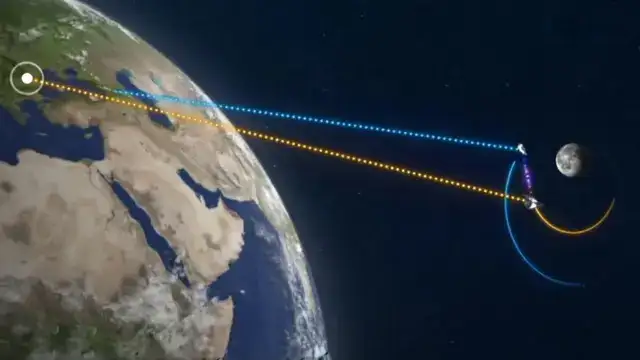
China has made a significant advancement in lunar navigation by successfully reflecting a laser beam off a satellite orbiting the Moon during daylight hours—a challenge previously deemed unfeasible due to overwhelming solar interference. This achievement, carried out by the Deep Space Exploration Laboratory (DSEL) utilizing the Tiandu-1 satellite, represents the first-ever Earth-to-Moon laser ranging accomplished under bright sunlight, as reported by Interesting Engineering.
The experiment took place over April 26–27 and showcased the ability to track and receive laser signals with remarkable precision despite daytime solar noise. Prior to this, laser ranging had been limited to nighttime periods due to the difficulty of filtering out the sun’s glare. Overcoming this obstacle marks a major step forward in enabling consistent navigation capabilities between Earth and the Moon for future lunar missions.
Exceptional Accuracy: “Like Landing on a Single Hair from Miles Away”
The researchers likened the targeting accuracy to "striking a single strand of hair from 6.2 miles away," emphasizing the extraordinary precision required to maintain a stable connection with a swiftly orbiting satellite in lunar vicinity. This advancement means China can now collect precise orbital data continuously anytime the satellite is visible, boosting real-time location updates and mission reliability.

Launched in March 2024, the Tiandu-1 is part of a trio of satellites forming the foundation for China’s anticipated Queqiao relay network, designed to support lunar communication and navigation. Alongside Tiandu-2 and the larger Queqiao-2, these satellites are critical components trialing the framework that will underpin forthcoming landers, rovers, and crewed expeditions targeted before 2030.
Transforming Lunar Navigation and Communication
Introducing daylight laser ranging removes a key limitation in Earth-Moon tracking, opening new possibilities for autonomous spacecraft navigation, precise landings, and real-time coordination of lunar rover operations. This technology is also expected to contribute significantly to the approach, descent, and landing phases of missions bound for the lunar south pole.
This accomplishment complements a series of rapid developments in China's lunar exploration program. On May 3, China’s Chang’e-6 mission successfully returned the first samples taken from the Moon’s far side. Looking ahead, the Chang’e-8 mission, planned for launch in 2028, aims to test nuclear power sources and other infrastructure to support the International Lunar Research Station, a joint lunar base initiative co-developed with Russia.
- Categories:
- Science











0 comments
Sign in to Comment