
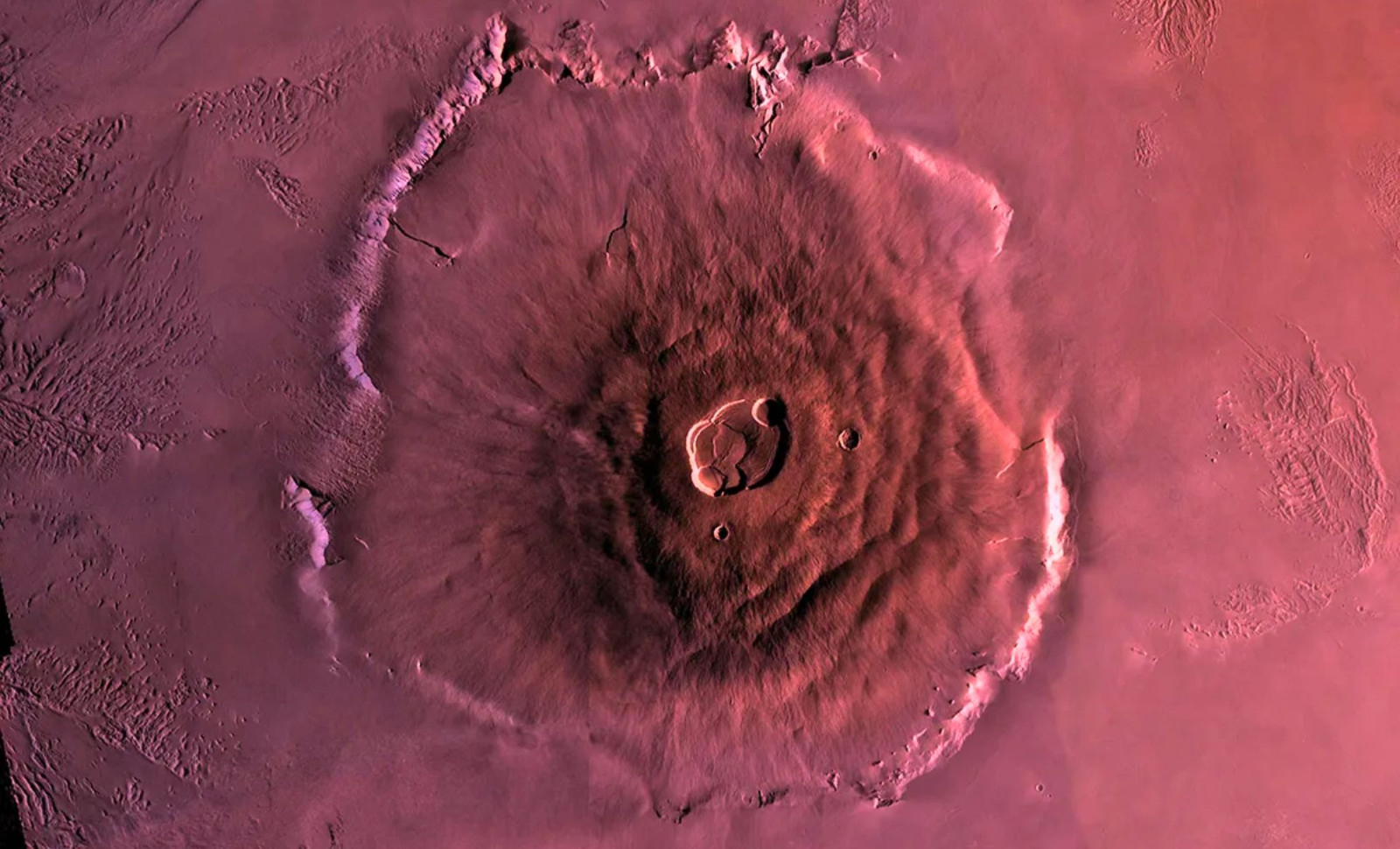
Standing at more than twice Everest's height, Olympus Mons reigns as the most colossal volcano across the Solar System. Its enormous scale and distinctive features continue to captivate planetary scientists long after its initial identification.
Stretching over an area comparable to the size of Poland, this ancient volcano offers more than just impressive dimensions; it provides vital clues to unraveling Mars’s volcanic past. Its existence pushes the boundaries of our understanding about volcanic activity in planets without tectonic plate movement.
Visible From Earth: A Volcanic Behemoth on Mars
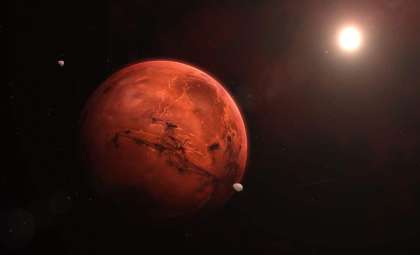
Situated in the western hemisphere of Mars, near the equator, Olympus Mons towers up to 26 kilometers above the surrounding plains. As NASA highlights:

“It is 27 kilometers high, over 600 kilometers at the base, and is surrounded by a well-defined scarp that is up to 6 km high. The summit caldera (central depression) is almost 3 km deep and 25 km across.”
Historical observations, noted by the BBC Sky at Night Magazine, revealed Olympus Mons as a bright landmark visible even before spacecraft exploration. Early astronomers named it Nix Olympica, meaning “Olympic Snow”, based purely on telescopic data.
Its authentic structure was not unveiled until 1971 during NASA’s Mariner 9 mission, which provided the first comprehensive maps of Mars’s surface. Since that breakthrough, Olympus Mons has become a focal point in studies of the Red Planet’s geological history.
A Unique Volcanic Landscape: Gentle Slopes Over Steep Peaks
Unlike Earth’s typically steep volcanoes, Olympus Mons belongs to the class of shield volcanoes. These form from the steady, fluid lava flows that spread extensively, creating a broad and gentle slope resembling a warrior’s shield or flattened dome.
@spacefrenzLargest Mountain in our Solar System! #Space #solarsystem #Mars #planet #geography #Mountain
♬ this feeling – Øneheart
Covering nearly 300,000 square kilometers, Olympus Mons encompasses an area larger than many nations. This vastness stems from the volcano’s non-explosive growth — slow but continuous lava flows that accumulate to form its expansive shape.
A Lava Giant Shaped by Mars’s Stable Crust
One reason Olympus Mons towers so impressively is Mars’s lack of tectonic plate shifts. On Earth, plate movement relocates volcanic sites, but Mars’s crust remains largely unmoved, allowing lava to repeatedly erupt at the same location over millions of years.
This enormous volcano stands atop a persistent magma hotspot within the Tharsis Rise region. The steady hotspot caused successive lava flows to build a giant volcano unmatched anywhere else in the Solar System.
Due to Mars’s small size and stable crust, it has never experienced the volcanic chain formation seen on Earth where drifting plates produce multiple mountains. This has allowed Olympus Mons to grow uninterrupted, making it an extraordinary geological formation.
Sleeping Giant: Dormant Yet Remarkable
Although inactive now, Olympus Mons’s last major volcanic eruption took place roughly 25 million years ago, which is quite recent geologically. No eruptions have been recorded since humans began monitoring Mars.
Studies referenced by Sky at Night Magazine suggest older volcanic layers lie beneath recent lava flows, signaling a complex eruption history. The volcano’s shape remains largely intact, preserved by Mars’s lack of atmosphere and erosion forces present on Earth.
Excitingly, in 2024 researchers discovered frost deposits on Olympus Mons, equivalent to the volume of around 60 Olympic-sized swimming pools of water, sparking renewed scientific interest in this Martian icon.
- Categories:
- Space






0 comments
Sign in to Comment