
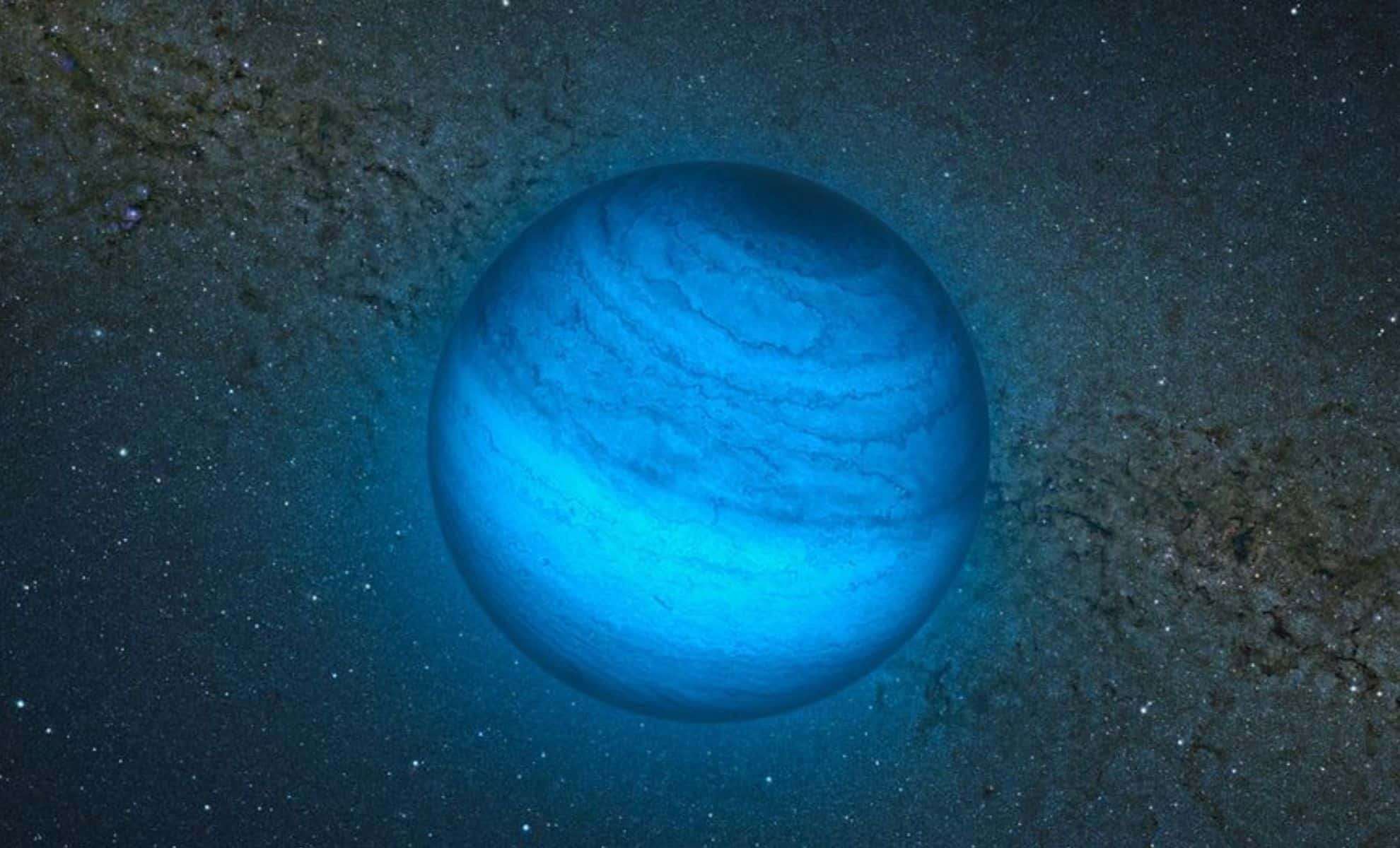
Utilizing a blend of fortunate timing and the principles of Albert Einstein’s general relativity, scientists have identified a wandering planet not bound to any star, known as a rogue or free-floating planet, deep within space. This finding was made achievable by reanalyzing archival observations from the Hubble Space Telescope. Detailed in a report by Space.com, the breakthrough depended on gravitational microlensing, an effect predicted by Einstein in 1915, which describes how massive bodies distort space-time and bend light. This enabled researchers to detect the rare planet drifting alone, contrasting with typical exoplanets that orbit stars, highlighting the lasting impact of Einstein’s insights in contemporary space exploration.
Einstein’s Theory Pivotal in Detecting the Rogue Planet
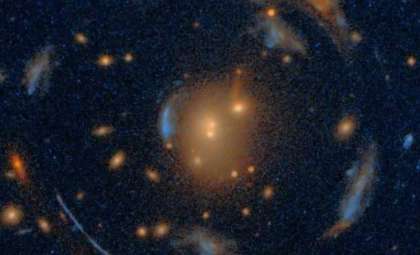
Einstein’s 1915 theory of general relativity fundamentally transformed the comprehension of gravity by suggesting that mass warps the fabric of space-time, bending light rays traveling nearby. This phenomenon—called gravitational lensing—occurs when a massive body, such as a planet, aligns with a background light source, like a star, causing the light to be magnified and producing an opportunity to observe otherwise hidden objects.
Przemek Mroz, a University of Warsaw professor involved in the study, emphasized, “Free-floating planets do not orbit stars like typical exoplanets; instead, they roam through the galaxy’s darkness, making them invisible to standard detection methods that depend on stellar illumination.” To uncover these elusive objects, researchers rely on gravitational microlensing, where a planet’s gravity can momentarily brighten a distant star's light.

The Microlensing Phenomenon behind the Discovery
The event named OGLE-2023-BLG-0524, detected on May 22, 2023, triggered this discovery. It was first observed pointing toward the Galactic bulge by the Optical Gravitational Lensing Experiment (OGLE), a survey tracking microlensing occurrences, and later confirmed by the Korea Microlensing Telescope Network (KMTNet).
This microlensing episode was notably brief—lasting only eight hours, ranking it among the shortest observed. As Mroz noted, “The Einstein timescale for this event was merely eight hours, making it particularly fleeting compared to typical microlensing records.” Detailed examination implied the lensing object could be either a Neptune-sized planet situated roughly 15,000 light-years away in our galaxy’s disk or a slightly larger Saturn-mass body about 23,000 light-years distant in the Galactic bulge.
Determining if the Planet has a Stellar Partner
A key question was whether this planet truly drifts solo or orbits a distant star. If a host star existed, it would create additional, longer microlensing signals, but none were observed. This absence suggested the planet might indeed be a solitary wanderer.
“This detection originated from both the OGLE survey and KMTNet,” Mroz mentioned. “Though a wide-orbit stellar companion can’t be completely excluded, the slowly changing positions of the lens and background star should eventually reveal whether light from the planet is detectable when they separate.”
However, such a measurement is complex and will require patiently waiting. “It will take at least a decade before current tools like the Hubble Space Telescope or large ground observatories can resolve them clearly,” Mroz added.
Insights Gained from Hubble’s Historical Observations
The area where the microlensing took place had already been imaged by the Hubble Space Telescope in 1997, more than 25 years before the microlensing event, offering a rare chance to search for any star linked to the lensing planet in these older images.
The team’s model indicated that in 1997, the source star and the lens would be separated by a mere 0.13 arcseconds, a distance still distinguishable with Hubble’s resolution. If the lens had been a bright star, it would have shown up in those archival pictures, but none was detected. “This allowed us to test the possibility of a stellar companion,” Mroz said.
The lack of detectable light led researchers to conclude that if a companion star did exist, it would have to be extremely faint, ruling out between 25% and 48% of potential stellar partners and strengthening the case for the object being a true rogue planet.
- Categories:
- News








0 comments
Sign in to Comment