
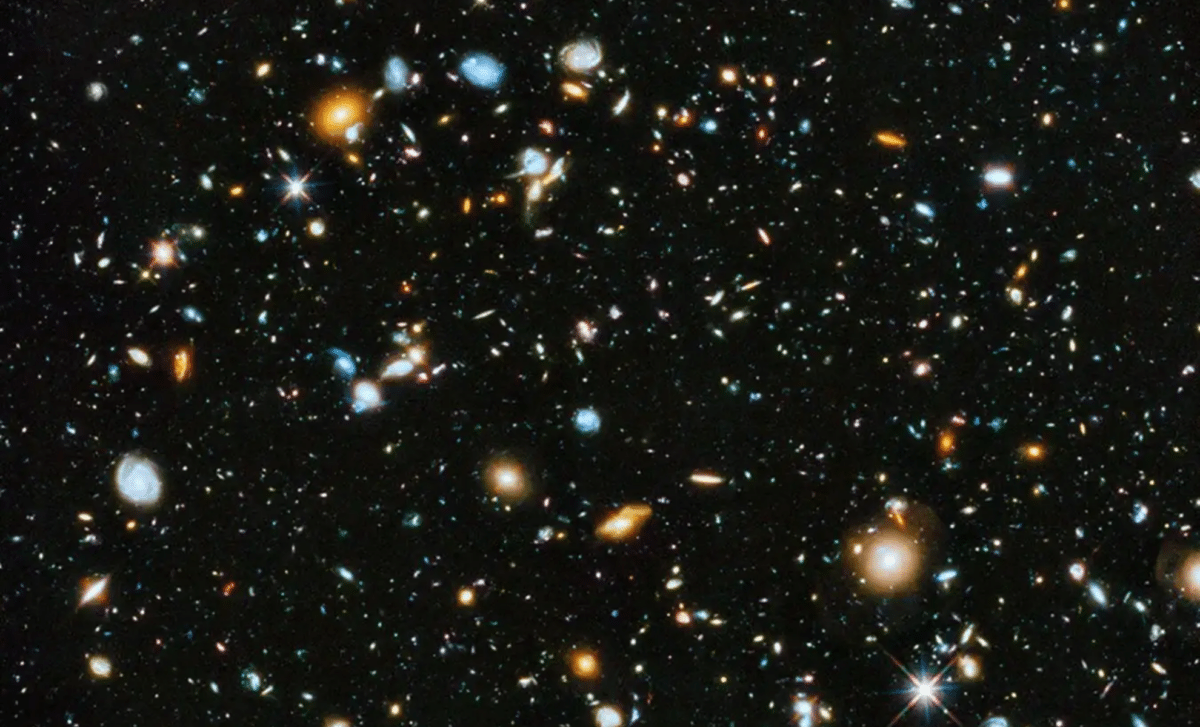
Recent cosmological research is casting doubt on a fundamental premise long held in physics: that the universe maintains uniformity when viewed on the grandest scales. Utilizing data from supernova observations, galaxy mapping, and advanced machine-learning techniques, scientists have detected initial indications that cosmic geometry might diverge from the traditional model guiding cosmology for nearly 100 years. These insights, shared in preprints on arXiv, hint at undiscovered physical processes influencing how the universe evolves.
Questioning the Cornerstone of Contemporary Cosmology
The basis of today’s cosmological understanding is the Friedmann-Lemaître-Robertson-Walker model, or FLRW cosmology. It presupposes that on sufficiently broad scales, the universe is homogeneous and isotropic – meaning matter is roughly evenly spread out and the universe appears similar in all directions. This hypothesis is central to the dominant cosmological framework known as Lambda-CDM, integrating dark matter and dark energy.
This new study calls the precision of this assumption into question. Rather than taking uniformity for granted, the researchers probed whether cosmic formations—like galaxy clusters, filamentary connections, and expansive voids—could significantly influence the structure and expansion of the cosmos. Their analysis drew on data from the Pantheon+ supernova compilation, the Dark Energy Spectroscopic Instrument (DESI), and baryon acoustic oscillation studies tracing ancient density fluctuations.

They found subtle yet consistent deviations from the expected FLRW model predictions. These variances, measured across different methods and datasets, ranged from roughly 2 to 4 sigma significance—insufficient to declare a definitive discovery but compelling enough to attract serious scientific attention.
“We saw a surprising violation of an FLRW curvature consistency test, hinting at new physics beyond the standard model,” study co-author Asta Heinesen, a physicist at the Niels Bohr Institute in Copenhagen and Queen Mary University of London, told Live Science via email, referring to the assumption that space’s curvature is the same everywhere. “This could potentially be due to various effects, but more research is needed to address the cause of the FLRW violation that we see empirically.”
The Universe’s Large-Scale Network Might Influence Its Geometry
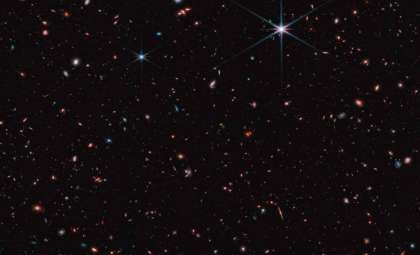
A notable focus of the study is how the universe’s intricate large-scale architecture could skew measurements of cosmic growth. The cosmos is not a simple, smooth expanse. Instead, galaxies cluster together, linked by vast strands called filaments, while enormous voids devoid of matter span intergalactic spaces, collectively termed the cosmic web.
The investigators suggest that this complexity may conflict with the simplifications underlying classical cosmological models. One explanation is the Dyer-Roeder effect, where photons from distant sources predominantly travel through sparsely populated expanses instead of dense regions, potentially misleading observers about universal density.
Another factor is cosmological backreaction, where the formation and growth of structures subtly modify the average behavior of space-time itself, impacting cosmic expansion over billions of years. Thus, galaxy clusters and voids may collectively influence universal dynamics beyond localized effects.
“FLRW cosmology assumes a space-time that has spaces that are maximally-symmetric,” Heinesen said. “It is necessary to go beyond FLRW space-times when cosmological structures are present such as galaxy clusters and voids of empty space.”
These insights carry significant consequences since many attempts to resolve cosmological discrepancies still rely on FLRW principles. If the universe’s shape and expansion do not conform to these assumptions, current competing models involving dark energy or alternative gravity theories might require reevaluation.
Innovative Machine Learning Approaches Illuminate Cosmic Expansion
The researchers developed a novel methodology aimed at evaluating cosmological hypotheses without preset model constraints. Central to this effort was a machine learning technique called symbolic regression, which autonomously seeks mathematical formulas within observational data rather than fitting data into existing theoretical constructs.
Applying this tool, they successfully reconstructed the universe’s expansion timeline from raw astronomical measurements. Additionally, they used adaptations of the Clarkson-Bassett-Lu consistency test, designed to verify alignment with FLRW cosmology through observational evidence.
Their preprint documents on arXiv reveal how these approaches enabled detection of potential Dyer-Roeder and backreaction signatures in current datasets. This achievement marks a shift from prior studies, where separating such phenomena from dark energy or modified gravity effects was more challenging.
“The main finding is that you can directly measure Dyer-Roeder and backreaction effects from available cosmological data, and clearly distinguish these effects from other alterations of the standard cosmological model, such as evolving dark energy and modified gravity theories,” Heinesen said. “This was previously not possible in such a direct way, and this is what I think is the breakthrough in our work.”
Though machine learning's role in cosmology has grown rapidly over the last decade, experts urge caution when interpreting outcomes from sophisticated algorithms. The team underscored the need for larger observational samples and further validation before definite conclusions about cosmic geometry are drawn.
Potential to Transform the Future Understanding of Cosmology
While the results are preliminary, their implications cannot be overlooked. Should subsequent findings affirm deviations from the FLRW model, this would influence much of theoretical cosmology. Numerous explanations for inconsistencies in cosmic expansion measurements currently depend on tweaks to dark energy, dark matter, or gravity, still grounded in FLRW cosmology.
The study suggests these explanations may prove insufficient if foundational geometrical assumptions fail. The authors propose that large-scale cosmic structures have a direct and pivotal impact on the universe’s evolutionary path.
“If these indicated deviations from an FLRW geometry are real, it would signify that most of the cosmological solutions considered for solving the cosmological tensions — evolving or interacting dark energy, new types of matter or energy, modified gravity and related ideas within the FLRW framework — are ruled out,” the researchers wrote.
Upcoming observational campaigns promise vastly improved measurements of cosmic growth and galactic distributions. Initiatives linked to DESI, the Euclid space mission, and next-generation telescopes could soon clarify whether the detected patterns are mere anomalies or signs of fundamentally new physics.
“It is to apply our theoretical results to data to test the standard model and to produce constraints on the Dyer-Roeder and backreaction effects,” Heinesen explained.
For now, the observations serve as a thought-provoking indication rather than a revolutionary confirmation. However, the idea that the universe might defy one of cosmology’s longest-standing assumptions is already sparking lively debate among physicists exploring the deep nature of space, time, and cosmic change.
- Categories:
- News









0 comments
Sign in to Comment