
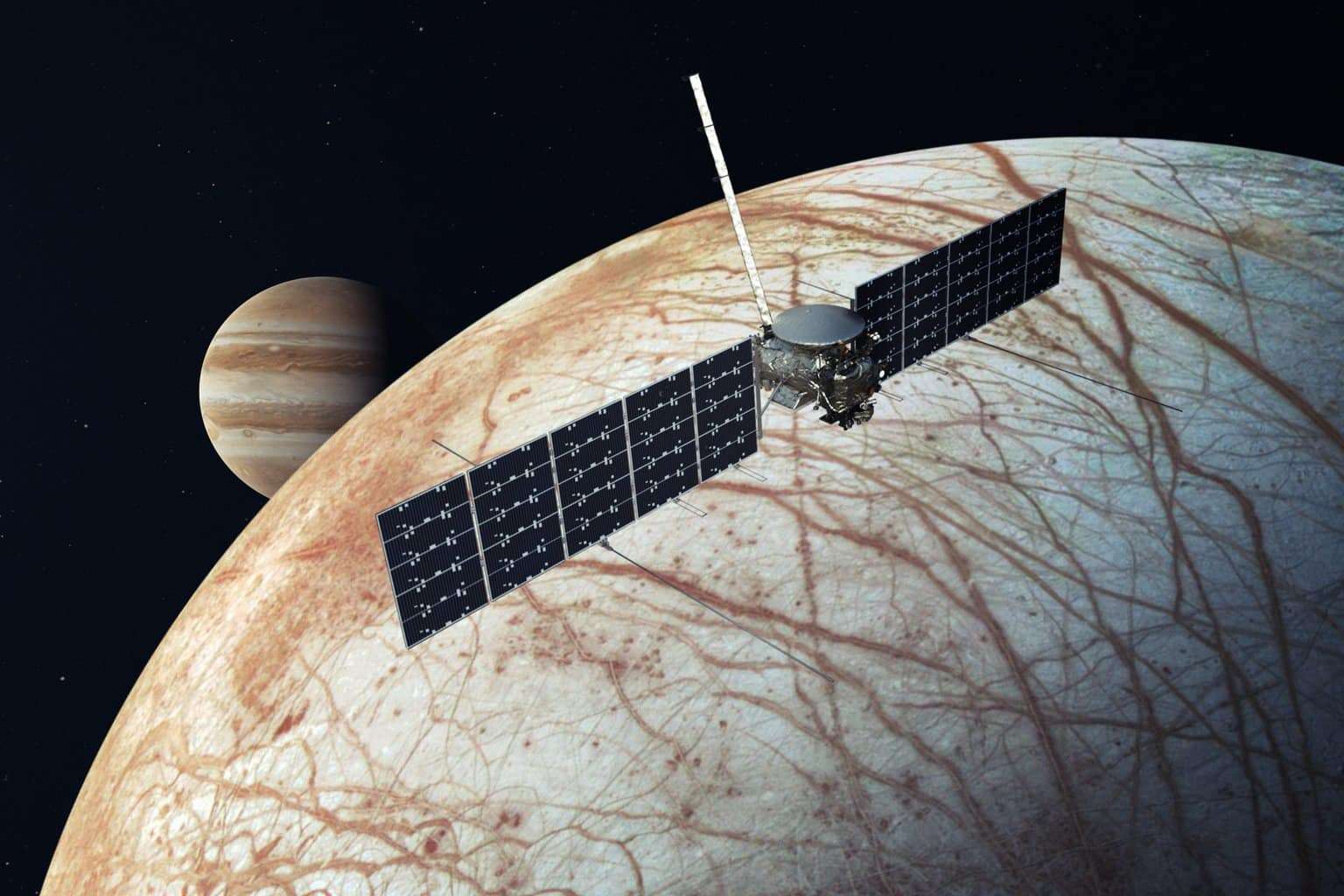
NASA’s groundbreaking Europa Clipper mission, crafted to investigate Jupiter’s frozen moon Europa, is now scheduled for lift-off no earlier than October 14, 2024.
The launch was postponed due to the impact of Hurricane Milton in Florida, which caused minor damage at NASA’s Kennedy Space Center. This eagerly awaited mission will ride on a SpaceX Falcon Heavy rocket, beginning a crucial expedition aimed at uncovering potential signs of life beneath Europa’s icy shell.
Exploring Europa: A Pioneering Mission
The Europa Clipper initiative stands as a landmark project from NASA, focused on one of the solar system’s most captivating moons. Europa’s frozen exterior and the likely presence of a vast subsurface ocean have long intrigued scientists interested in astrobiology. The primary mission goal is to evaluate the potential habitability of Europa’s ocean beneath its thick ice crust, investigating whether it might harbor extraterrestrial life.

Scientists theorize that Europa may feature powerful plumes of water vapor erupting from its hidden ocean, possibly surpassing Earth's total ocean volume. By examining these jets and the underlying sea, Europa Clipper aims to reveal whether the moon’s ocean environment can sustain life. Equipped with innovative tools such as , spectrometers, and dust counters, the spacecraft will gather detailed information on Europa’s geology. One mission objective is to analyze the gravitational forces between Europa and Jupiter, which might generate enough heat to keep its ocean liquid. Additionally, the spacecraft’s imaging systems will capture the moon’s tenuous atmosphere and active surface features, helping paint a fuller picture of Europa’s dynamic evolution.
Researchers anticipate using this wealth of data to "accurately assess the habitability potential of Europa’s ocean beneath the icy shell." Success in this mission could offer vital insights into the possibility of life beyond Earth, potentially shaping the landscape of space exploration for years to come.
Impact of Hurricane Milton on Launch Schedule
Though the Europa Clipper project has progressed over many years, recent launch preparations faced setbacks from natural events. Originally planned for October 10, 2024, the launch was pushed back following the passage of Hurricane Milton, which impacted Florida early this month. To ensure the spacecraft’s readiness and conduct thorough safety checks, NASA and SpaceX first shifted the launch to October 13 and then to October 14. While the hurricane caused minor setbacks — including damaged awnings and broken doors and traffic signals — the overall condition of Kennedy Space Center remained controllable.
NASA’s Damage Assessment and Recovery Team performed a detailed inspection post-storm, confirming that personnel could safely return to the facility. They reported that the destruction was manageable, with little obstruction to mission timelines. Images from the site showed an overturned flatbed trailer, but no major structural harm. Still, agencies proceeded cautiously, prioritizing thorough system checks before proceeding.
Kennedy is now OPEN!
The Damage Assessment and Recovery Team has completed their assessment of the center and its facilities, and determined that employees can safely return on-site to resume working.
The damage identified is manageable and in-line with the items the Ride Out… pic.twitter.com/7gxcFCCzLh
— NASA’s Kennedy Space Center (@NASAKennedy) October 11, 2024
These schedule revisions highlight the complexities of managing ambitious space missions like Europa Clipper. Despite the hurricane’s relatively minor effects, NASA and SpaceX emphasize safety — especially given the $5 billion value of this endeavor. The launch window remains open through November 2, maintaining a viable period for the mission to commence its voyage toward Jupiter.
Launch Plan and Journey Overview
The Falcon Heavy rocket provided by SpaceX is crucial for delivering Europa Clipper into orbit. The attempt is set for October 14 at 12:06 p.m. EDT (1606 GMT), launching from Pad 39A at Kennedy Space Center. Both NASA and SpaceX have scheduled a series of time slots optimized to send Europa Clipper on the precise path needed to reach Jupiter. The launch timing slightly shifts earlier each day within the window to ensure the spacecraft attains the correct orbit for its extended trip.
After lift-off, Europa Clipper will embark on an approximate six-year journey through the solar system, arriving at its target on April 11, 2030. The spacecraft will perform multiple flybys of Jupiter and its moons, employing their gravitational fields to adjust course and conserve fuel—an essential tactic for the mission’s success.
When near Europa, the spacecraft will conduct numerous close flybys, utilizing its sophisticated instruments to chart the moon’s surface, scrutinize its icy crust, and investigate the ocean hidden beneath. Unlike older missions relying on distant observations, Europa Clipper will provide intimate, detailed measurements of the moon’s chemistry, magnetic environment, and ice-water interactions, essential for understanding its habitability.
Significance and Future Prospects
The Europa Clipper launch symbolizes a vital advance in the exploration of planetary bodies and the quest to find life beyond Earth. As it approaches Europa in 2030, the mission will deliver groundbreaking data that might transform our understanding of the outer solar system. The search for life on Europa remains one of the most compelling questions in astrobiology, and this mission is a crucial stride toward answering it.
NASA anticipates that results from Europa Clipper will not only clarify the moon’s potential to support life but also inform future missions. Confirming habitability could set the stage for deploying landers or even underwater probes to explore Europa’s ocean directly. This mission's findings may also influence how humanity approaches life detection on other icy worlds like Enceladus or on Mars.
NASA experts have emphasized that "Europa is among the best locations to search for life beyond Earth" because of its possible subsurface ocean. Success here could enlarge the horizons of astrobiological studies, guiding future expeditions to moons and planets in the outer reaches of our solar system.
- Categories:
- Astronomy ,
- News ,
- Space ,
- Nasa









0 comments
Sign in to Comment