

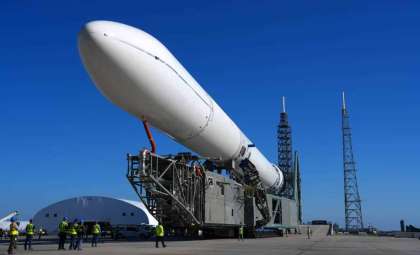
Blue Origin is gearing up for the first launch of its New Glenn rocket, scheduled for mid-October 2024. This towering rocket, standing 320 feet tall, will lift off from Cape Canaveral Space Force Station, carrying NASA’s ESCAPADE mission bound for Mars.
This landmark launch represents a critical step for Blue Origin as it endeavors to become a significant competitor in the commercial space sector and showcase its innovative reusable rocket technologies.
New Glenn’s Advanced Design: A Bold Step Forward in Rocketry
The New Glenn rocket is among Blue Origin’s most ambitious endeavors since its founding by Jeff Bezos in 2000 with the vision of lowering spaceflight costs and broadening mission capabilities. Honoring John Glenn, the first American to orbit Earth, the rocket features a reusable first stage intended to touch down on a sea-based platform approximately 620 miles downrange. This approach aims for up to 25 reuses, similar to SpaceX Falcon rockets, to drive down expenses and enhance sustainability.

One distinguishing attribute of New Glenn is its expansive 7-meter diameter payload fairing, spacious enough to house objects the size of three school buses. This immense capacity enables the rocket to transport substantially larger payloads than many competitors, appealing to customers like NASA and companies such as Amazon that are developing the Project Kuiper satellite constellation for worldwide internet access.
Equipped with cutting-edge BE-4 engines fueled by liquefied natural gas (LNG) and liquid oxygen (LOX), New Glenn can deliver up to 45 metric tons to low Earth orbit and 13 metric tons to geostationary transfer orbit. These capabilities make it versatile for deploying large satellite arrays and facilitating deep space missions.
Facing Setbacks: Blue Origin’s Path to New Glenn’s Launch
Despite targeting a mid-October 2024 launch, Blue Origin has encountered delays linked to technical challenges in production. Significant setbacks arose from hardware issues that impacted components of the subsequent New Glenn rockets. Nevertheless, the company remains focused on maintaining its October timeline for the inaugural flight.
#NewGlenn’s inaugural mission aims to send @NASA’s ESCAPADE to Mars, with a launch date no earlier than October 13.
— Blue Origin (@blueorigin) August 23, 2024
There is immense expectation for a successful first launch amid a competitive landscape dominated by established entities like SpaceX and ULA. The rocket’s performance will be scrutinized by potential customers and experts alike, as a successful mission could open doors to valuable contracts, including national security launches for the U.S. Space Force. Securing such opportunities is vital for Blue Origin’s growth and positioning in the industry.
Blue Origin is placing considerable faith in New Glenn’s reusability and heavy-lift strengths to carve out its niche in commercial spaceflight. Success will bolster future endeavors, supporting NASA’s Artemis program and ambitious missions venturing beyond Earth, with sustainability and affordability as key goals.
Future Prospects: Blue Origin’s Horizon with New Glenn
The outcome of New Glenn’s debut will have lasting effects on Blue Origin’s trajectory. Beyond upcoming NASA and Project Kuiper launches, New Glenn is poised to play a vital role in the Artemis program, facilitating cargo deliveries to lunar orbit and advancing human exploration of Mars in the decades ahead.
Looking forward, Blue Origin aims to amplify its presence within the commercial space market. With contracts spanning private and governmental sectors, New Glenn might become a cornerstone for missions demanding large payload capacities, deep space exploration, and possibly crewed flights. Its blend of reuse and power offers broad appeal to a range of clients.
For now, attention centers on October 13, 2024, when Blue Origin plans to launch New Glenn for the first time. A successful lift-off will confirm the rocket’s capabilities and assert Blue Origin’s role as a formidable contender in the commercial space arena, opening a fresh chapter dedicated to making spaceflight more accessible and cost-effective.




0 comments
Sign in to Comment