
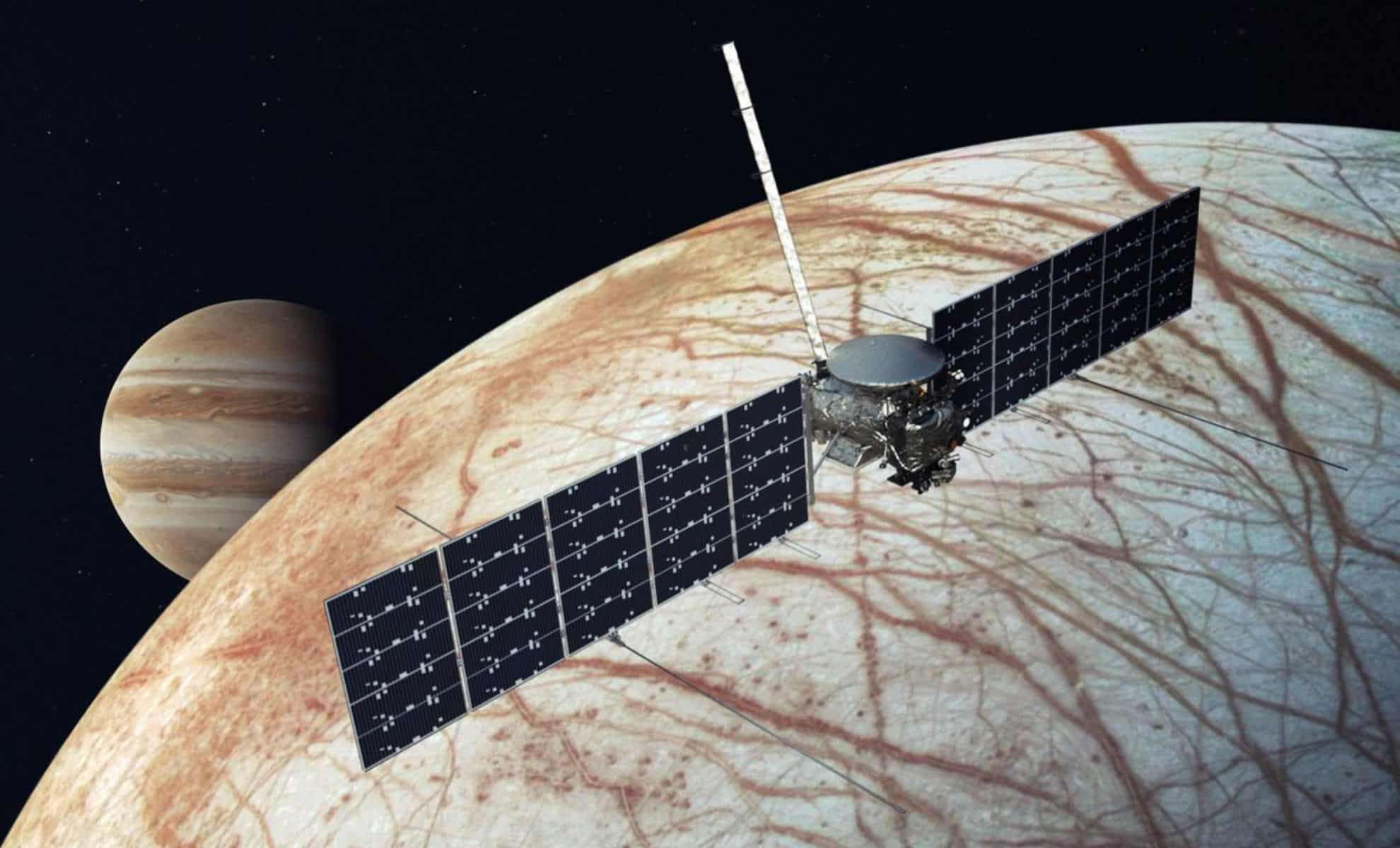
NASA’s Europa Clipper mission, geared to explore Jupiter’s enigmatic ice-covered moon Europa, has reached a vital project milestone, ensuring it remains on schedule for its planned launch on October 10, 2024.
Designed to investigate the ocean lurking beneath Europa’s icy crust and assess its potential to support life, this mission is among NASA’s most daring planetary explorations.
Importance of the Milestone Achieved
Recently, the Europa Clipper successfully cleared Key Decision Point E (KDP-E), a major evaluation step confirming the spacecraft’s readiness for launch and operational activities. This assessment, completed ahead of the scheduled September 9, 2024 review, involved a comprehensive examination of all spacecraft systems to ensure they meet the rigorous standards required for mission success. Successfully passing KDP-E affirms that the spacecraft is prepared and timeline commitments are being met for its expedition to Jupiter.

The mission team conducted rigorous testing, with a special focus on the spacecraft’s transistors that regulate electrical currents. These components must endure the intense radiation surrounding Jupiter. The positive outcomes from these evaluations have reassured engineers about the spacecraft’s robustness for the journey ahead.
Gigantic Solar Arrays Fuel the Spacecraft
Alongside KDP-E clearance, the Europa Clipper has been equipped with NASA’s largest solar panels ever designed for a planetary mission. Each panel spans roughly 46.5 feet (14.2 meters) in length and 13.5 feet (4.1 meters) in width. When fully extended in space, the spacecraft, including its solar wings, will stretch over 100 feet (30.5 meters), exceeding the size of a professional basketball court. These expansive arrays are crafted to capture scarce sunlight, as Europa resides in a part of the solar system receiving just 3% to 4% of Earth’s sunlight.
The solar panels underwent meticulous testing at NASA's Kennedy Space Center in Florida, where they were deployed individually in a clean room setting to validate their functionality under space-like conditions. Once operational, these arrays will generate approximately 700 watts of power, sufficient to run the spacecraft’s scientific instruments, communication systems, and propulsion units.
Taejoo Lee, overseeing solar array delivery at the Johns Hopkins Applied Physics Laboratory (APL), described the challenges faced: “While the spacecraft itself benefits from heating systems that maintain its temperature, the solar arrays are exposed to the vacuum of space without any active thermal regulation, meaning they endure extreme environmental temperature variations.”
Readying for the Voyage to Europa
With solar arrays installed and KDP-E behind them, the Europa Clipper is poised for its journey. Launching atop a heavy-lift rocket, the spacecraft will travel over five years to arrive at Jupiter's system by 2030. Upon arrival, it will perform multiple flybys of Europa using advanced instruments to scrutinize the moon’s frozen surface, subsurface ocean, and tenuous atmosphere.
The mission’s core goal is to evaluate Europa’s ocean’s capacity to sustain life. The spacecraft will look for signs of biological processes, analyze the ice and ocean chemistry, and study the moon’s atmospheric makeup, providing critical insights into the possibility of habitation beyond our planet.
A standout feature of the mission involves radar equipment designed to penetrate Europa’s ice shell and locate liquid water reservoirs beneath. These radar antennas, planned to deploy two weeks following the solar panels, are vital for mapping ice thickness and spotting hidden lakes beneath the surface. Lee commented on this technological feat: “Initially, developing solar arrays robust enough to support such enormous radar antennas seemed nearly impossible. Thanks to the team’s innovation, we overcame that obstacle.”
Countdown to Launch
As launch day draws near, the Europa Clipper team continues final system verifications, procedural rehearsals, and integration preparations with its launch vehicle. NASA will soon host briefings to share mission details and highlight its significance to planetary science.
The Europa Clipper mission stands as a cornerstone of NASA’s broader quest to study the outer solar system and explore habitats that might harbor life. The data it gathers will deepen our knowledge of Europa and support humanity’s greater efforts to find environments beyond Earth capable of sustaining life.
This endeavor marks a profound leap in space exploration and promises to expand our understanding of the solar system and our cosmic neighborhood. As NASA’s largest planetary spacecraft prepares to launch, anticipation grows worldwide for the groundbreaking discoveries ahead.









0 comments
Sign in to Comment