
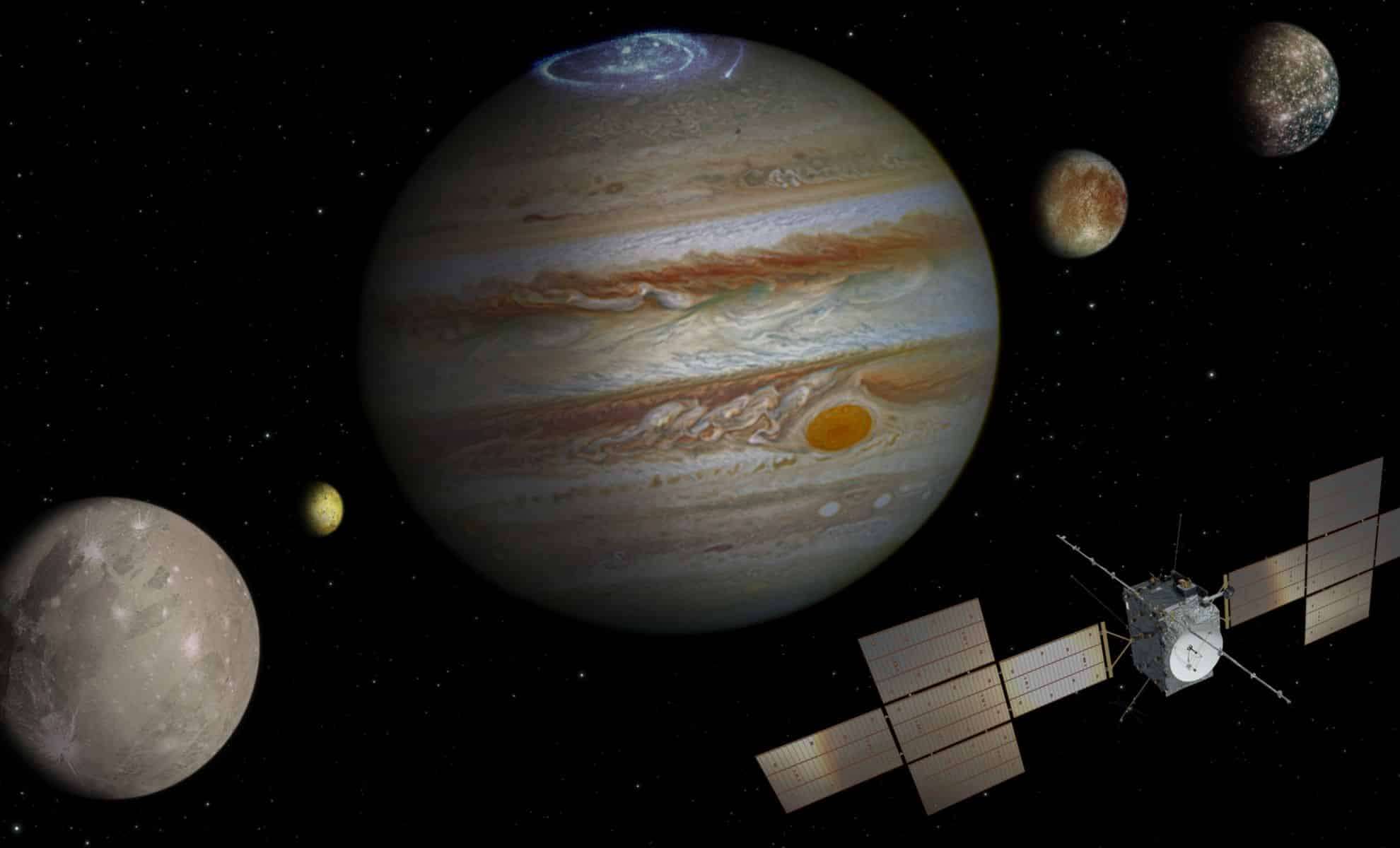
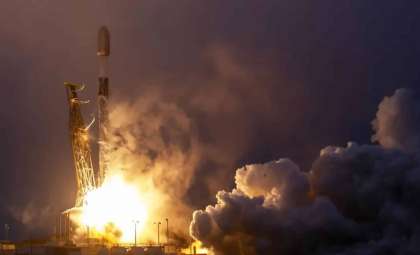
The European Space Agency’s (ESA) JUpiter ICy moons Explorer (JUICE), launched on April 14, 2023, signifies a historic advancement in planetary exploration.
This bold endeavor targets a comprehensive study of Jupiter along with its frigid moons—Europa, Ganymede, and Callisto—to uncover details about their makeup, geological characteristics, and potential to support life.
A Voyage Across the Solar System to Jupiter
JUICE’s trip to Jupiter is an intricate, multi-year expedition involving several gravity assists to refine its speed and path. Among these is the vital lunar-Earth flyby, which leverages the gravitational fields of the Moon and Earth for a fuel-efficient boost. This gravity assist allows the spacecraft to gain momentum necessary to continue its journey towards the Jovian system.

The lunar-Earth flyby is planned for August 2024, where JUICE will first pass near the Moon, followed shortly by a close encounter with Earth. This event not only accelerates the mission but also provides an opportunity to calibrate onboard instruments and collect data from the Earth-Moon environment.
Executing this precise maneuver highlights the sophistication and meticulous planning behind interplanetary navigation. It also offers a chance to study gravitational interactions in real time, enriching our knowledge of orbital mechanics.
Key Scientific Objectives and Goals of the JUICE Mission
The mission’s chief aim is to examine Jupiter’s icy moons, focusing particularly on Ganymede, the solar system's most massive moon. Scientists seek to characterize subsurface oceans, surface materials, and assess the habitability of these moons. Insights gained could provide crucial clues about life’s potential beyond our planet.
The spacecraft carries advanced instruments such as spectrometers, radar systems, and high-resolution cameras to perform detailed analysis. A significant target is measuring ice shell thickness and detecting possible liquid water reservoirs beneath.
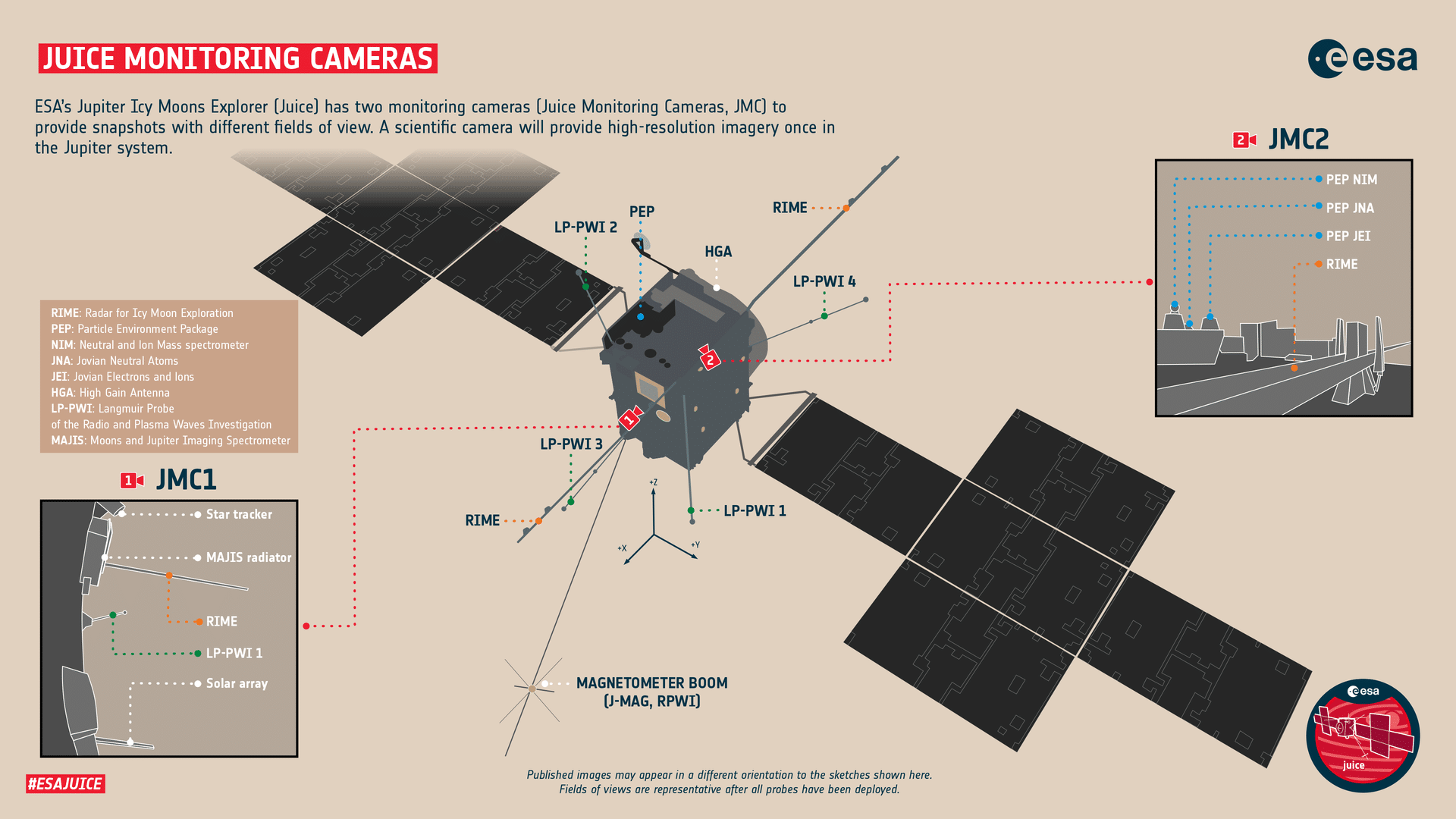
Beyond the moons, JUICE will investigate Jupiter’s atmosphere and magnetosphere, and how these interact with its satellites. The onboard instruments will map surfaces at high resolution, analyze chemical and magnetic properties, and identify gravitational anomalies that reveal the moons’ interior structures.
Obstacles and Future Insights
The trek to Jupiter presents significant challenges including vast distances, strong radiation fields, and the need for exact navigation. The success of the upcoming lunar-Earth flyby is critical to maintaining the mission’s trajectory. Upon arrival at Jupiter, JUICE will confront additional hurdles conducting detailed research within intense radiation belts.
Despite these difficulties, the JUICE mission holds potential for revolutionary discoveries. Data returned will deepen our comprehension of Jupiter’s system and aid planetary science, particularly in the quest to identify extraterrestrial life markers.
Findings from JUICE may guide future exploratory missions to the outer planets and provide relevant knowledge for icy worlds like Saturn’s Enceladus and Neptune’s Triton, which might harbor similar conditions.
ESA’s JUICE mission is a landmark venture into the solar system’s outer regions. The imminent lunar-Earth flyby represents a pivotal step toward the comprehensive study of Jupiter and its frozen satellites.
As JUICE voyages onward, the scientific community awaits fresh revelations. This mission embodies global cooperation and humanity’s enduring drive to explore the cosmos, expanding our grasp of the universe we inhabit.
- Categories:
- Astronomy ,
- News ,
- Space ,
- Aircraft









0 comments
Sign in to Comment