
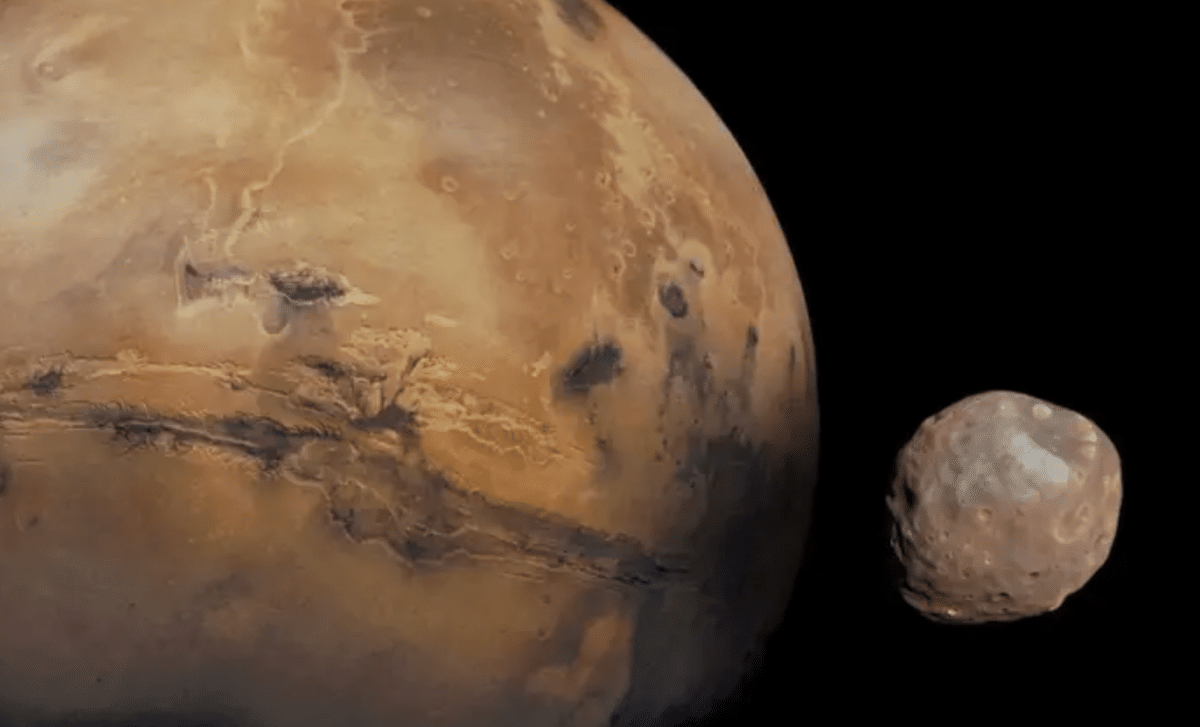
A recent investigation highlighted by New Scientist suggests that Mars could have once orbited a significantly larger moon than its current satellites. This celestial body might have generated tidal forces on the planet, as indicated by tidal patterns observed in sedimentary formations within the Gale Crater.
Insights from Gale Crater Sediments
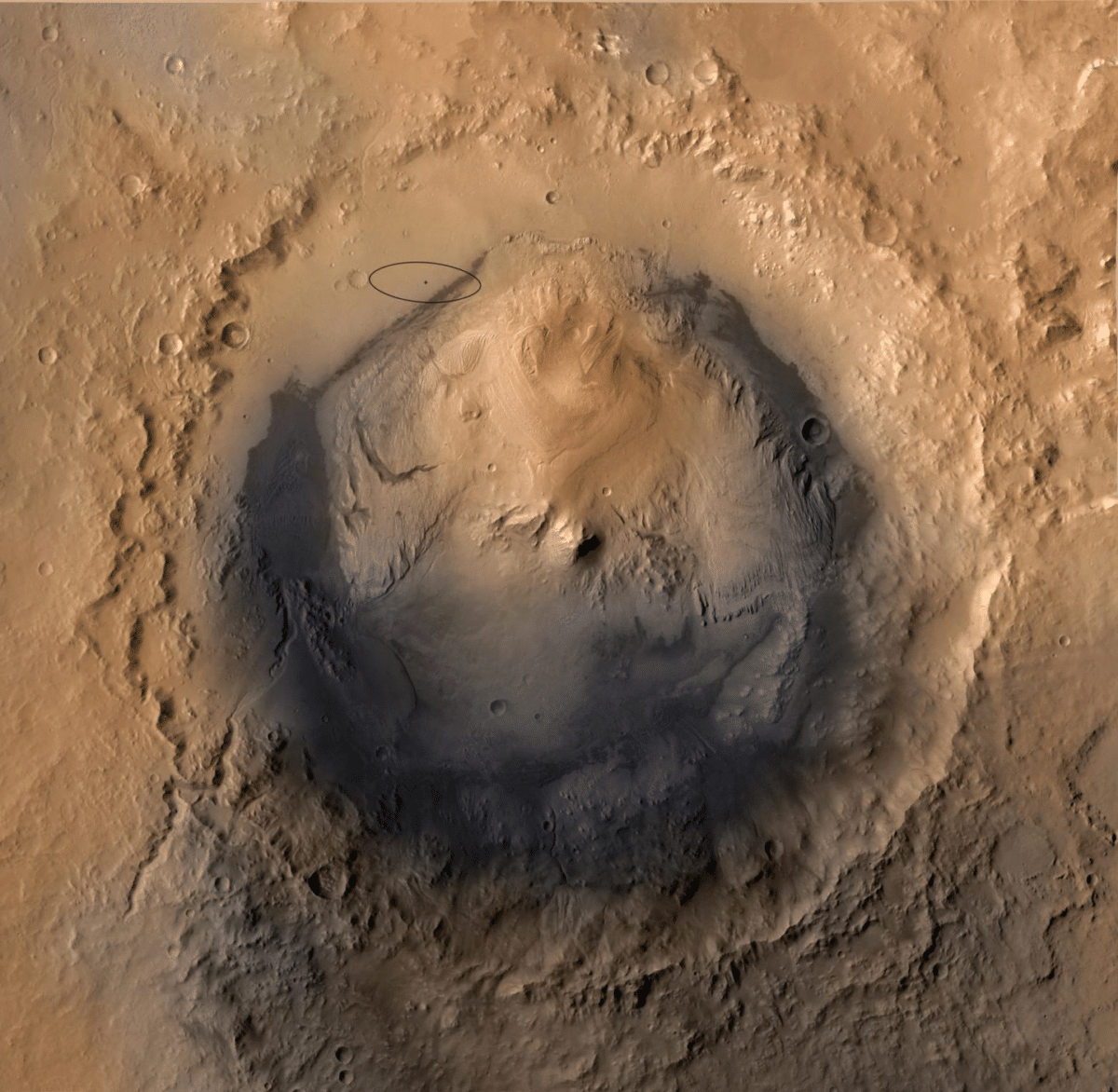
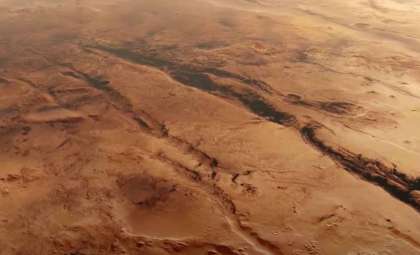
The Gale Crater, a key area for Mars exploration (as previously explored), has revealed layered sediment structures hinting at tidal influences. These rhythmic deposits, or rhythmites, develop due to regular tidal actions and provide evidence of ancient aquatic environments. New Scientist features work by Suniti Karunatillake and colleagues from Louisiana State University, who meticulously analyzed these patterns. Karunatillake remarks,
“The rhythmic layering, indicative of tidal action, is preserved in the crater’s sedimentary deposits, suggesting that a large body of water may have once existed there.”
Add Cosmo Herald as a Preferred Source

This finding challenges conventional views, proposing that early Mars might have experienced much more Earth-like conditions. Yet, considering the diminutive size of Mars’ present moons, the question arises as to what could have caused such tidal phenomena.
Mars’ Moons and Their Influence on Ancient Tides
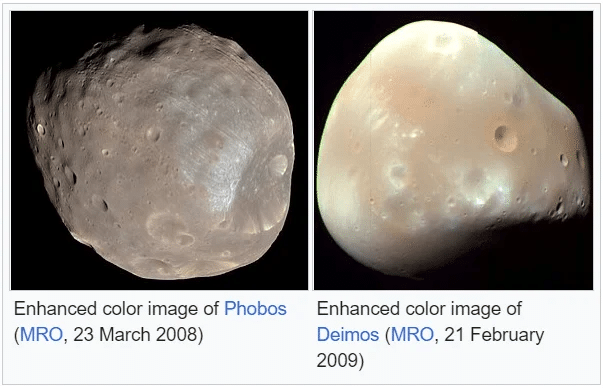
The current moons of Mars, Phobos and Deimos, are too small to create the gravitational pull needed to form tides like those observed in Gale Crater. This has led to speculation that Mars once possessed a larger moon capable of generating such effects, possibly influencing the Martian seas during the planet’s early history.
Researcher Mazumder emphasizes the significance of these rhythmic sediment layers as evidence of tidal action.
Mazumder points out that, on Earth, finding such rhythmites ‘is a very robust proof of tidal activity. In other words: marine conditions.'”
Drawing parallels with Earth’s tidal records, this evidence suggests that Mars might have harbored similar ancient water systems, offering clues about its capacity to support life.
Questioning Gale Crater’s Role as a Tidal Record Site
There are skeptics who doubt that Gale Crater is an ideal location to identify traces of tidal activity on Mars. As one expert comments,
“Thus, even with a larger moon in the past, I don’t think these two locations are the good ones to record tidal deposits.”
This view implies that other geological factors might explain the sedimentary patterns, meaning Gale Crater might not conclusively reflect ancient Magdalene tidal dynamics.
Nevertheless, the hypothesis of a vanished giant moon contributing to tides remains plausible, prompting ongoing efforts to find more definitive evidence across Mars.
Possible Alternative Interpretations
To reconcile Mars’ current moons with the tidal patterns observed, researcher Sarkar offers another perspective. Sarkar suggests,
“Maybe an ocean was hydrologically connected with Gale. Even subsurface porosity can connect bodies and cause tides.”
This proposition implies that Mars’ fractured crust and underground channels might have transmitted tidal effects despite the absence of a large satellite. Subsurface water systems could have allowed tidal forces to propagate, accounting for the rhythmites found within the crater.
Though the tidal hypothesis faces some challenges, this idea expands our understanding of Mars’ early water networks. The planet’s complex geology might have facilitated unique interactions among ancient water reservoirs, producing tidal signatures.
Broader Implications: Mars’ Habitability Potential
The existence of a sizeable moon that influenced tidal motions would indicate that Mars’ primordial environment was far more active and Earth-like than previously assumed. Tidal movements and vast water bodies could have created favorable conditions for life’s emergence. This possibility continues to fuel the search for ancient biological markers on the Red Planet.
Evidence of tides in Gale Crater combined with theories about a lost large moon opens new doors towards understanding Mars’ climatic past. It paints a picture of a once dynamic world with oceans and vibrant weather systems, potentially capable of sustaining life.
- Categories:
- Astronomy




0 comments
Sign in to Comment