
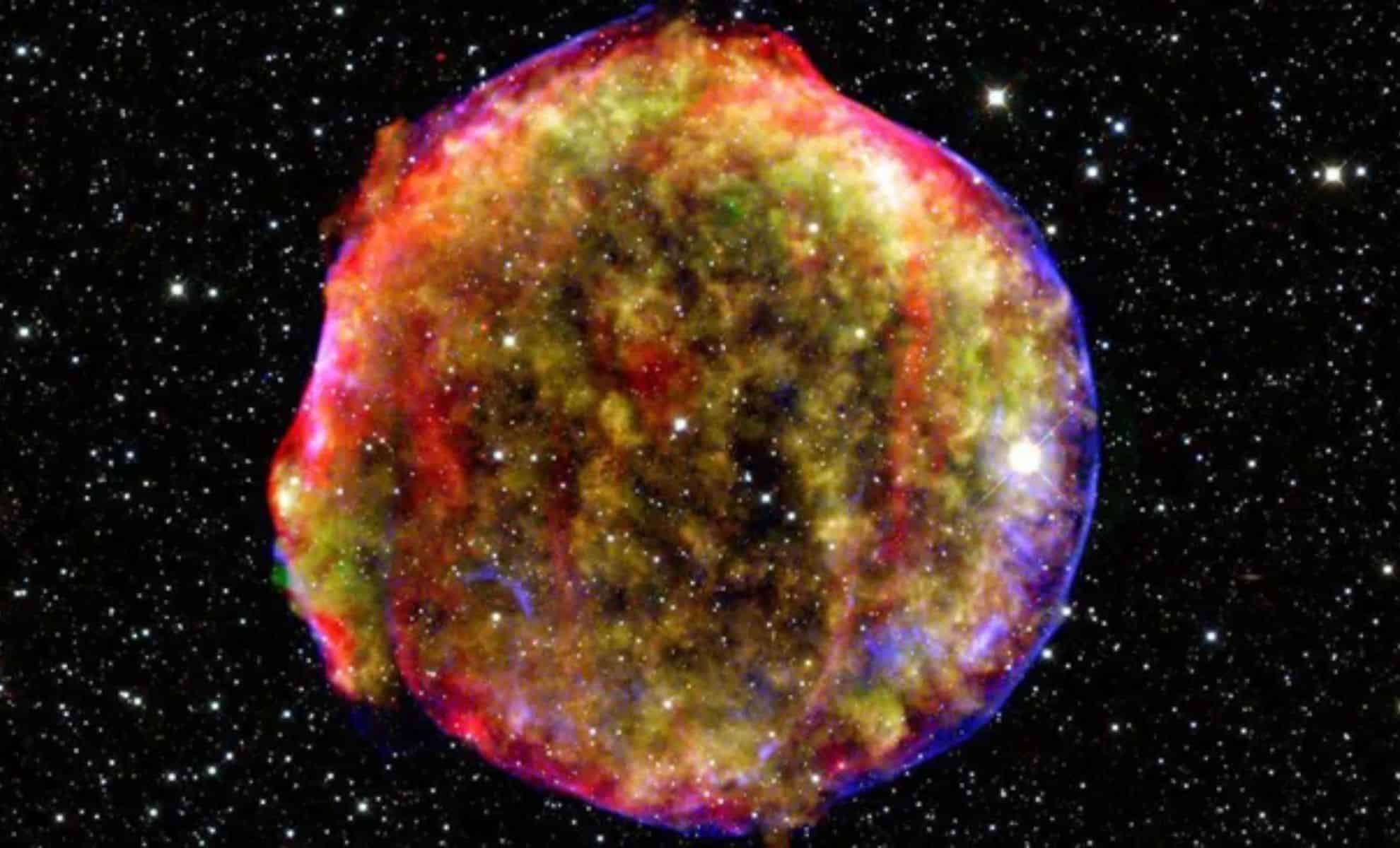
New research reveals that remnants of supernova explosions may temporarily become the universe’s most powerful particle accelerators, outpacing even the Large Hadron Collider. A study recently accepted in Astronomy & Astrophysics and posted on arXiv proposes a process by which ordinary stellar explosions transform into PeVatrons, sources capable of emitting cosmic rays with energies reaching up to one peta-electronvolt (PeV). This intense particle acceleration appears to last only a short time, which likely explains the scarcity of detectable signals despite the common occurrence of supernovae in our galaxy.
Unraveling the Puzzle of Ultra-Energetic Cosmic Rays
Scientists have been investigating the origins of highly energetic particles, known as cosmic rays, for more than 100 years. These particles, mostly protons but sometimes heavier atomic nuclei, relentlessly strike Earth with energies far beyond what human-built accelerators can achieve — often exceeding them by factors of a thousand or more.
Supernova explosions have long been suspected as the sources of these ultra-high-energy cosmic rays in the PeV range. When massive stars explode, the enormous energy and turbulent magnetic fields created seemed ideal for accelerating particles. Yet, concrete proof connecting supernovae directly to PeV cosmic rays has remained elusive.

Famous supernova remnants such as Tycho and Cassiopeia A have been observed emitting energetic radiation but not nearly at the level needed to account for the most powerful cosmic rays. The new findings shed light on this longstanding gap.
The Importance of a Dense Gas Shell Around the Star
The authors highlight that the star’s surroundings prior to exploding are crucial. Stars often lose material through winds or eruptions before they go supernova, but this mass loss must form a sufficiently dense and compact shell to trigger the PeVatron phase. At least two solar masses of gas need to be expelled into a tight envelope around the star.
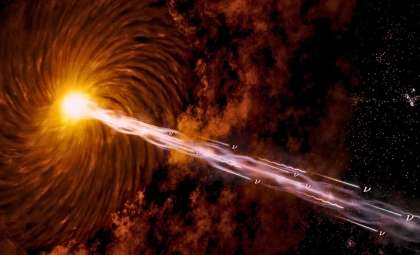
When the supernova’s shockwave crashes into this dense shell, it creates powerful magnetic fields that accelerate particles trapped in the turbulent region. These charged particles repeatedly scatter across the shock front, gaining more energy each time until they escape as cosmic rays with extremely high energies.
This intense acceleration stage is very brief, lasting just a few months. Afterward, the shock weakens and the region no longer produces cosmic rays at PeV energies, although it continues to generate lower-energy cosmic rays for years or even centuries.
Why PeVatrons Are So Rarely Observed
The fleeting nature of the PeVatron phase likely explains why scientists rarely witness these cosmic particle accelerators in action. In the Milky Way, supernovae occur roughly every 30 to 50 years, but catching one within this narrow window—especially close enough to detect PeV cosmic rays—remains an extraordinary challenge.
Most observations of supernova remnants happen well after this brief peak activity period when the cosmic rays emitted have significantly lower energies.
This discovery bridges the gap between supernovae’s theoretical potential to produce PeV cosmic rays and the lack of direct observational evidence so far.
- Categories:
- News




0 comments
Sign in to Comment