
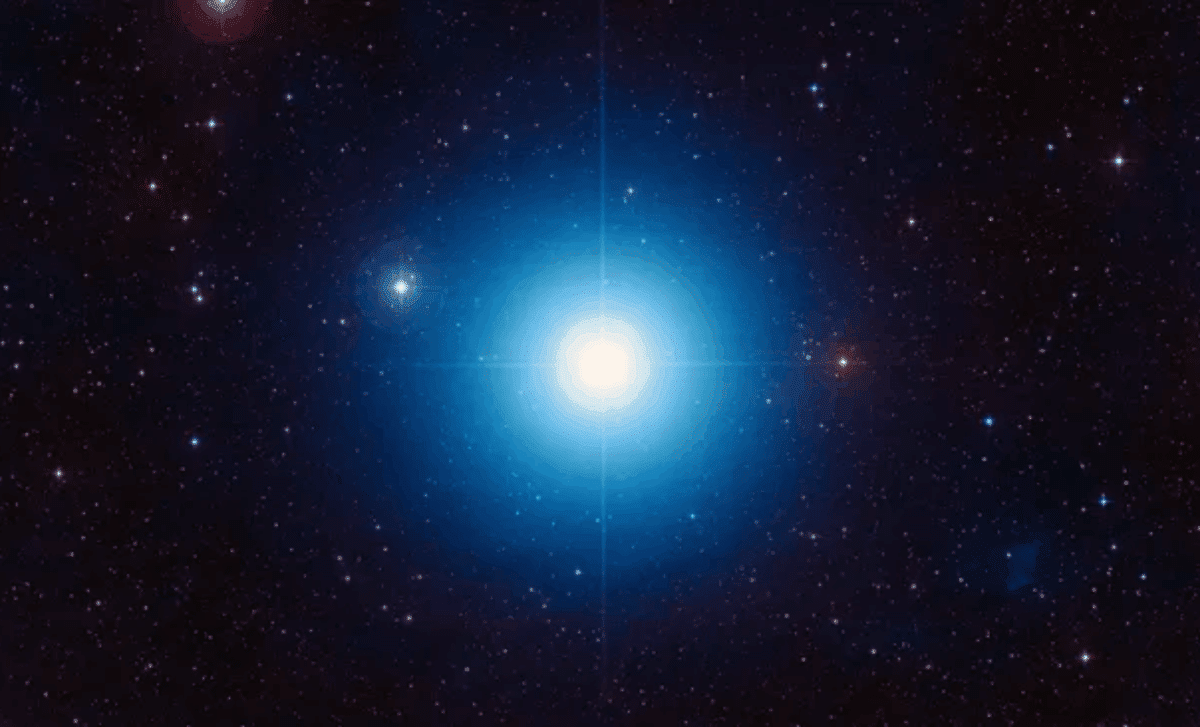
As autumn advances across the Northern Hemisphere, a solitary gleam becomes visible just above the southeastern horizon. This is Fomalhaut, a distinguished star set apart by its unique placement and historical significance. Though often overshadowed by more prominent constellations, its striking isolation demands attention.
Autumn’s Most Isolated Luminous Star
Located within the unassuming constellation Piscis Austrinus—dubbed the Southern Fish—Fomalhaut stands virtually alone within a dark section of the sky. It shines at magnitude +1.2, not among the very brightest, yet its brilliance uniquely illuminates the sparse southeastern sky during October nights. The star’s name, rooted in Arabic and meaning “mouth of the fish,” perfectly reflects its position within the constellation often depicted as drinking water from neighboring Aquarius.
Amidst the typically bustling star patterns of the season, Fomalhaut holds firm as a solitary fixture against a largely empty stellar backdrop. This isolation has earned it the nickname “The Solitary One.” For observers in northern cities such as New York, Chicago, or Denver, it represents the southernmost bright star visible on autumn evenings—a serene indicator of seasonal change.

If you step outside near 9:30 p.m. and direct your gaze low toward the southern horizon, Fomalhaut’s bluish-white shimmer will stand out in a sky otherwise sparse with bright stars, as noted by Space.com. To make locating it simpler, many stargazing apps turn your smartphone into a handy star map. Once found, it’s easy to understand why this star has fascinated sailors and astronomers alike for centuries—acting as a guiding beacon in a vast cosmic ocean.
The Regal Star and Its Astronomical Mysteries
More than 5,000 years ago, Persian sky watchers identified four “royal stars” assigned to the cardinal points of the heavens. Along with Aldebaran, Regulus, and Antares, Fomalhaut was honored as one of these celestial guardians. This elite status, preserved through Babylonian, Greek, and Arabic traditions, predates the telescope era by millennia.
Contemporary science has only added layers to Fomalhaut’s story. In 2008, the Hubble Space Telescope revealed an intriguing object orbiting the star, named Fomalhaut b. Initially celebrated as a rare direct glimpse of an exoplanet, subsequent investigations—particularly with NASA’s Spitzer Space Telescope—have suggested that the object may instead be a dust or gas clump within a distant debris ring, rather than a bona fide planet.
This evolving understanding highlights Fomalhaut’s dual role: as a bright celestial landmark welcoming the fall and as an enigmatic subject advancing our knowledge of planetary formation.
A Stellar Emblem of the Changing Season
Fomalhaut captivates not only through its isolation and debated planetary companion but also through its enduring connection to Earth’s seasonal cycle. For generations, the star has been regarded as a signpost of autumn, emerging as foliage turns and nights grow chilly. Its low altitude in Northern Hemisphere skies lends it a reflective, almost wistful glow. Writers such as Fred Schaaf and Martha Evans Martin have likened it to a celestial lighthouse or a poignant reminder of the seasonal shift.
Martin, in her early 20th-century work The Friendly Stars, portrayed Fomalhaut as "adding to the somber signs of approaching autumn, and sometimes giving one a touch of melancholy." For those sensitive to the subtle cues of the night, this star symbolizes not just changing patterns above but the quiet mood of fall itself.
Beyond its poetic significance, Fomalhaut remains invaluable for celestial navigation. Its solitary brilliance offers pilots and sailors a reliable point of reference in southern skies, especially where few other stars shine bright. Combined with its rich mythological and scientific background, Fomalhaut stands as a rare star that embodies beauty, meaning, and practical use all at once.
- Categories:
- News










0 comments
Sign in to Comment