
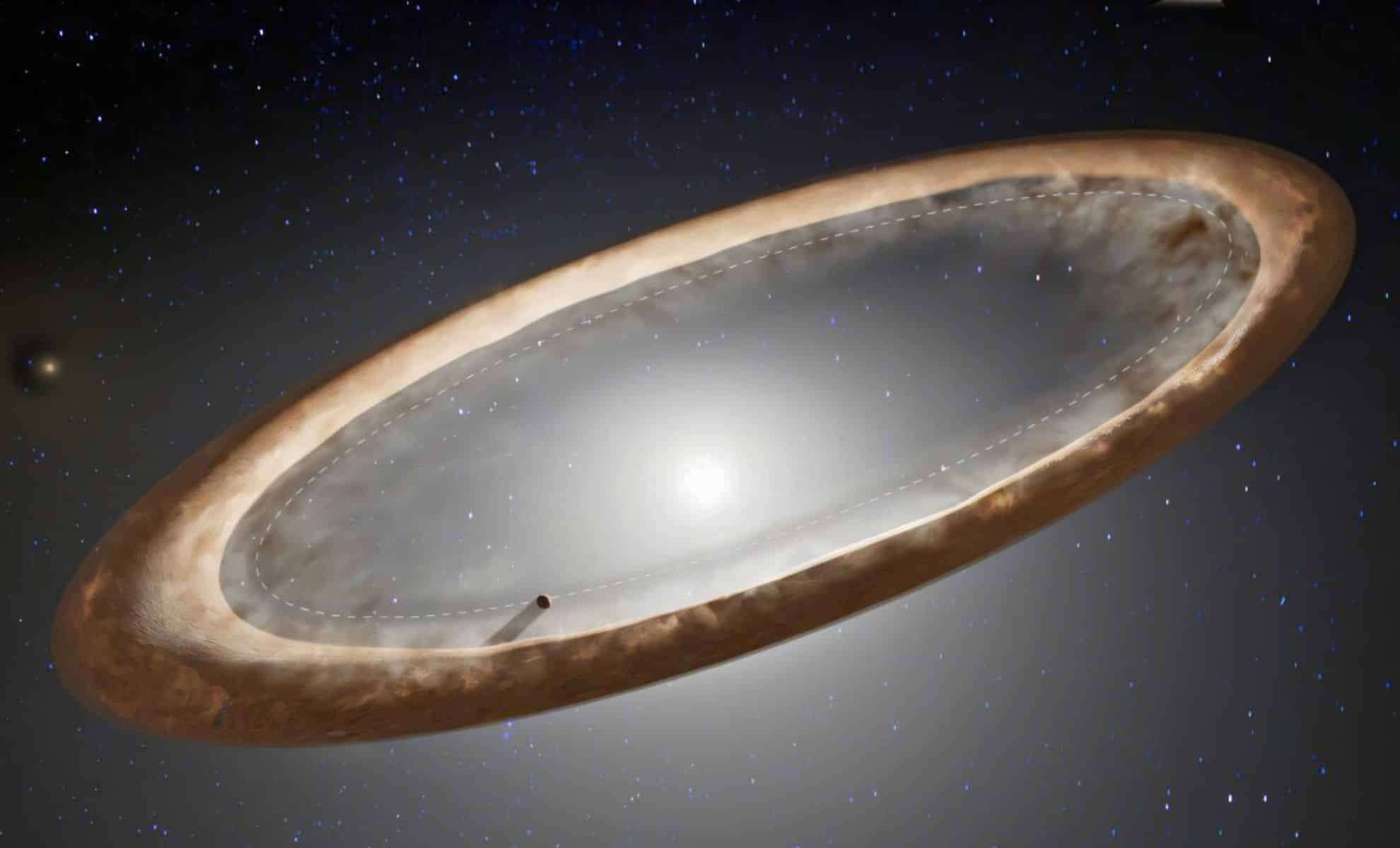
Recent research published in The Astrophysical Journal and The Astrophysical Journal Letters sheds new light on the distorted structure of Fomalhaut’s debris disk. Leveraging data obtained from the Atacama Large Millimeter/submillimeter Array (ALMA), astronomers detected variations in the disk’s eccentricity relative to its distance from the star, indicating a complex and evolving formation that challenges earlier assumptions.
Fomalhaut’s disk, resembling an oversized and more diffuse version of our solar system’s asteroid belt, has puzzled scientists due to its asymmetric appearance. The latest discoveries suggest the existence of a hidden planet that may have influenced the disk’s shape billions of years ago.
Reevaluating the Eccentricity of Fomalhaut’s Debris Disk
For nearly twenty years, the cause behind Fomalhaut’s warped debris disk has remained elusive. This new work reveals that the eccentricity, or degree of elongation, diminishes as the distance from the host star increases. The disk's inner regions are notably more stretched, while its outer parts display a subtler elongation.

This pattern, known as a “negative eccentricity gradient”, is unprecedented among observed debris disks, making Fomalhaut’s disk exceptionally noteworthy. Joshua Bennett Lovell, who led the study, remarked: “Our data reveal for the first time that the disk’s eccentricity is not uniform but instead decreases steadily with distance — a phenomenon never definitively seen before in any debris disk.”
Concealed Planets as Architects of the Disk’s Shape
One explanation for this distinctive morphology is the gravitational influence of an undiscovered planet orbiting within the debris disk. Scientists propose that this planet’s significant mass could have shaped the disk’s eccentric nature during the system’s formative years. The gravitational forces exerted by this unseen companion may have continued to shape the disk’s structure for more than 400 million years.
According to Lovell, “The disk’s remarkable configuration likely originated during the protoplanetary disk phase and has been maintained for over 400 million years thanks to ongoing gravitational interactions with this planet.”
This hypothesis aligns well with existing models where a planet’s gravity sculpts the environment around it, potentially influencing debris disks for billions of years through sustained orbital motion.
Astronomers have created the clearest image yet of Fomalhaut's debris disk using ALMA, revealing a distinct warped shape with a decreasing eccentricity as it moves away from the star. This uneven, asymmetric structure, suggests gravitational sculpting by a hidden, massive planet. pic.twitter.com/KcyfUfXXHf
— 🌌 Trentymus Kostorus | Astrophysicist (@TrentKostorus) September 6, 2025
ALMA's High-Resolution Imaging Clarifies the Disk’s Form
Breakthroughs came through ALMA’s sophisticated imaging, capturing the disk in unprecedented detail at 1.3 mm wavelengths. Researchers introduced a new model that accounted for variations in radius, width, and asymmetry to analyze these images. The results confirmed a pronounced decrease in eccentricity moving outward, matching theoretical models of planet-disk gravitational interactions. This observation represents the first confirmed case of a negative eccentricity gradient in a debris disk.
Additional confirmation was achieved by contrasting data from ALMA and the James Webb Space Telescope (JWST). The variations in brightness between the disk's inner and outer edges defied explanation by previous uniform eccentricity models, bolstering the team’s innovative theory. Jay Chittidi, a graduate researcher at Johns Hopkins University, commented, “No static eccentricity model could replicate these unusual details within Fomalhaut’s disk.” The study team anticipates that forthcoming ALMA observations, already authorized, will further test their findings.
- Categories:
- News











0 comments
Sign in to Comment