
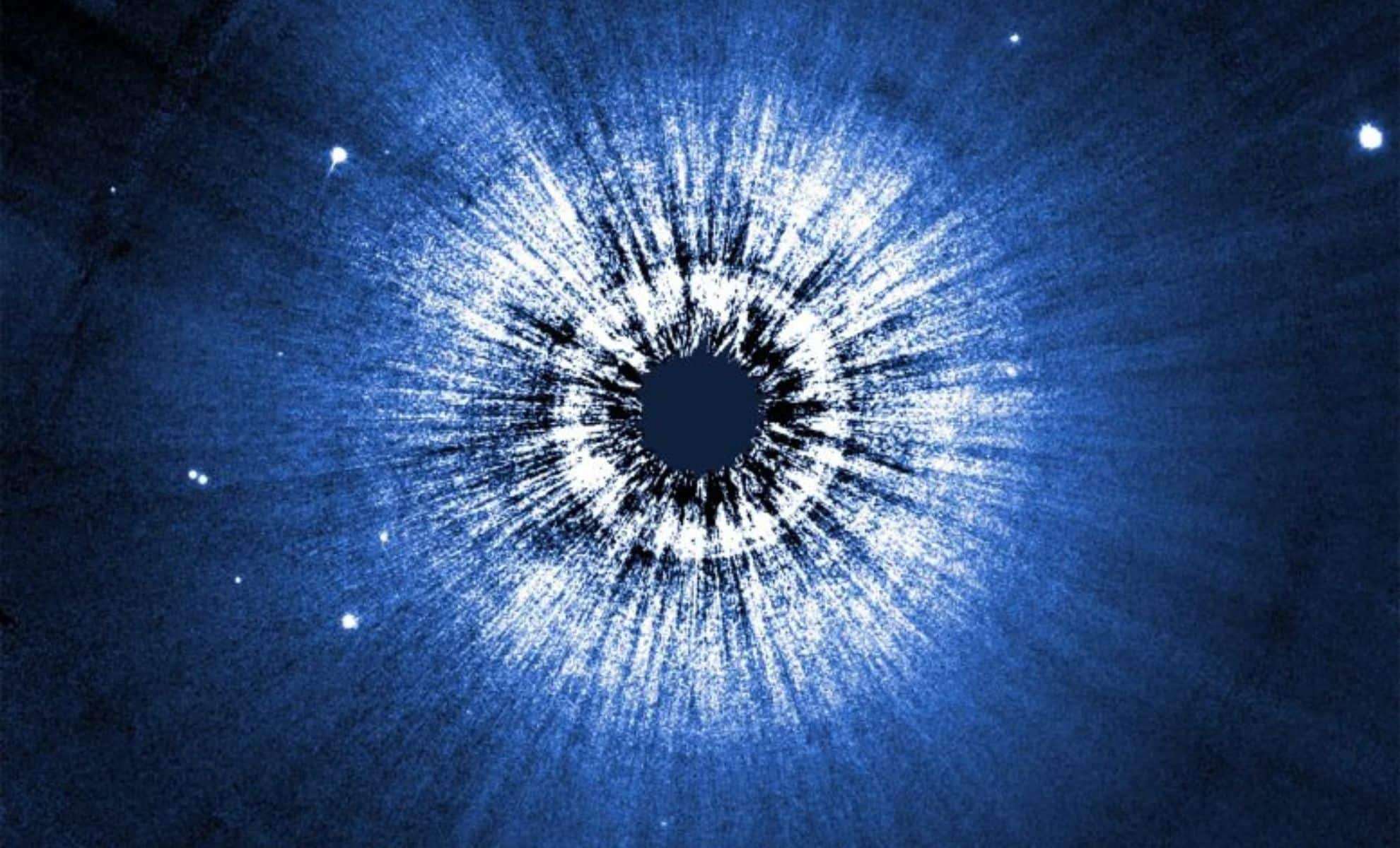
Astronomers using observations from the Hubble and James Webb space telescopes have identified a remarkably even and planet-absent disk of dust encircling Vega, a luminous star located roughly 25 light-years away in the Lyra constellation. This discovery is unexpected, as most stellar debris disks display disruptions caused by large planets sculpting the surrounding dust and gas. Yet, Vega’s extensive dust ring, stretching across a 100-billion-mile expanse, shows none of these typical disturbances, prompting scientists to reconsider prevailing ideas about how planets develop.
Vega’s Unusually Uniform Dust Disk
New research sheds light on the surprising nature of the debris disk surrounding Vega, one of Lyra’s most prominent stars 25 light-years from our solar system. Detailed images from NASA’s Hubble and James Webb telescopes reveal an extraordinarily smooth dust disk extending nearly 100 billion miles in radius. Unlike typical circumstellar disks that exhibit gaps, clumps, or spiral patterns indicative of gravitational interactions with sizable planets, Vega’s disk remains largely featureless. This unexpected uniformity challenges astronomers’ understanding of the processes shaping planetary systems.
The investigative team at the University of Arizona anticipated discovering clear gravitational footprints of planets influencing Vega’s disk—akin to “snowplows” carving paths through icy terrain. However, as described by András Gáspár, the disk’s surface is “as smooth as a pancake,” lacking any recognizable planetary signatures. Lead author Kate Su emphasized the implications, stating, “It’s causing us to rethink the diversity among exoplanetary systems.” According to SciTechDaily, the telescopes detected a layered dust distribution, with Webb’s infrared sensors observing sand-sized grains nearer the star, while finer, smoke-like particles appear in the outer halo, hinting at complex dust sorting mechanisms within the disk.

Reexamining Planet Formation Paradigms
The structure of Vega’s disk contradicts common predictions. In most systems, massive planets sculpt their surroundings, producing gaps and rings by clearing out debris. Yet, combined Hubble and Webb observations demonstrate an absence of such structural markers in Vega’s disk, implying either a lack of significant planets or different underlying dynamics at play. Lead researcher Kate Su remarked, “This discovery invites a fresh look at the variety of planetary system architectures,” highlighting how Vega’s disk challenges existing planetary formation assumptions.
The apparent lack of planetary effects raises compelling questions about Vega’s evolutionary history compared to stars like Fomalhaut, which shares nearly identical size, temperature, and age but displays a richly structured ringed disk likely influenced by massive planets. University of Arizona scientist George Rieke reflected, “Why does Fomalhaut, so similar to Vega, show clear signs of planet formation while Vega does not?” This disparity suggests unknown factors may crucially influence planetary system development.
Exploring Diverse Disk Structures
Astronomers now propose that differences in initial conditions or subtle gravitational effects could yield vastly different circumstellar disk formations even between comparable stars. For instance, Fomalhaut’s disk features intricate rings probably shaped by unseen planets, whereas Vega’s disk remains smooth and undisturbed. The research team posits these variations might reveal new planetary formation environments or alternative processes governing debris disks like Vega’s.
Findings from Hubble and Webb emphasize the diverse nature of planetary disks throughout our galaxy. Kate Su explains, “We still have much to learn about how planets form, and Vega’s unique dust disk observations will help refine theoretical models.” These insights are documented in two forthcoming papers published in The Astrophysical Journal, which delve deeper into the unusual characteristics and potential explanations for Vega’s dust disk anomalies.
The absence of planetary imprints in Vega’s dust disk challenges conventional hypotheses and underscores the complexities in unraveling planetary formation mechanisms. Continued studies of varied stellar disks, including those like Vega’s, promise to enhance our understanding of the wide-ranging architectures seen in exoplanetary systems.
- Categories:
- News










0 comments
Sign in to Comment