
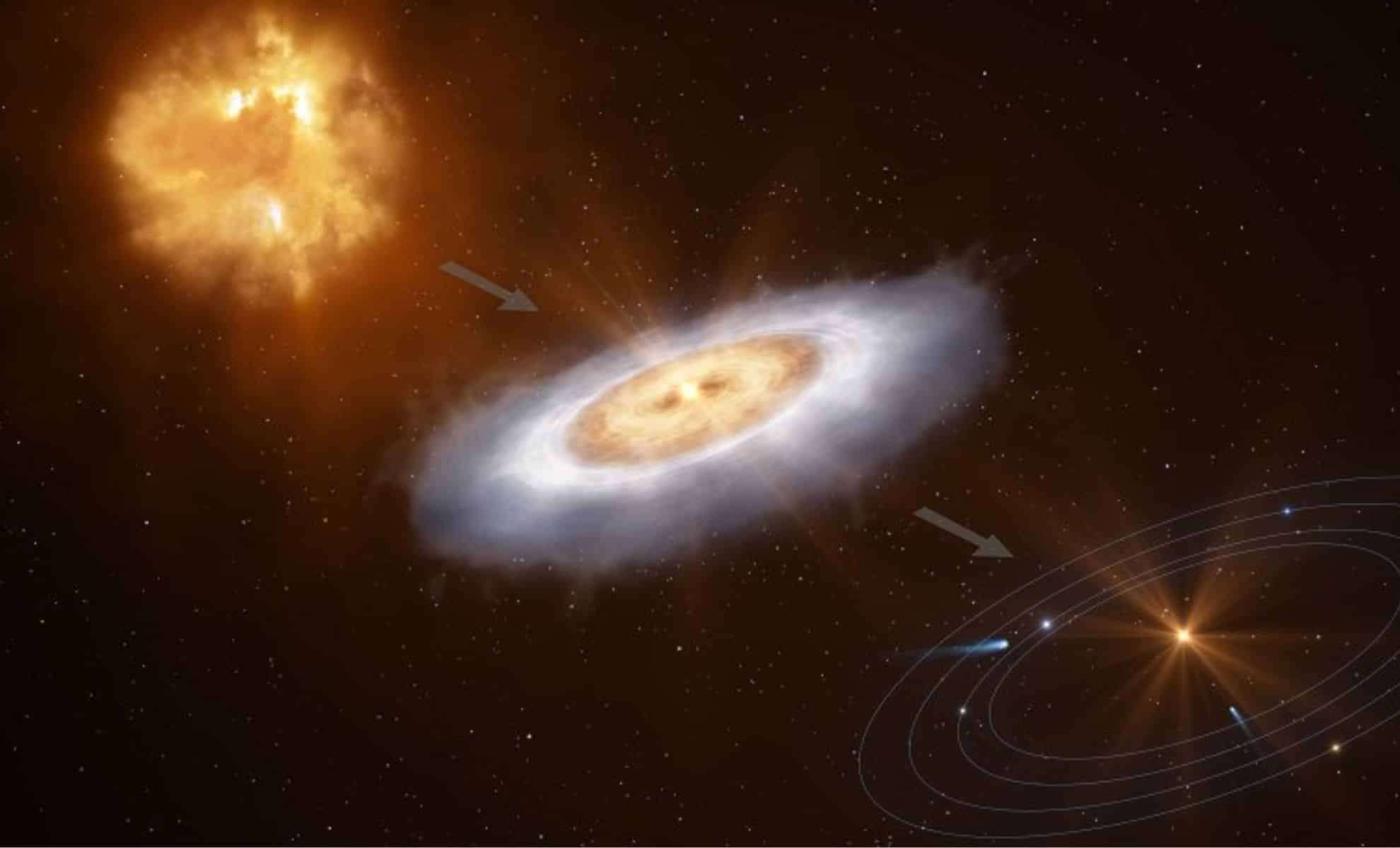
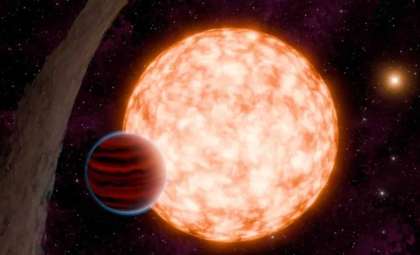
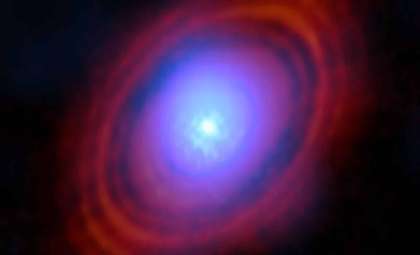
Researchers have uncovered a rich variety of complex organic molecules within the protoplanetary disk of a youthful star, shedding new light on the early chemical ingredients essential for life. Utilizing the Atacama Large Millimeter/submillimeter Array (ALMA), a team led by Abubakar Fadul from the Max Planck Institute for Astronomy (MPIA) identified 17 distinct complex molecules orbiting the star V883 Orionis.
Continuity of Organic Molecules Through Star Formation
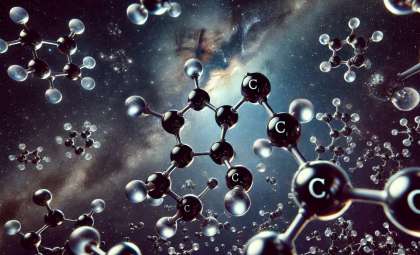
These molecular compounds, considered key precursors to life’s fundamental elements, provide crucial insight into how simple molecules from interstellar space evolve into more intricate chemistries relevant to nascent planets.
Previous theories proposed a “reset scenario,” suggesting that intense energetic phenomena near forming stars, like shocks and radiation, would obliterate most preexisting complex molecules. However, findings from Fadul and colleagues indicate a continuous chemical progression. Their research posits “a seamless chemical enrichment from interstellar clouds directly to advanced planetary systems.”

Co-author Kamber Schwarz notes, “Our observations imply that protoplanetary disks retain complex organic molecules from earlier stages and that synthesis of such molecules can persist during the disk phase.”
Among the detected 17 compounds in V883 Orionis were glycolonitrile — a chemical forerunner to amino acids like glycine and alanine — and the nucleobase adenine, which is central to RNA and DNA structures. Additional finds, such as ethylene glycol, implicated in more elaborate organic reactions, underscore the astrochemical ties to biological origins.
Stellar Flares Illuminate Concealed Molecules
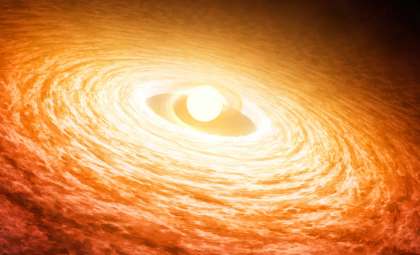
The identification of these complex organics was facilitated by a starlight burst within the V883 Orionis system. Ordinarily, such molecules remain locked inside icy dust grains in the cold outer disk past the snowline. When the young star experiences an outburst phase, the accretion of gas onto the star creates substantial heat, causing the ice to sublimate and releasing complex molecules into the gas where they can be detected.
This process parallels what occurs in our Solar System, where comets containing intricate molecules produce gaseous halos as they warm near the Sun, allowing spectroscopic analysis. Both scenarios demonstrate how external heating exposes hidden organic chemistry.
“Complex molecules including ethylene glycol and glycolonitrile emit radio wave signatures,” explains Schwarz. “ALMA’s capabilities are ideal for capturing these faint signals.” Situated at 5,000 meters altitude in the European Southern Observatory (ESO) within the Chilean Atacama Desert, ALMA provides exceptional sensitivity for studying the subtle emissions from V883 Orionis.
Bridging Interstellar Chemistry and the Origins of Life
Complex molecules such as methanol, acetonitrile, and propionitrile have been observed in star-forming regions before, yet this new work crucially links the chemistry of early space environments to the organic materials incorporated into comets, asteroids, and meteorites.
This chemical continuity, spanning vast distances and timescales from interstellar clouds to planetary systems, outlines a sustained path toward molecular complexity. Tushar Suhasaria, leader of MPIA’s Origins of Life Lab, states, “Our recent findings suggest ethylene glycol may form by UV-triggered reactions from ethanolamine, a compound newly detected in space.”
Future Research and Unanswered Questions
Although these results are encouraging, the research team acknowledges further investigation is necessary. Schwarz notes, “Several spectral features remain unresolved,” and higher-resolution observations are required to verify some molecular detections. The chance remains that even more elaborate molecules could be identified in the future.
The researchers also anticipate that exploring additional wavelength bands across the electromagnetic spectrum might reveal novel chemistries. Fadul muses, “The door is open to discovering the full scope of cosmic prebiotic chemistry within various star-forming environments.”
- Categories:
- News



0 comments
Sign in to Comment