
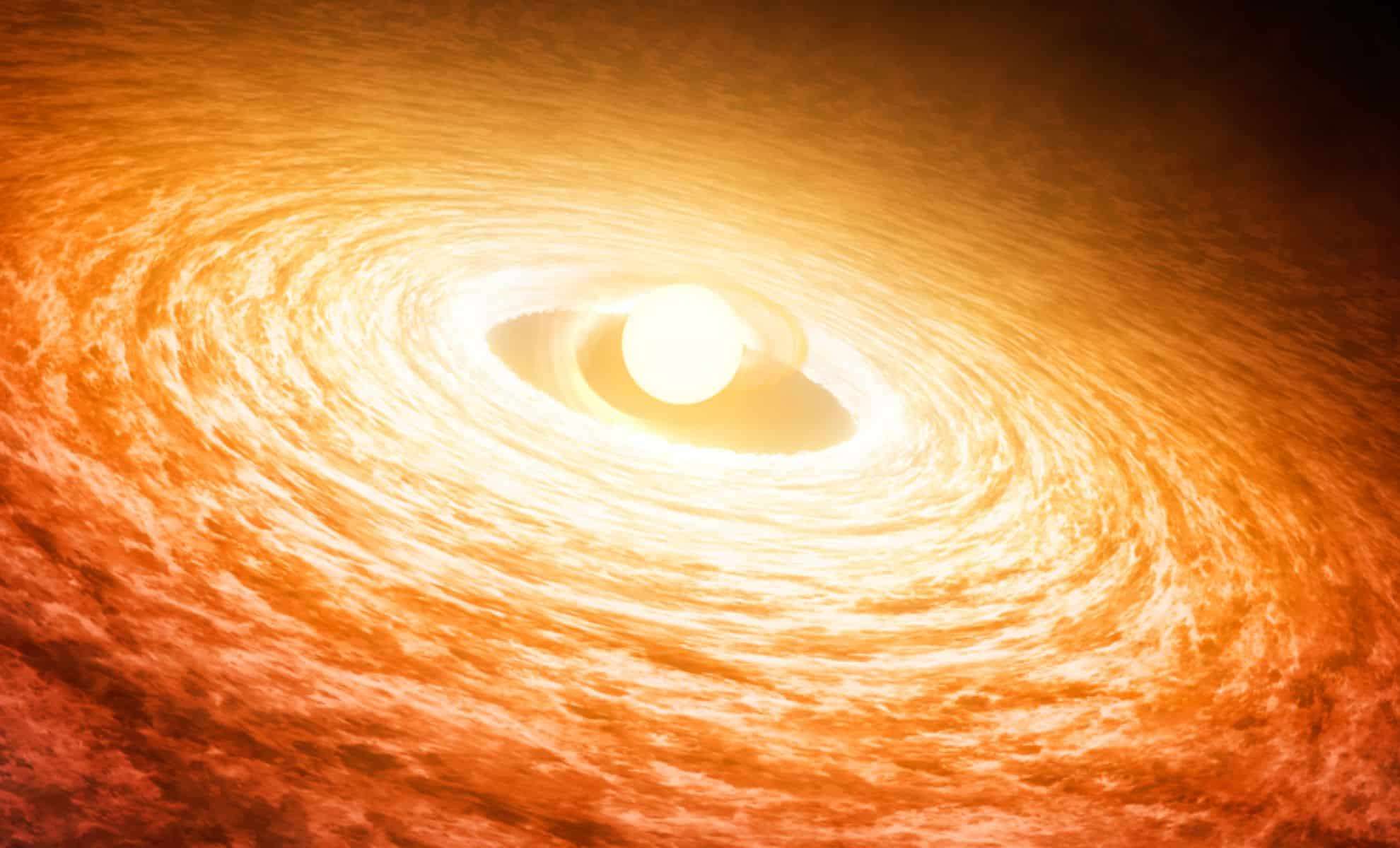
The NASA Hubble Space Telescope has captured remarkable new insights into FU Orionis (FU Ori), a youthful star in the Orion constellation famous for its extraordinary brightness surge nearly 100 years ago. Utilizing cutting-edge ultraviolet imaging, researchers uncovered that the star’s accretion disk—a rotating structure funneling gas and dust to the star—is significantly hotter and more energetic than scientists had anticipated. These discoveries challenge established models of young, eruptive stars and provide key understanding of the earliest phases of star development.
Scientists described the findings as "intensely hot," revealing conditions in FU Ori’s core region where temperatures soar up to 16,000 kelvins, almost triple the Sun's surface temperature. This breakthrough may revolutionize the way astronomers interpret the interaction between stars and their accretion disks.
A Unique Stellar Phenomenon
First noted in 1936, FU Orionis amazed the astronomy community by brightening by a factor of one hundred within just months, becoming one of the most luminous young stars observed. Rather than a sudden explosion, FU Ori’s brightness has gradually decreased over decades, classifying it as an exceptional member within the FU Ori class of eruptive young stars.

FU Ori is part of a group of youthful stars called T Tauri stars, which are still accumulating mass from their surrounding disks. What distinguishes FU Ori, however, is its mode of accretion: unlike typical T Tauri stars where magnetic forces keep the disk from direct contact, FU Ori’s disk extends right to the star's surface, leading to intense and unstable interactions.
According to Adolfo Carvalho from Caltech, who led the research, “Hubble’s observations reveal an impact zone far hotter than previous theories predicted. Temperatures hitting 16,000 kelvins—nearly threefold the Sun’s surface—are almost double what earlier models suggested. This significant temperature increase compels us to rethink the physical processes involved.”
Probing the Accretion Disk’s Core
By analyzing data from Hubble’s Cosmic Origins Spectrograph (COS) and Space Telescope Imaging Spectrograph (STIS), astronomers obtained the first ultraviolet spectra of FU Ori. They observed an extraordinary environment at the inner boundary of the accretion disk, where gas rushes toward the star at speeds surpassing its rotation. The collision causes a powerful shockwave, heating the gas to extreme temperatures and producing intense ultraviolet emission.
This unexpected intensity defied prior theoretical expectations. Co-author Lynne Hillenbrand commented, “We anticipated some unique features at the star-disk interface but were surprised by how much brighter the ultraviolet emission was than predicted. The excess emission was a remarkable revelation.”
Consequences for Planetary Genesis
Insights from FU Ori extend beyond stellar phenomena, influencing theories about planet formation. Stars like FU Ori impact the chemical makeup and physical properties of their surrounding disks, the cradles of newborn planets. Yet, the forceful accretion events can disturb these fragile planetary nurseries.
Carvalho explains, “When a planet forms far from the star, outbursts from an FU Ori-type star can alter the chemical materials the planet gathers. Conversely, planets forming very close may be drawn inward quickly or even consumed within a few such intense bursts. Close-in rocky planets might be destroyed or severely compromised.”
This dynamic underlines how the survival and evolution of planetary systems depend on delicate stellar conditions.
Expanding Our Understanding of Youthful Stars
The pioneering ultraviolet observations of FU Orionis mark a significant advance in the study of young star systems. Utilizing Hubble’s unique capabilities, astronomers have delved deeper into the star's accretion mechanics than previously possible. These findings challenge conventional frameworks surrounding bursting young stars and open new paths for exploring star and planet formation.
As Hillenbrand reflected, “Many young stars exhibit complex ultraviolet spectra, but Hubble’s size, spectral reach, and FU Ori’s fortunate accessibility have allowed us to probe the heart of this extraordinary class of stars like never before.”
The research team continues to interpret the spectral data from Hubble, aiming to further uncover details about the star’s accretion flows and outflows. These efforts promise to enrich our knowledge of the dynamic environments shaping newborn stars and their emerging planetary companions.
- Categories:
- News








0 comments
Sign in to Comment