

Astronomers have uncovered an enormous quantity of water vapor in space—measuring three times the volume of all Earth's oceans—encircling a young stellar system recently observed.
This extraordinary detection, accomplished with the Atacama Large Millimetre/submillimetre Array (ALMA), reveals a promising site for planet formation and offers fresh insights into the origins of planetary systems and the possibilities for life beyond our planet.
Enormous Water Vapor Presence Detected Near HL Tauri
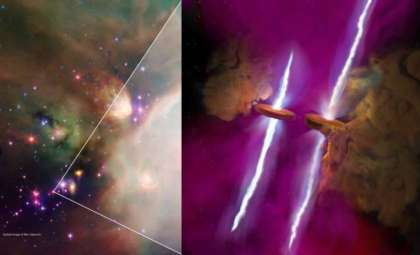
Located roughly 450 light-years away, the HL Tauri system has drawn scientific interest following the identification of a massive volume of water vapor within its surrounding gas-and-dust disk. Being in a youthful evolutionary phase, HL Tauri’s protoplanetary disk is exactly the nature of environment where planets emerge as dust particles gradually merge to form larger structures.

The remarkable aspect of this discovery lies in the sheer quantity of water vapor detected. Measurements indicate that the amount of water vapor present surpasses three times the total volume of Earth's oceans. Such an abundance implies that water may play a critical role within planetary development. Given water’s significance as a crucial ingredient for life, this finding fuels intriguing possibilities regarding the formation of potentially habitable planets around stars like HL Tauri. Lead researcher Stefano Facchini remarked, “I had never imagined that we could capture an image of oceans of water vapor in the same region where a planet is likely forming.” This observation offers an exceptional glimpse into the early phases of planet building, highlighting water’s potential importance.
Consequences for Habitability and Planet Development
The detection of this vast water vapor reservoir carries profound implications for how planets form and their capacity to support life. The study, featured in Nature Astronomy, proposes that the water vapor surrounding HL Tauri may be a vital component catalyzing planet formation while augmenting their future habitability. Scientists speculate that this environment might reflect conditions similar to those present in our own solar system during Earth’s initial formation phase roughly 4.5 billion years ago.
This water vapor likely fulfills several functions throughout the assembly of planetary bodies. It may regulate temperature within the protoplanetary disk, a key element for solid body formation. Its existence also points to an ample supply of hydrogen and oxygen, essential atoms for crafting rocky worlds with atmospheres conducive to life. Facchini elaborated, “Our recent images reveal a substantial quantity of water vapor at a range of distances from the star that includes a gap where a planet could potentially be forming at the present time.” This disk gap is thought to be created by a nascent planet clearing its path—the hallmark of ongoing planet formation.
Moreover, the similarities between HL Tauri and early Earth provide a valuable setting for studying processes that lead to habitable planets. Although additional research is required to confirm whether planets in this system can sustain life, the detection of such significant water vapor volumes is an encouraging sign.
Water’s Importance in Space Studies and Upcoming Investigations
Water remains central in the quest to locate life outside Earth. Finding such enormous amounts of water vapor surrounding HL Tauri extends our understanding of how life-friendly environments may develop throughout the cosmos. For many years, water has served as a critical marker in locating potential biospheres, and this detection confirms that planets forming in these environments might have promising prospects for habitability.
Beyond its impact on habitability, water vapor influences larger-scale dynamics shaping planetary systems. It can contribute to forming complex molecules capable of spawning life’s building blocks. The conditions around HL Tauri are important not only for planet creation but also for fostering the chemical reactions necessary to produce organic compounds, which could eventually incorporate into emerging planets.
This discovery also emphasizes the need for improved comprehension of water distribution in the cosmos. As observations from advanced instruments like ALMA continue, more star systems exhibiting similar water vapor concentrations may come to light. Enhanced knowledge about water’s role in planet formation will better guide efforts to identify other worlds with the potential for life. Such developments could steer future space missions towards these distant realms and possibly reveal life’s presence beyond Earth.
The detection of water vapor at HL Tauri highlights the significance of supporting space exploration technologies. Facilities like ALMA deliver unparalleled opportunities to examine distant astronomical phenomena in detailed ways previously unimaginable. As such capabilities progress, ongoing discoveries about star and planet formation will reveal new pathways toward understanding the universe’s capacity to nurture life.
- Categories:
- Astronomy ,
- News ,
- Science ,
- Space









0 comments
Sign in to Comment