
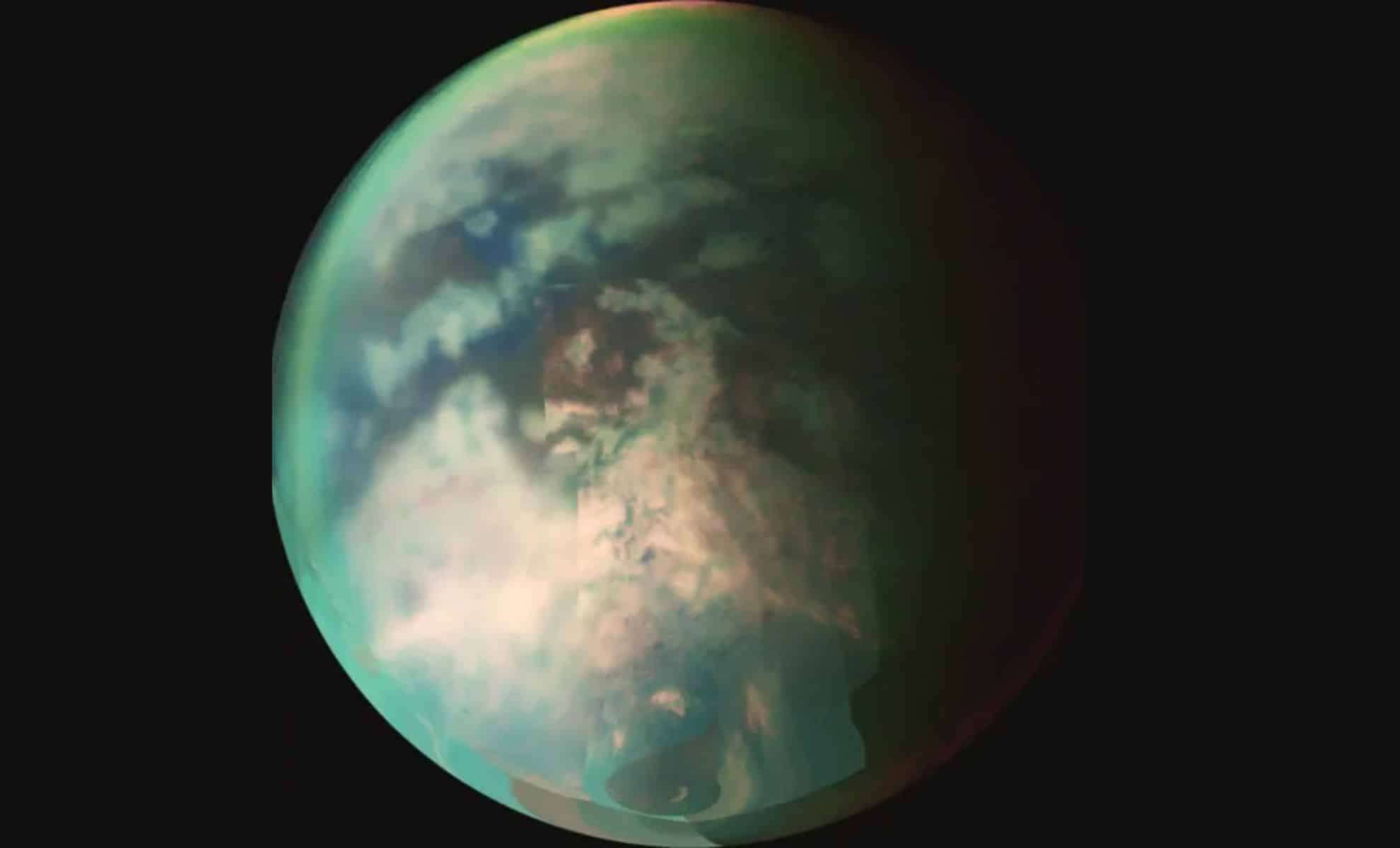
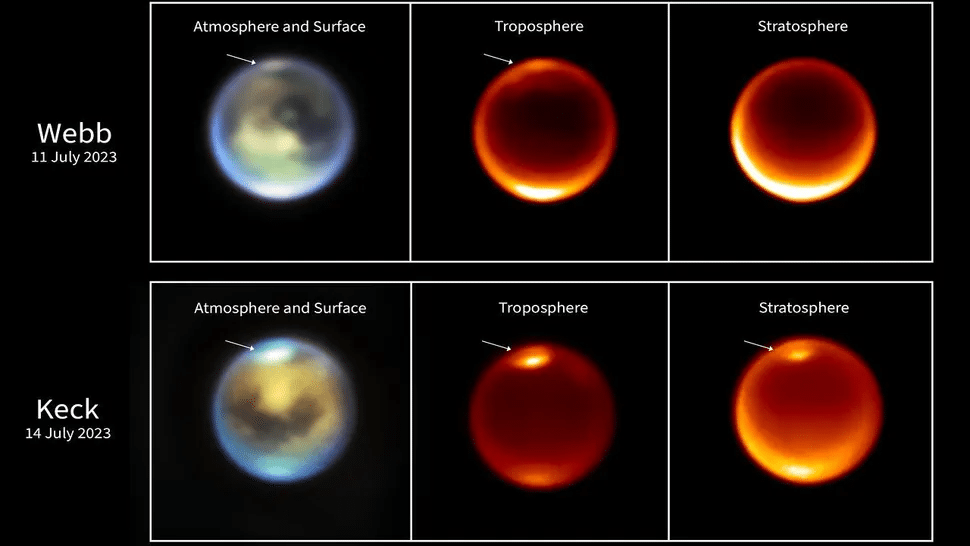
The James Webb Space Telescope (JWST) has delivered groundbreaking infrared images capturing active cloud development over the northern hemisphere of Titan, Saturn’s largest moon. Presented in a recent study published in Nature Astronomy, this marks the inaugural confirmation of methane cloud convection in Titan’s northern summer. Titan’s weather system, featuring expansive lakes and seas filled with liquid methane, holds a singular place in our solar system, as it is the only other celestial body besides Earth where surface weather phenomena like clouds and precipitation occur. Observations from JWST alongside data from Hawaii’s W.M. Keck Observatory shed light on Titan’s atmospheric dynamics and chemical interactions, laying groundwork for upcoming exploratory missions such as NASA’s Dragonfly rotorcraft.
A Closer Look at Titan’s Atmosphere and Its Methane Clouds
Distinguished by its dense nitrogen atmosphere and extensive methane and ethane liquids, Titan’s northern hemisphere—home to most of its lakes and seas—has now been observed via JWST to exhibit methane clouds spanning multiple altitude layers. While previous evidence of cloud convection was limited to Titan’s southern hemisphere, these new findings provide the first full picture of the moon’s active meteorology. Conor Nixon of NASA’s Goddard Space Flight Center highlighted Titan’s uniqueness, stating, “Titan is the only other place in our solar system that has weather like Earth, in the sense that it has clouds and rainfall onto a surface.” These methane-driven weather cycles continuously replenish the moon’s hydrocarbon reservoirs and influence its climate patterns.
New Clues About Titan’s Atmospheric Chemistry: Methyl Radicals Detected
Beyond cloud tracking, JWST also identified methyl radicals present in Titan’s atmosphere—a component previously unaccounted for in organic chemistry models of the moon. These radicals arise when solar radiation and energetic particles from Saturn’s magnetic environment fragment methane molecules. The reactive methyl groups then contribute to the synthesis of more complex organics like ethane, integral to Titan’s hydrocarbon lakes. Stefanie Milam, an astrochemist and co-author, illustrated the breakthrough: “For the first time we can see the chemical cake while it’s rising in the oven, instead of just the starting ingredients of flour and sugar, and then the final, iced cake.” This discovery enables scientists to witness the active chemical pathways shaping Titan’s atmosphere and supports investigations into its potential prebiotic processes.

Looking Ahead: Dragonfly Mission to Decipher Titan’s Mysteries
The timing of these findings is pivotal as NASA’s Dragonfly mission prepares for launch in 2028, aiming to reach Titan by 2034. This innovative nuclear-powered rotorcraft will explore Titan’s surface extensively, examining its atmospheric chemistry, weather patterns, and habitability prospects with unparalleled detail. Data about methane cloud behavior and organic compounds gathered by JWST will be vital in guiding Dragonfly’s scientific objectives, especially in the quest to find precursors of life. Dragonfly embodies a significant milestone in exploring one of the most Earth-like worlds in our cosmic neighborhood.
- Categories:
- News








0 comments
Sign in to Comment