
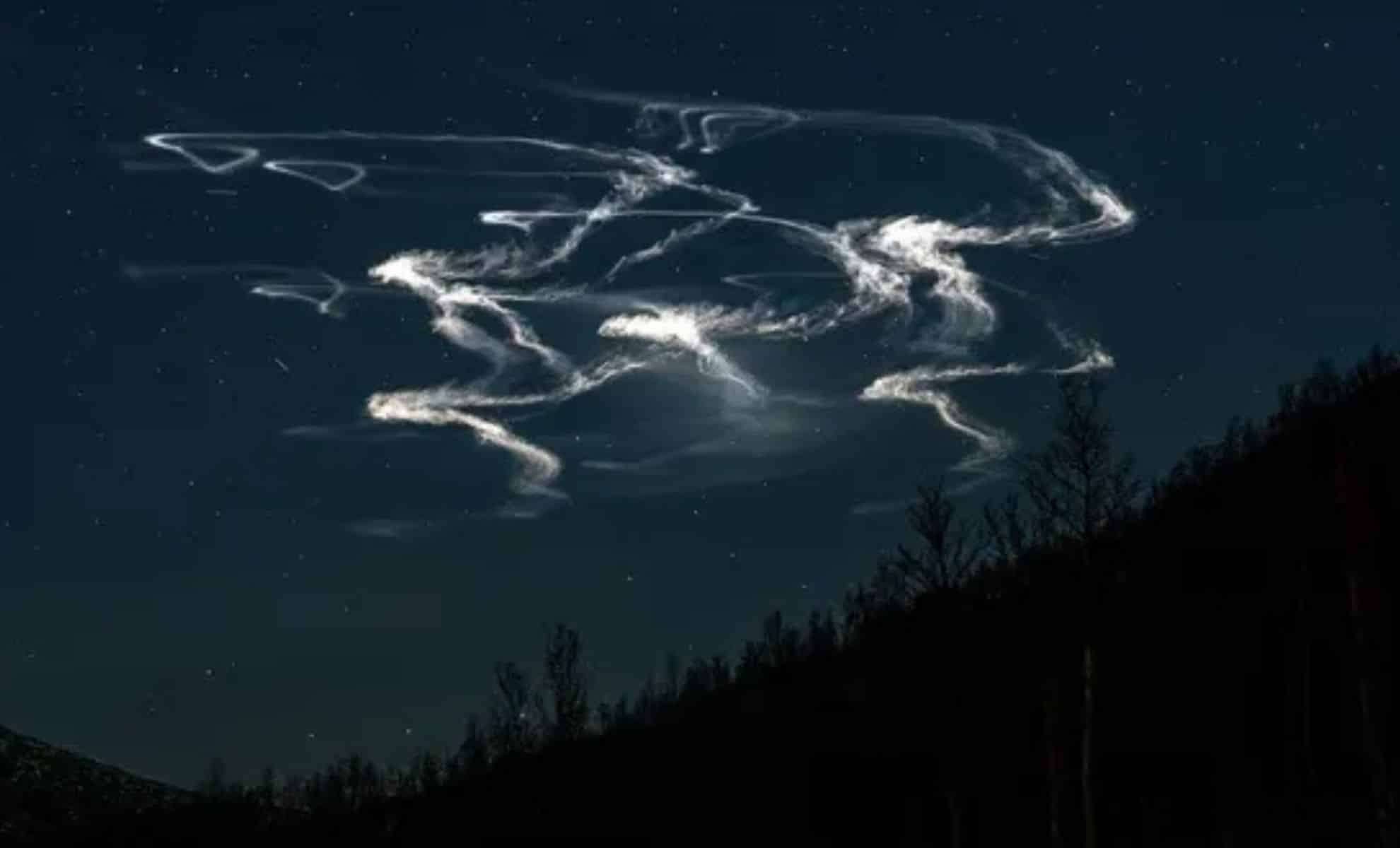
On November 10, 2024, NASA launched an extraordinary experiment above Northern Norway by sending two sounding rockets aloft, which released luminous chemical clouds under the shimmering glow of the aurora borealis. This initiative, known as the Vorticity Experiment (VortEx), sought to explore how gravity waves and turbulence interact within Earth's atmosphere. Against the backdrop of dancing northern lights, the experiment provided new perspectives on how energy travels between atmospheric layers, enriching our understanding of climate and weather dynamics.
Creating Glowing Clouds: The Science Behind NASA's Experiment
For the VortEx project, NASA’s rockets emitted trimethyl aluminum (Al₂Me₆), a chemical that generates luminous, swirling clouds when exposed to oxygen. These man-made plumes acted as visible tracers, enabling researchers to observe otherwise hidden movements caused by atmospheric turbulence and gravity waves. Gravity waves arise from disturbances like wind shifts or storms, sending ripples through the atmosphere that can affect local weather and the jet stream.
The glowing clouds formed within the turbopause, a vital atmospheric boundary approximately 90 kilometers above Earth’s surface. This zone marks the transition where the mesosphere fades into the thermosphere, featuring intricate interactions between turbulent and layered airflows. Observing such phenomena is key to enhancing weather models and comprehending atmospheric behavior.

A Mesmerizing Light Show Under the Arctic Sky
Launching from the Andøya Space Center near the Arctic Circle, the experiment took advantage of the site’s closeness to frequent auroras. The brilliant artificial clouds merged with natural northern lights, creating an extraordinary visual spectacle. Scientists monitored these formations from multiple Norwegian observatories, capturing detailed data on turbulence and wave movements in the upper atmosphere.
Ivar Sandland, a traveler and photographer in Northern Norway, described his surprise witnessing the event: “Seeing the rocket launch, I thought it was a very unusual cloud.” As covered by Space.com, Sandland later learned this unique phenomenon was part of NASA's atmospheric study that combined celestial and human-made beauty in the night sky.
Why Focusing on the Turbopause Matters
The turbopause functions as a critical transition zone where chaotic turbulence gives way to more stable atmospheric layers. This boundary not only shapes global weather but also plays a role in how space weather events, like solar storms, impact Earth’s environment and technologies.
The VortEx mission concentrated on the behavior of gravity waves as they travel and fade within the turbopause. Understanding these energy transfers is essential for refining predictions related to weather, climate, and upper atmospheric conditions.
Insights gained from these experiments also advance planetary science, since similar atmospheric dynamics occur on Mars, Venus, and other worlds. Earth-based studies like VortEx thus serve as valuable analogs for grasping weather and climate processes beyond our planet.
NASA’s Innovation in Atmospheric Research
The VortEx initiative epitomizes NASA’s efforts to advance atmospheric science through inventive methods. By pairing rocket flights with chemical tracers, researchers achieved visualization of subtle, otherwise invisible atmospheric phenomena. This technology promises to deepen understanding of the intricate interplay between turbulence, wave motion, and energy flow in Earth's upper atmosphere.
Beyond expanding fundamental knowledge, these investigations enhance awareness of space weather’s effects on satellites and communication systems. Data from VortEx are expected to refine predictive climate models and guide future studies of atmospheres both on Earth and across the solar system.
- Categories:
- News





0 comments
Sign in to Comment