

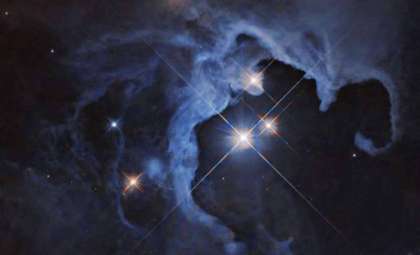
Researchers have recently assessed the possibility that, roughly two million years in the past, Earth passed through cold and dense clouds drifting through interstellar space, likely impacting the planet’s climate and atmospheric conditions.
The investigation, spearheaded by Merav Opher, a professor of astronomy at Boston University and a fellow at the Harvard Radcliffe Institute, offers new perspectives on how our sun’s galactic position may have influenced Earth’s environmental history.
Published in Nature Astronomy, the paper suggests that the solar system encountered a thick interstellar cloud that compressed the heliosphere—the sun’s protective magnetic shield created by the solar wind. This shrinking of the heliospheric boundary potentially left Earth vulnerable to increased cosmic rays and interstellar particles, with possible consequences for climate and atmospheric chemistry.

Understanding the Heliosphere’s Shielding Effect
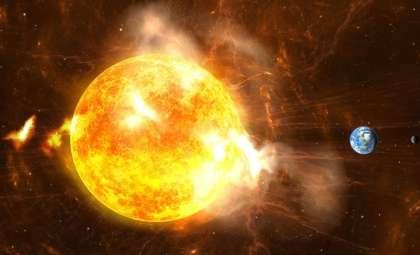
The heliosphere is an immense bubble dominated by the solar wind, extending far beyond the outer planets and acting as a barrier protecting our solar system.
This magnetic shield repels a large fraction of harmful cosmic radiation and particles from outer space that would otherwise reach the planets. According to Opher’s findings, the thick interstellar cloud, part of a structure known as the Local Ribbon of Cold Clouds, temporarily pushed the heliosphere inward, exposing Earth and the other planets outside this natural defense. This increased exposure would have allowed a greater influx of cosmic rays and interstellar materials to interact with Earth’s atmosphere and surface.
Using advanced simulations, Opher and her team traced the position of the sun and the heliosphere’s configuration from two million years ago. Their results indicate that during this interval, the solar system passed through a particularly dense sector of the Local Ribbon of Cold Clouds, specifically the Local Lynx section. This event likely caused a significant heliospheric contraction that exposed Earth directly to the interstellar environment. Supporting this scenario, scientists have discovered elevated concentrations of isotopes such as iron-60 (60Fe) and plutonium-244 (244Pu) within geological samples, including ocean floor sediments, moon rocks, and ice core records, indicating heightened cosmic ray activity during that epoch.
Links to Climate and Geological Records
The presence of these isotopes points to Earth’s direct contact with interstellar components and corresponds with a notable global cooling phase characterized by multiple ice ages. This climate shift aligns chronologically with the solar system’s passage through the dense interstellar cloud.

The surge in cosmic ray exposure may have altered atmospheric processes, promoting cooling effects on Earth’s surface. Opher’s simulations estimate that the heliosphere remained compressed for up to a million years, dependent on the size and density of the interstellar cloud encountered. This prolonged period of elevated cosmic radiation could have influenced not only climate but also evolutionary dynamics affecting early human ancestors and other life forms.
This study emphasizes the active role the solar system’s cosmic surroundings play in shaping Earth’s climate. As stars travel through the Milky Way, they periodically encounter varying interstellar environments that can influence their planetary systems. While encounters with dense interstellar clouds are infrequent, they represent significant factors capable of triggering climatic and possibly biological changes. Future investigations are planned to reconstruct the sun’s trajectory and heliosphere structure even further back in time to deepen our grasp of how such galactic interactions have impacted Earth’s development.
Implications for Future Study and Planetary Habitability
Beyond shedding light on past Earthly climatic changes, this research opens new pathways to understanding how interstellar environments affect planetary systems and their potential for supporting life. As the solar system continues navigating through space, it will inevitably encounter other interstellar clouds that might influence Earth’s climate again. Researchers at Boston University’s SHIELD DRIVE Science Center are now extending their analysis to explore the sun’s movements over the past seven million years, assessing how these cosmic interactions have shaped the heliosphere and Earth’s environment.
This work highlights the necessity of including galactic influences when evaluating planetary climates and evolutionary history. Combining geological isotope records with sophisticated simulations offers a compelling approach to recreating ancient cosmic encounters and their terrestrial impacts. Gaining further clarity on the sun’s path through the galaxy and its interactions with interstellar matter enriches our understanding of the complex relationship between cosmic forces and planetary conditions.
Opher and her collaborators’ findings enhance our knowledge of how the solar system’s galactic context can influence habitable conditions on Earth. By examining both historical and prospective solar paths, scientists aim to better predict how encounters with interstellar clouds could affect Earth’s climate and ecosystems in the future. This research not only explains historical climate variations but also informs predictions about possible risks and opportunities arising from the dynamic cosmic environment surrounding our planet.
- Categories:
- Astronomy ,
- News ,
- Space ,
- Physics







0 comments
Sign in to Comment