
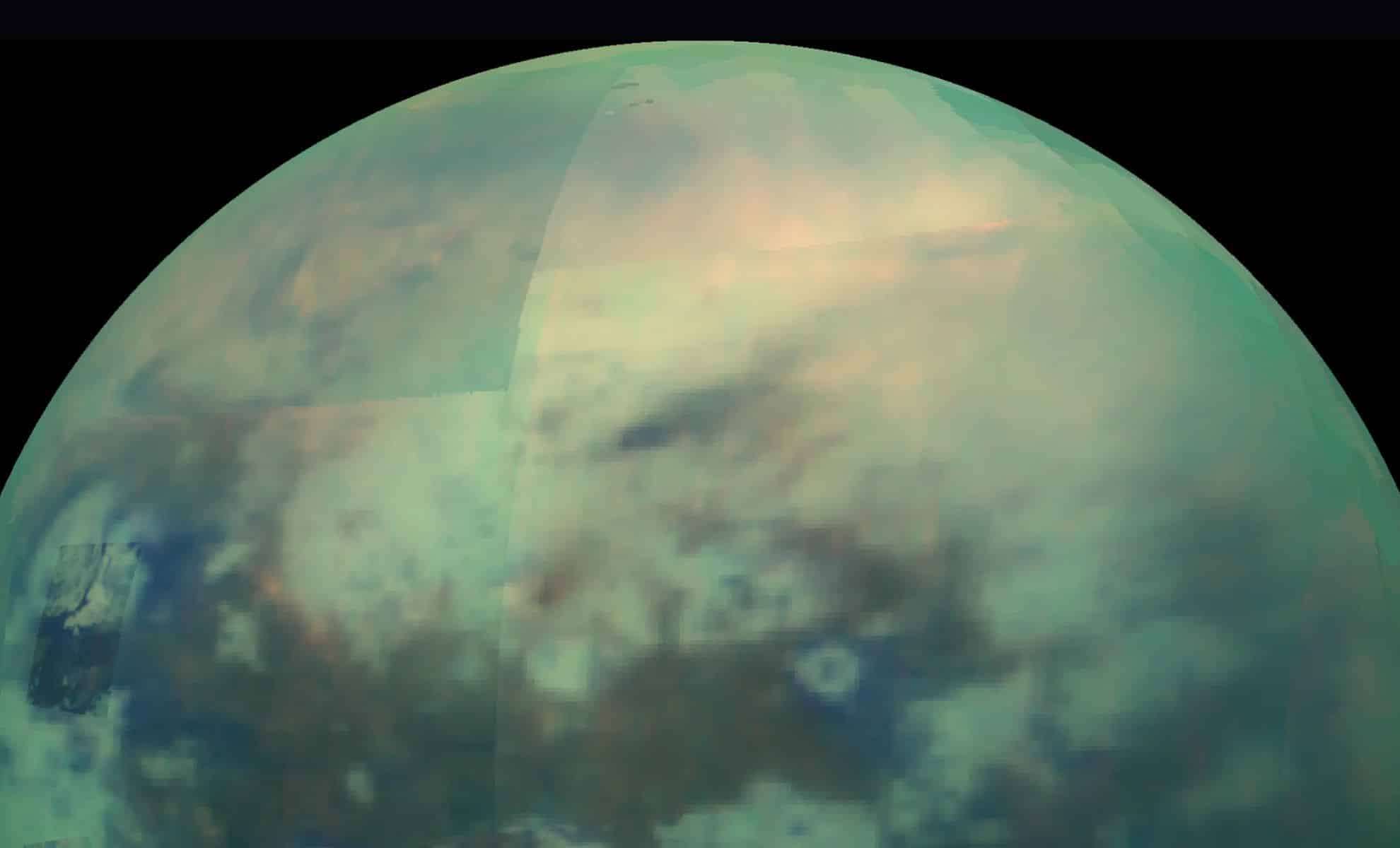
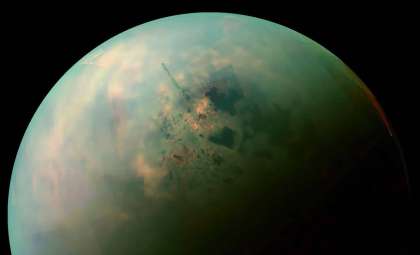
New research indicates that Titan, Saturn’s largest moon, may possess a substantial crust of methane clathrate ice reaching depths of up to six miles, offering fresh insights into its geological structure and atmospheric behavior.
Scientists at the University of Hawai’i at Mānoa propose that this extensive crust, formed by methane encased in ice, might explain the atypically shallow impact craters and the persistent methane concentration in Titan’s dense atmosphere.
This discovery is anticipated to support the forthcoming NASA Dragonfly mission, which plans to explore Titan’s methane-rich landscape upon its arrival in 2034, potentially uncovering conditions favorable to life.

Exploring Titan’s Distinctive Methane Clathrate Ice Layer
Titan stands apart in the solar system due to its surface features—rivers, lakes, and seas filled with liquid hydrocarbons such as methane and ethane. Beneath its frozen exterior, a layer of methane clathrate—where methane molecules are trapped within water ice—may insulate the underlying ice, warming it enough to enable greater flexibility and tectonic activity than previously recognized.
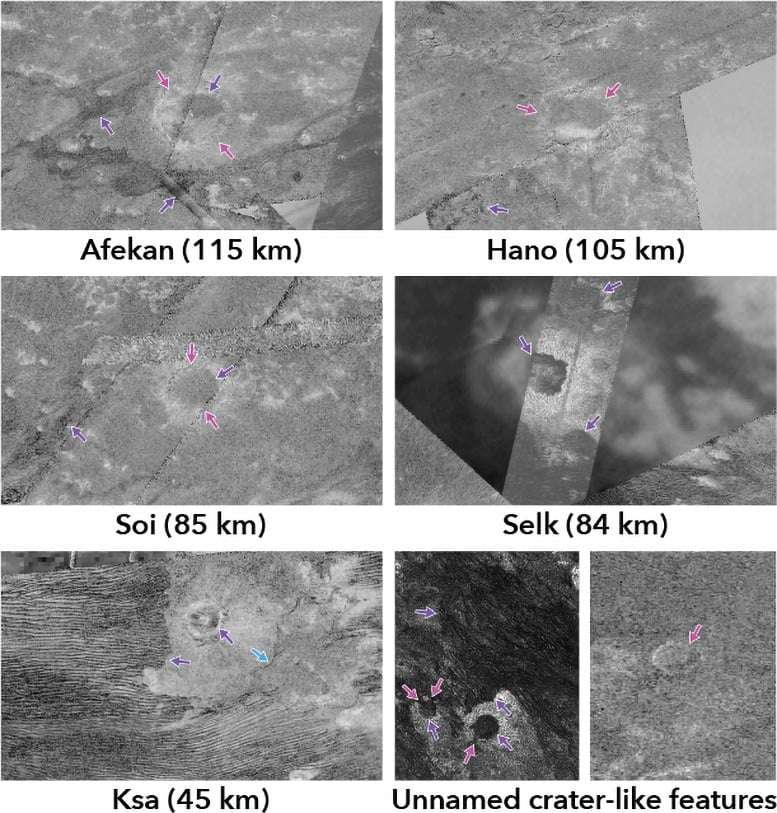
To delve deeper into this feature, researchers examined data from NASA’s Cassini spacecraft, renowned for its detailed imaging of Titan before its mission concluded in 2017. Scientists were intrigued by Titan’s impact craters, which are both fewer in number and shallower compared to other icy moons. Study lead author Lauren Schurmeier remarked, “the scarcity and reduced depth of craters on Titan was unexpected because, by comparison with similar moons, we anticipated a higher number of deeper craters.”
Modeling various ice shell compositions revealed that a methane clathrate layer between three and six miles thick would allow Titan’s surface to gradually rebound after impacts, softening crater depths through a process similar to glacier flow on Earth. This geological relaxation blurs crater contours over time, resulting in the smoother landscape observed.
Methane’s Influence on Titan’s Climate and Atmosphere
This methane clathrate crust doesn’t just affect Titan’s terrain; it also plays a crucial role in sustaining its methane-dense atmosphere. Despite constant degradation from solar radiation, Titan’s methane levels remain stable, likely due to a slow, ongoing release from the clathrate layer. This supports a methane-driven cycle akin to Earth's water cycle, where methane evaporates, forms clouds, and precipitates back to the surface.
Schurmeier explained that Titan offers a unique environment to study methane’s lifecycle and its warming effect, which could provide comparative insights into methane’s greenhouse role on our own planet.
On Earth, methane clathrates reside in cold regions like permafrost and ocean floors and occasionally emit methane gas, impacting global climate. Understanding Titan's methane circulation could shed light on similar Earth processes, including how geological activity might destabilize methane clathrates and feed atmospheric methane.
Potential for Habitability and NASA’s Dragonfly Exploration
If Titan’s methane ice crust effectively insulates its interior, it may help maintain a warmer, liquid subsurface ocean beneath the frozen exterior. This scenario raises the possibility of habitability, as such an environment might enable chemical exchanges between the ocean and surface, bringing signs of microbial life or biosignatures within reach.
The NASA Dragonfly mission, set to launch in 2028 and arrive on Titan by 2034, aims to study these surface and atmospheric processes in detail. Scheduled to land near the Selk Crater, Dragonfly's rotorcraft design will facilitate exploration over varied terrains, enabling it to analyze methane cycles and surface materials, potentially revealing evidence of life-supporting conditions.
- Categories:
- Astronomy ,
- News ,
- Space ,
- Nasa









0 comments
Sign in to Comment