
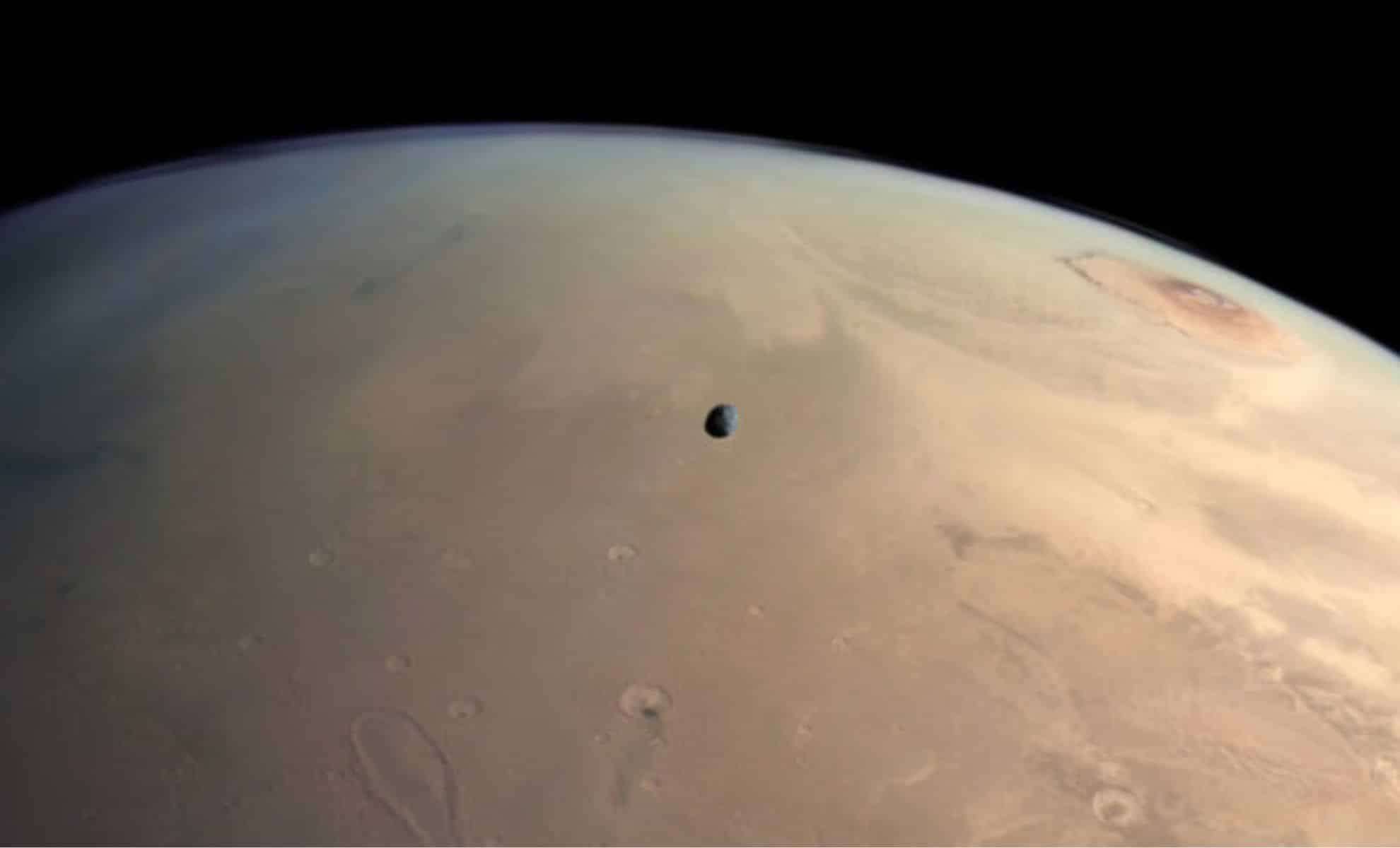
The European Space Agency's Mars Express spacecraft continues to amaze with incredible imagery of Mars, recently capturing an extraordinary scene featuring the planet's largest moon, Phobos, the immense Olympus Mons volcano, and the fragile Martian atmosphere.
Captured on July 13, 2024, and skillfully processed by UK-based astronomy enthusiast Andrea Luck, this image provides a rare glimpse into Mars’ complex surface and atmospheric dynamics. The photograph highlights the geological diversity of Mars while underscoring the ongoing discoveries made by exploration missions unraveling the planet's enigmas.
Phobos: Mars’ Approaching Satellite
In this remarkable image, Phobos, Mars’ closer and larger moon, takes center stage. Orbiting at an exceptionally close distance of about 6,000 kilometers—making it the nearest moon to its planet in our solar system—Phobos appears as a small, irregular celestial body marked by numerous craters and grooves, artifacts of its turbulent history, all captured in impressive detail by Mars Express.

Yet, Phobos is gradually spiraling inward due to the tidal pull exerted by Mars. Scientists estimate that within 30 to 50 million years, the moon will either crash into Mars or break apart under these gravitational forces, potentially forming a ring system. This countdown to destruction gives Phobos a unique status among planetary moons, symbolizing both wonder and inevitability in our solar neighborhood.
1/n 🧵 New epic photo of Phobos over Mars – lurking around Olympus Mons! (2024-07-13)
Full size image 140 MP: https://t.co/IB6o2dNbza (it’s huge)
Image Processing: AndreaLuck CC BY
Raw data: ESA/DLR/G.Neukum-FUBerlinESA Mars Express – New Data Release#Space #Astronomy #Mars pic.twitter.com/wztumMxxyQ
— Andrea Luck (@andrluck) September 1, 2024
Olympus Mons: The Solar System’s Largest Volcano
Visible in the image’s backdrop is Olympus Mons, Mars’ colossal shield volcano and the tallest known volcano within our solar system. This volcanic titan soars 26 kilometers above the Martian surface—almost triple the height of Earth’s Mount Everest—and spans a base roughly 600 kilometers wide, comparable to the size of Poland. Its summit extends beyond much of Mars’ thin atmospheric layer and effectively reaches space.
Formed through the slow buildup of lava flows over millions of years, Olympus Mons is geologically youthful, with its last eruption dating back approximately 25 million years. The volcano’s altitude results in surface pressures near its peak that border the vacuum of outer space, making it a remarkable Martian landmark. Mars Express’ imagery allows us to grasp the sheer scale and importance of this majestic feature in Mars’ geological history.
Martian Atmosphere: A Delicate Veil
The latest imagery from Mars Express also highlights the planet’s thin and wispy atmosphere visible as a faint layer hugging the horizon. Composed predominantly of carbon dioxide, with traces of nitrogen and argon, Mars’ atmosphere is much slimmer than Earth’s yet crucial in influencing Martian climate and surface phenomena.
Wispy high-altitude clouds visible in the photograph point to active atmospheric processes, including massive dust storms that periodically engulf Mars and cyclical polar ice fluctuations shaped by seasonal shifts. The atmosphere’s fragility results in extreme temperature differences, contributing to the harsh environment posing challenges for future exploration missions.
Featuring Olympus Mons alongside the tenuous atmosphere emphasizes the stark contrast between Mars’ rugged terrain and the near-vacuum conditions above. This juxtaposition illustrates the formidable obstacles faced by both robotic explorers and eventual human visitors.
The Mars Express Journey: Decades of Discovery
Since launching in 2003, the Mars Express orbiter has continuously expanded our knowledge of Mars, operating for over 20 years. Its objectives include searching for evidence of past life, analyzing the atmospheric composition, and mapping the surface at unprecedented resolutions. The mission’s enduring success reflects both the spacecraft’s resilience and the dedication of the teams overseeing it.
The breathtaking image taken on July 13, 2024, exemplifies Mars Express’ ongoing contributions to planetary science. Detailed glimpses of Phobos, Olympus Mons, and the Martian atmosphere provide fresh insights into Mars’ complex geology and climate interrelations.
As the Mars Express mission presses forward, it promises to yield further captivating imagery and data, deepening our understanding of the Red Planet and its dynamic environment. Its longevity underscores the crucial role sustained space exploration plays in uncovering our solar system’s secrets.
- Categories:
- Astronomy ,
- News









0 comments
Sign in to Comment