
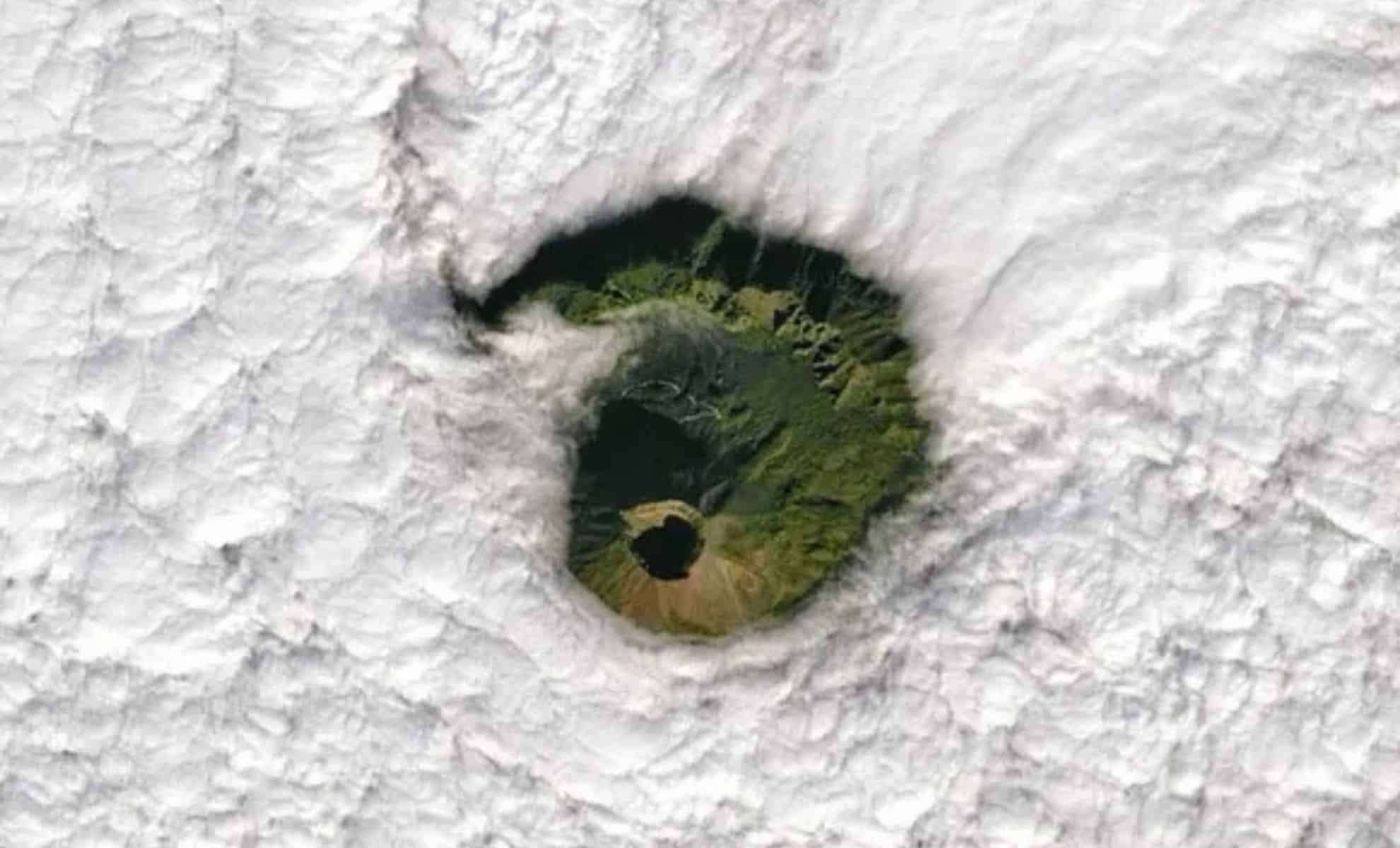
Captured by NASA’s Landsat 8 satellite, a striking image reveals the summit of Mount Vesuvius viewed through a circular opening in a thick cloud layer. This remarkable photo from January 2, 2022, showcases the volcano’s caldera, a large crater at its peak, framed perfectly by the cloud gap, forming a surreal “eye” looking skyward.
Rising 4,203 feet near Naples, Italy, Vesuvius is known for its devastating eruption in 79 A.D. that buried the Roman towns of Pompeii and Herculaneum under volcanic debris, preserving them for centuries. The volcano remains highly active and dangerous, with millions living in its surrounding zones at risk of future activity.
The Enigmatic Cloud Opening
The unusual round hole in the dense clouds enveloping Vesuvius adds to the intrigue of this image. While the precise cause is unclear, its shape is similar to fallstreak holes, formed when passing aircraft create circular clearings in cloud layers. Given the volcano’s vicinity to Naples International Airport, such air traffic could be responsible for this striking cloud formation.

This opening not only highlights Vesuvius’ current caldera but also reveals the eroded remains of Mount Somma, an earlier volcanic structure that collapsed before Vesuvius formed. The alignment provides a rare viewing angle of these intertwined geological landmarks.
Why Vesuvius Is a Continuing Threat
Vesuvius belongs to the Campanian volcanic arc, a belt of volcanoes formed by the collision between the African and Eurasian tectonic plates. Although its last major eruption occurred in 1944, seismic activity persists with earthquake clusters recorded, including in 1999, indicating ongoing subterranean activity.
The volcano’s threat is amplified by the dense human populations nearby. Around 800,000 residents live along its slopes, and up to 3 million more live within regions vulnerable to its eruptions. The next explosive event is considered inevitable, though its timing and scale remain unpredictable.
A 2011 Nature study dubbed Vesuvius “Europe’s ticking time bomb,” highlighting gaps between scientific understanding and governmental disaster planning. Its explosive history and proximity to populous areas make Vesuvius one of the globe’s most closely watched volcanoes.
Tracing Vesuvius’ Volcanic Legacy
The volcano’s past is as dramatic as its profile. Vesuvius built itself inside the remains of the ancient Mount Somma, a much older volcano that collapsed millennia ago. The satellite image reveals the caldera and surrounding ridges that narrate a story of repeated destruction and renewal through ages.
The catastrophic eruption of 79 A.D. remains Vesuvius’ most notorious event, unleashing deadly pyroclastic flows that engulfed Pompeii and Herculaneum, preserving a moment frozen in time. Since then, the volcano has erupted multiple times, with the most recent significant activity in the 20th century.
Modern Surveillance of Vesuvius’ Activity
Advances in monitoring technology have greatly enhanced our ability to detect changes in Vesuvius’ behavior. Researchers employ seismic sensors, gas analyzers, and satellite observations to monitor magma dynamics and gas emissions, providing crucial data to foresee potential eruptions.
The Landsat 8 photo exemplifies how orbital imaging can capture awe-inspiring views of Earth's volatile zones. This glimpse of Vesuvius piercing the clouds highlights both the beauty of natural phenomena and the vital need for constant vigilance to protect those living nearby.
Preparing for the Inevitable
Experts agree that Mount Vesuvius will erupt again—it's only a matter of when. Planning for this event demands coordination among scientists, officials, and emergency services. Evacuation efforts aim to relocate residents within 72 hours, though some question whether this window is adequate for rapid eruptions.
Vesuvius is a powerful symbol of nature’s force and the fragile balance between human civilization and the earth’s geological power. As ongoing research strives to anticipate its next move, images like this from Landsat 8 provide striking insight into a volcano that has shaped history and continues to captivate global attention.
- Categories:
- News






0 comments
Sign in to Comment