
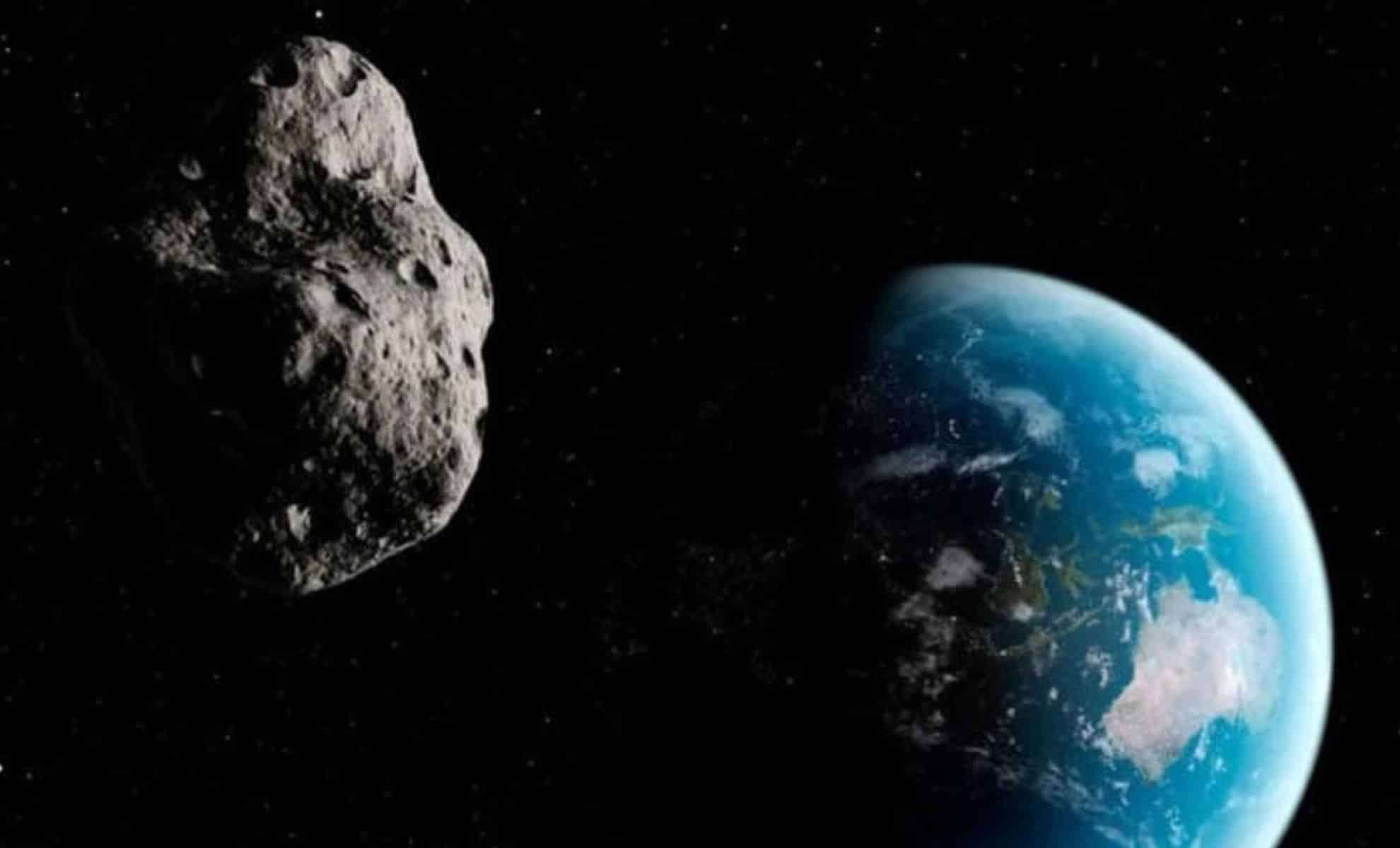
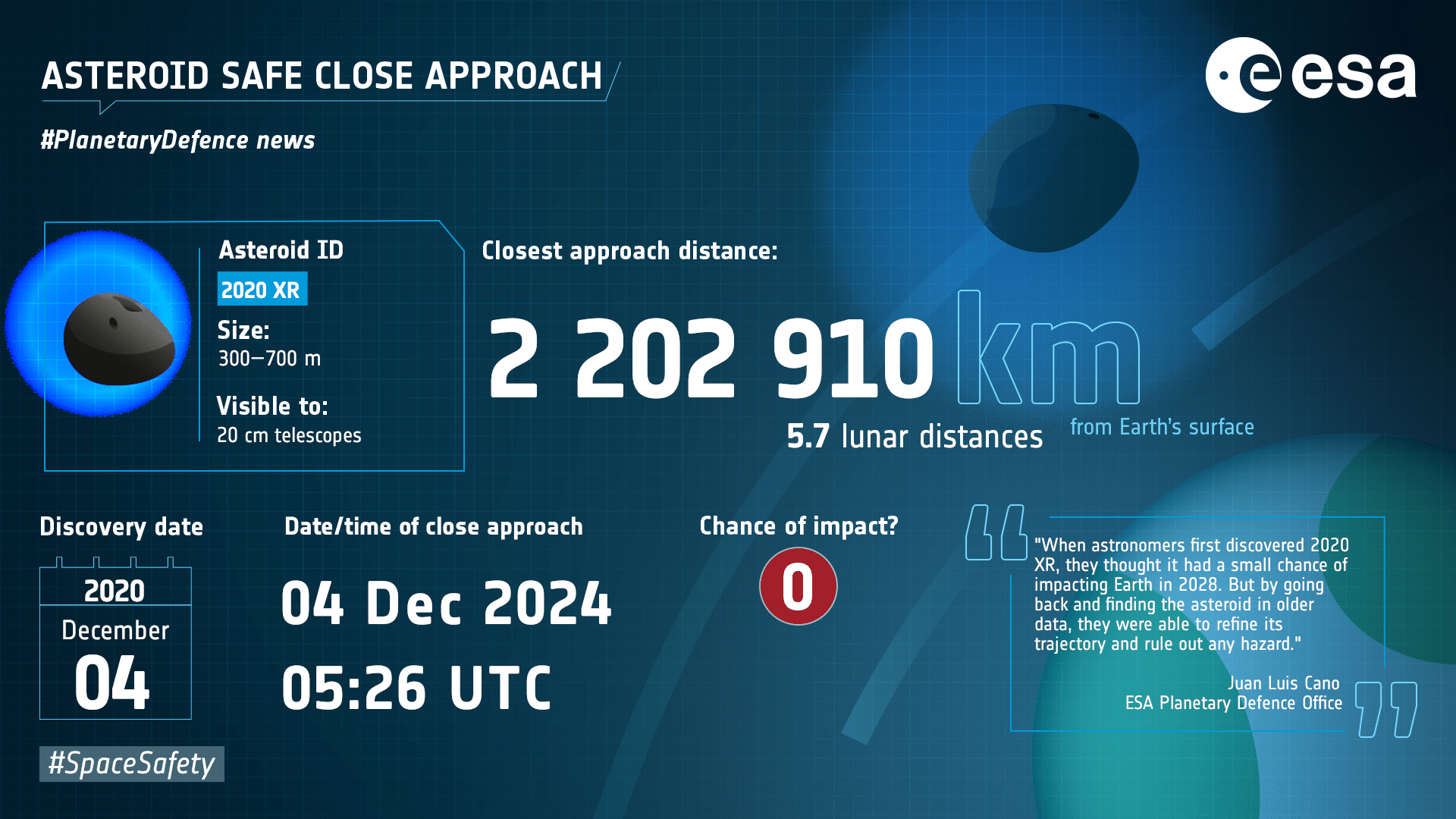
Later this evening, the colossal asteroid known as 2020 XR will make its nearest approach to Earth, coming within a distance of approximately 1.37 million miles. This gap equates to about five times the distance from Earth to the Moon, making it closer than most usual asteroid flybys. Measuring nearly 1,200 feet (366 meters) across—similar in size to a football stadium—this space rock is speeding through space at a remarkable 27,500 miles per hour (44,300 km/h).
This encounter represents a milestone because since its initial detection in 2020, this will be the closest 2020 XR has come to our planet. Despite its enormous size and rapid speed, astronomers assure there is no danger involved. Researchers have maintained detailed surveillance since the asteroid was discovered, continuously analyzing its trajectory. For those interested in witnessing this rare event, the Virtual Telescope Project plans to broadcast a live video stream of the asteroid's approach, providing a unique opportunity to observe the event in real time.
Understanding a “Potentially Hazardous Asteroid”
Asteroid 2020 XR is categorized as a potentially hazardous asteroid (PHA), a designation reserved for objects larger than 500 feet (150 meters) that pass within 4.65 million miles of Earth. Although this asteroid falls within that range, scientists confirm its current approach does not pose a threat.

Initial observations raised concerns about a possible collision in the near term. Juan Luis Cano, coordinator at the ESA's Near-Earth Object Coordination Center, recalled, “When first detected, 2020 XR was thought to carry a minor risk of impacting Earth in 2028.” However, after further analysis and comparison with archival data, astronomers have refined its orbit and eliminated the possibility of any impact. Cano added, “By tracing the asteroid in earlier observations, its path was accurately assessed, removing any hazards.” Thus, this close pass delivers no threat to Earth.
A Close Flyby and a Historic Observation
Even though 2020 XR will not collide with Earth tonight, this close passage is noteworthy. It is the closest approach this asteroid has achieved since its discovery and offers scientists a valuable chance to study it closely. While its classification as potentially hazardous might sound alarming, the asteroid’s trajectory ensures it will safely pass Earth, allowing researchers to deepen their understanding of such objects.
The asteroid's previous nearest pass occurred in December 1977, when it was over 10 million miles (16 million km) farther away compared to tonight’s approach. Following this event, it will remain more than 170 years before 2020 XR comes as near as it will this evening. The next anticipated close flyby is scheduled for November 2028, when the asteroid will still be at a safe distance of 11.3 million miles (18.2 million km) from Earth.
Viewing Opportunities for the 2020 XR Flyby
While 2020 XR will be too faint to be seen without assistance, amateur astronomers equipped with telescopes featuring at least an 8-inch (20-centimeter) aperture can spot the asteroid as it crosses the sky. For those without equipment, the Virtual Telescope Project will provide a livestream of the event, showcasing the asteroid’s transit in clear detail. The broadcast begins at 13:30 ET on December 3 and is accessible via the VTP online platform.
This flyby presents a rare spectacle to watch a near-Earth object up close, emphasizing the critical efforts of astronomers who continuously monitor space debris to safeguard our planet.
The Vital Role of Monitoring Near-Earth Objects
The imminent approach of 2020 XR highlights the ongoing need to track Near-Earth Objects (NEOs) with precision. Despite the absence of current danger, continually updating orbital data ensures readiness for potential future threats. Advances in observational instruments and data processing have dramatically enhanced the accuracy of asteroid path predictions, allowing experts to dismiss impact risks like those once considered for 2020 XR.
Persistent research into these celestial bodies serves as an early warning system, critical for planetary defense. As technology evolves, scientists refine their capacity to forecast trajectories, equipping humanity with better tools to face any emerging hazards from space objects in the years ahead.
- Categories:
- News






0 comments
Sign in to Comment