

On December 25, 2022, a previously undocumented form of aurora was spotted over the Arctic, revealing new details about solar and geomagnetic interactions.
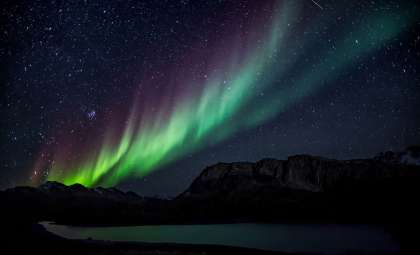
This extraordinary event, termed the polar rain aurora, was seen from Earth’s surface for the first time, casting a vast, gentle green light across the horizon.
Identification and Features
The polar rain aurora exhibited an even, steady green glow extending approximately 4,000 kilometers (2,485 miles) across the northern polar region. Unlike typical auroras that fluctuate in color and shape, this one remained constant and smooth, producing a calm but mysterious display. Traditionally, auroras are dynamic, with shifting patterns and vibrant hues.

Typically, charged particles from the sun interact with Earth’s magnetosphere and funnel towards the poles, creating auroras with changing visual patterns. However, the event on Christmas night was notably different—spanning a massive area yet maintaining a featureless, uniform green light that held steady across the sky.
A collaborative investigation by scientists at the University of Electro-Communications in Tokyo and the U.S. Defense Meteorological Satellite Program (DMSP) fleet analyzed this unusual occurrence.
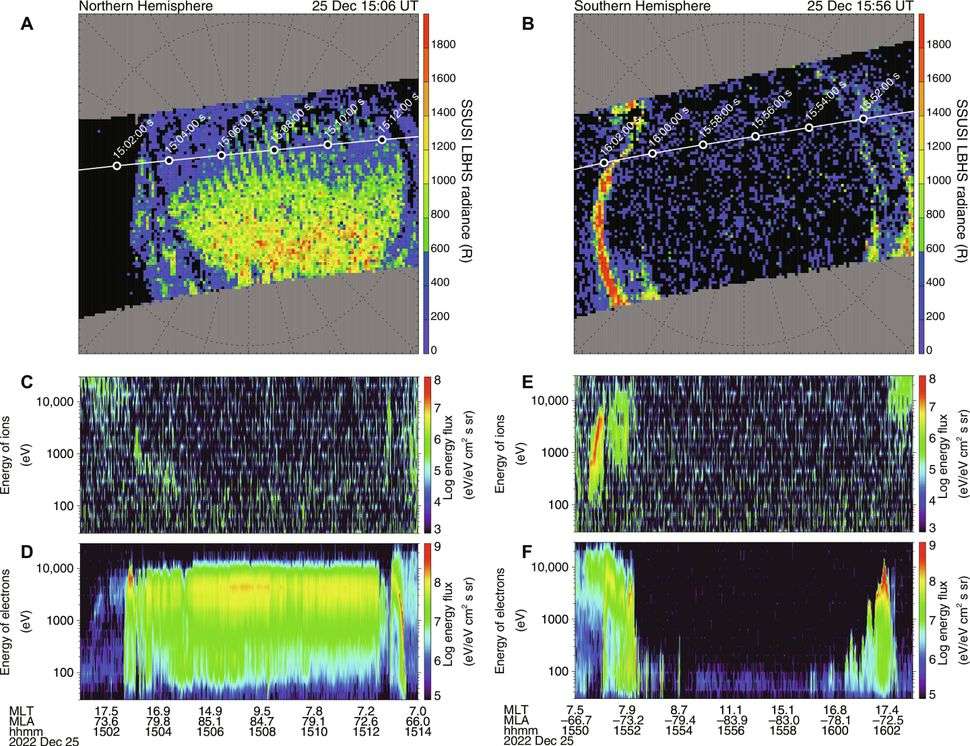
Captured by an All-Sky Electron Multiplying Charge-Coupled Device (EMCCD) camera in Longyearbyen, Norway, this aurora was linked to a deluge of energetic electrons coming directly from the sun, a phenomenon previously detectable only from orbit.
The researchers estimate that the electron flow emerging from a solar coronal hole extended roughly 7,500 kilometers (4,600 miles) across Earth’s sky, explaining the extraordinary breadth of this auroral event. “This vast and smooth form distinctly differs from known polar cap auroras,” stated the scientists. “It represents an aurora type not previously classified at polar latitudes.”
Mechanism Behind the Polar Rain Aurora
The even aurora arose under conditions where the solar wind—a continuous stream of ionized particles from the sun—dropped almost entirely, creating tranquil space weather around Earth. Coincidentally, a coronal hole had opened on the sun, providing a direct escape pathway for high-energy electrons.
These electrons streamed freely from the coronal hole without disruption by the solar wind. Usually scattered by turbulent solar winds, these particles gently cascaded over the North Pole in a steady downpour, resulting in a distinctive flat auroral glow.
Traveling along open magnetic field lines, the electrons linked with Earth’s magnetosphere above the Arctic region. The absence of solar wind turbulence allowed the electrons to reach the polar cap unimpeded, generating a vast and uniform light display.
Lead author Keisuke Hosokawa explained, “When solar wind pressure dropped, high-energy electrons above 1keV were detected by the DMSP satellites, producing this bright, green polar rain aurora visible from the ground.”
With the polar rain aurora, electrons streamed along solar magnetic flux tubes connecting smoothly to Earth’s north magnetic pole, bypassing the magnetotail where particles usually become trapped.
Under normal circumstances, the usual polar wind particles scatter these fast electrons from the coronal hole, preventing such steady precipitation. But here, the solar wind's pressure decline allowed the electrons to penetrate directly to Earth's magnetic poles.
The magnetic funnel through which these electrons traveled spans about 7,500 km (4,600 miles) at Earth's distance from the sun, accounting for the aurora’s unusually smooth appearance as the sun's magnetic flux tubes enveloped a larger region than Earth’s polar cap.
Because the electrons possessed high energy, the aurora emitted pure green light, as ionization of oxygen at lower altitudes requires more energy for red emissions. Satellite observations confirmed the aurora’s restriction to Earth’s sun-facing north magnetic pole during the winter season.
Significance and Prospects for Further Study
Capturing the polar rain aurora from the ground enhances understanding of how energetic electrons behave and interact with Earth’s magnetic environment. This rare event sheds light on the intricacies of space weather and underscores the value of ongoing environmental monitoring.
Published in Science Advances, the study details the specific solar-terrestrial conditions that caused this auroral rarity, emphasizing the necessity for more data to evaluate the broader effects of such phenomena on Earth’s near-space conditions.
Coupling observations from terrestrial cameras and orbiting satellites, researchers established that this distinctive aurora originated from suprathermal electrons streaming directly out of the Sun, a process known as “polar rain.” While satellite instruments have sporadically recorded polar rain, ground-based reports have been nonexistent until now.
Such smooth auroras usually go unnoticed by the naked eye. Until this event on Christmas 2022, their true nature and visual characteristics remained a mystery.
- Categories:
- Astronomy ,
- News ,
- Space ,
- Physics







0 comments
Sign in to Comment