
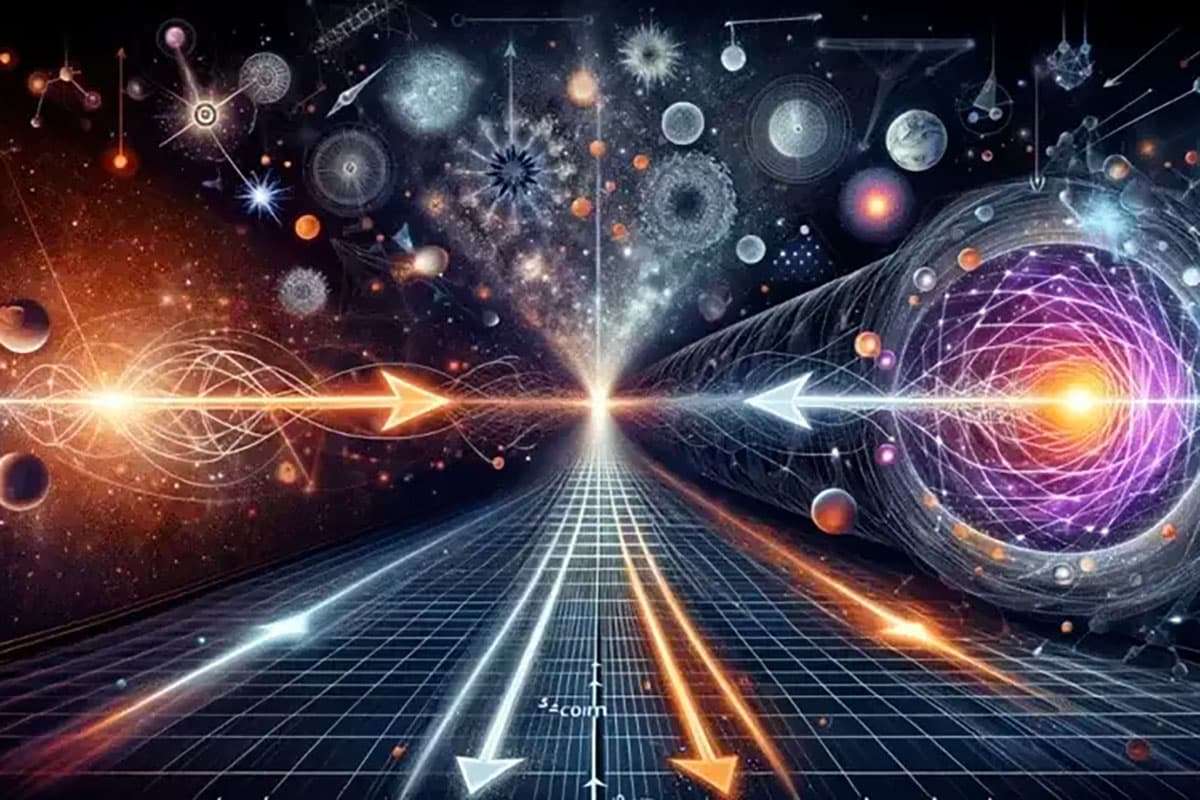
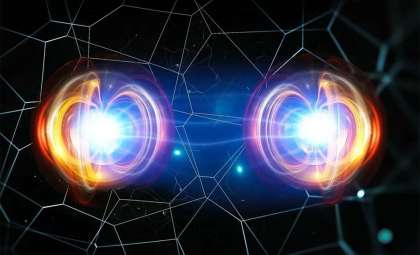
Central to this innovative hypothesis is the idea of quantum entanglement, a perplexing phenomenon that has intrigued scientists for decades. This enigmatic link between particles across immense distances could be crucial to unraveling the true essence of time.
Alessandro Coppo, a physicist from Italy’s National Research Council and the study's principal investigator, states, “The synchronization between the clock and the system triggers the emergence of time, which is fundamental to our existence.” This viewpoint implies that time does not exist as an independent entity, but instead arises from quantum-level interactions.
Utilizing the Page and Wootters framework, a concept introduced in 1983, the team examined two entangled quantum systems:

- A harmonic oscillator exhibiting vibrations
- A set of minuscule magnets functioning as a clock
The results showed precise consistency with the Schrödinger equation, which governs quantum state evolution. Interestingly, rather than relying on conventional time, the equation’s progression was based on the states of the tiny magnetic system.
Connecting Quantum Theory with Einstein’s Relativity
The persistent mismatch between quantum mechanics and Einstein’s general relativity remains a significant obstacle in unifying physics theories. This recent work offers a fresh approach to resolving the conundrum of time by addressing the contradictions between these two pillars of science.
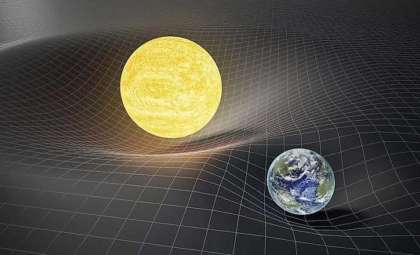
In quantum theory, time is treated as a constant, unidirectional flow from past toward future. By contrast, general relativity portrays time as interwoven with spatial dimensions, susceptible to warping under extreme gravitational forces. The emerging theory proposes that time arises from quantum entanglement, potentially harmonizing these disparate views.
To clarify the contrasts, consider this comparison:
New Insights into Reality From Quantum to Classical Scales
The team extended their analysis to everyday-sized objects, discovering that the complex quantum equations simplified into those familiar from classical physics. This indicates that the sensation of time’s passage may stem from entanglement effects even in large systems.
Coppo highlights the importance of this reversal in approach: “Our conviction is that beginning with quantum mechanics and progressing toward classical physics is the logical path, not vice versa.” This shift could drastically reshape how we understand the fabric of reality, linking the microscopic quantum world to macroscopic experience.
Nevertheless, some experts advise prudence. Vlatko Vedral, an Oxford-based professor specializing in quantum information science, cautions that although the mathematics are sound, proving practical effects remains an open challenge. Crafting empirical tests will be crucial to confirm the theory.
Reevaluating Our Cosmic Perspective
Exploring the idea that time might be an illusion prompts us to rethink how we perceive existence itself. Adam Frank, a theoretical physicist from the University of Rochester, suggests that a deeper comprehension of time may depend on adopting an internal viewpoint, concentrating on how consciousness perceives the unfolding universe.
This pioneering framework paves the way for future investigations, including:
- Creating experimental setups to verify the Page and Wootters mechanism
- Studying entanglement’s influence on larger, classical systems
- Testing potential adjustments in quantum and gravitational theories
- Delving into philosophical questions about time as a derived concept
As research progresses, we stand at the edge of a major paradigm shift in physics. Viewing time as an illusion rooted in the quantum interplay of particles challenges deeply held beliefs about reality. While extensive exploration lies ahead, this novel study offers a glimpse into a worldview where time emerges from the intricate quantum interactions that form the universe.
- Categories:
- Physics






0 comments
Sign in to Comment