
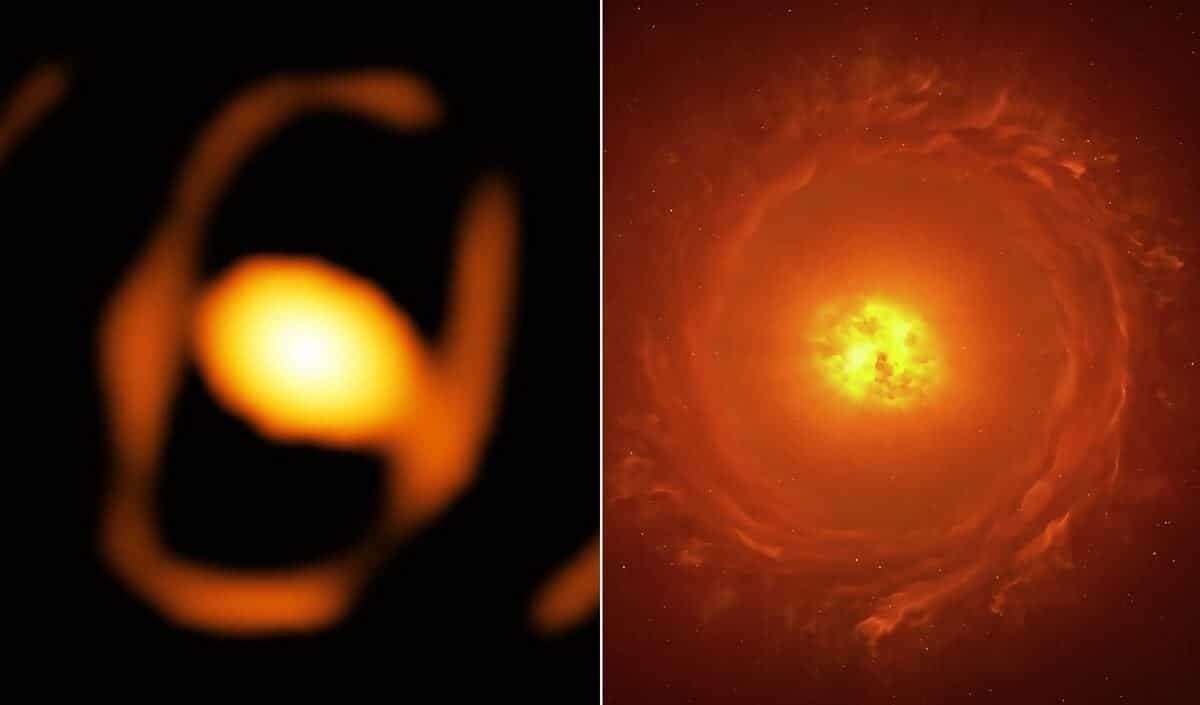
Located in the Large Magellanic Cloud—a neighboring galaxy orbiting the Milky Way roughly 160,000 light-years away—lies the enormous red supergiant star known as WOH G64. This stellar giant measures about 2,000 times the size of our Sun, ranking among the largest stars ever documented by astronomers.
The stunning image was captured using the cutting-edge interferometric capabilities of the Very Large Telescope operated by the European Southern Observatory. This advanced technology, previously responsible for imaging the first-ever black hole and the supermassive black hole at our galaxy’s core, has now revealed extraordinary details of a star in another galaxy.
The visual showcases WOH G64 surrounded by an elongated and asymmetrical envelope of gas and dust. Scientists believe this distinctive halo is connected to the star’s final evolutionary phases, with its irregular form possibly shaped by gravitational forces from a companion star yet to be discovered.

Innovative Technology: The GRAVITY Instrument
The groundbreaking image owes its existence to the GRAVITY instrument, which synthesizes light from four 8-meter telescopes to simulate an immense 130-meter telescope. This fusion allows astronomers to examine distant celestial objects with unparalleled clarity.
GRAVITY’s capabilities continue to impress the scientific community, and planned enhancements through the GRAVITY+ upgrade promise access to fainter and more remote stars with unprecedented precision.
This achievement complements other recent milestones in astronomy, such as the James Webb Telescope’s revelation of a supermassive black hole consuming material from its host galaxy, broadening our cosmic perspective.
Expanding the Frontiers of Astrophysics
The detailed image of WOH G64 paves the way for deeper investigations into stellar behavior beyond our galaxy. This breakthrough could significantly enhance our understanding of star development and demise, potentially revising prevailing theories about cosmic evolution.
Over the past decade, astronomers have noted a significant dimming of WOH G64, likely due to the emergence of hot dust clouds near the star that obscure its light. Such phenomena offer critical insights into the lifecycle of massive stars and their environmental effects.
Studying individual stars in other galaxies opens doors to:
- Advanced comprehension of how galaxies grow and change
- Refined models explaining star lifespans and transformations
- Improved knowledge of the origins of heavy elements
- New clues about conditions in the early universe
Moreover, this advancement sets a foundation for future discoveries, including detecting brown dwarf objects outside the Milky Way, paralleling recent successes of the James Webb Space Telescope.
Looking Ahead: Exploring the Potential for Life Beyond Earth
As observation techniques grow more sophisticated, the prospect of identifying extraterrestrial life becomes increasingly feasible. Although the hostile environment of WOH G64 is unlikely to support life, the same imaging technologies might soon allow the study of more Earth-like exoplanets in distant galaxies.
Being able to scrutinize single stars in remote galaxies enriches our understanding of the vast diversity of stellar systems, a crucial step in locating habitable zones and targeting the search for alien life.
Continued innovations in space observation—including remarkable observations of solar storms—drive scientific discovery forward and inspire wonder about the limitless mysteries beyond our world.
Each step forward in astronomical imaging enriches our grasp of the universe’s secrets. The vivid capture of WOH G64 exemplifies human curiosity and technological prowess in exploring the cosmos.
- Categories:
- Astronomy





0 comments
Sign in to Comment