

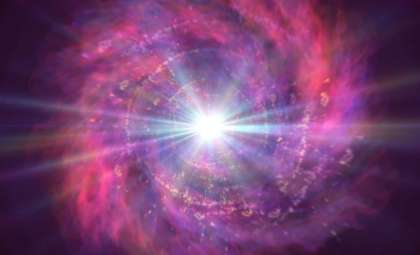
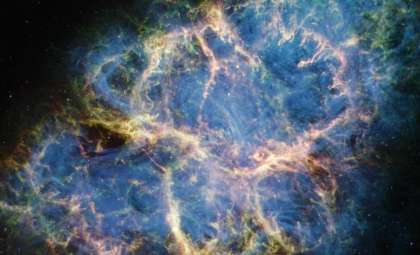
Scientists have turned their attention to the remnants of a stellar explosion located in the Large Magellanic Cloud (LMC), a nearby satellite galaxy of the Milky Way.
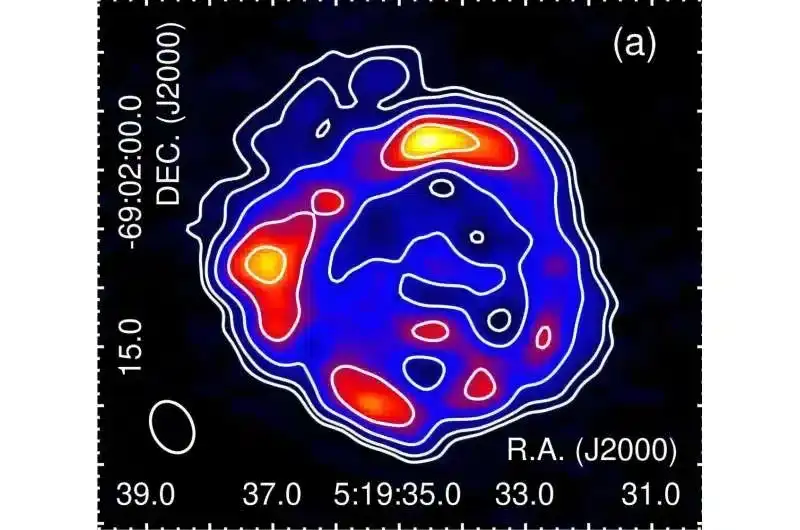
By combining high-definition imaging from Hubble with data from instruments like NASA’s Chandra X-ray Observatory, researchers have advanced in understanding the enigmatic supernova remnant MC SNR J0519–6902.
Decoding a Supernova Enigma in the LMC
The supernova remnant known as MC SNR J0519–6902, discovered back in 1981, has long fascinated astronomers.
Measuring an enormous 26 light-years across, this remnant’s size is so vast that it could encompass our entire solar system nearly nine times over.
Despite extensive study, the exact nature of the explosion behind this structure has remained elusive. Yet, recent observations have brought new insights that could clarify this cosmic mystery.
Fresh, high-resolution Hubble images have revealed subtle features unnoticed before, including a faint formation along the remnant’s northeast edge.
Additionally, astronomers detected a nearby cloud of atomic hydrogen that might be connected to the explosion.

The Catastrophic End of a White Dwarf
The leading theory points to a white dwarf star as the origin of MC SNR J0519–6902. White dwarfs are dense stellar cores left after stars about the same size as our Sun exhaust their fuel.
Once the hydrogen supply is depleted, nuclear fusion halts, causing the core to collapse under its own gravity while outer layers are expelled into space.
While most white dwarfs simply cool down after this phase, in binary systems they can accumulate material from a companion star.
This mass gain can push the white dwarf to a limit where it triggers a violent detonation known as a Type Ia supernova. Another possibility is the merger of two white dwarfs, which can also provoke an explosive event.
Scientists believe such a process led to MC SNR J0519–6902, although pinpointing the exact mechanism remains ongoing research.
“Which of these scenarios caused this specific explosion is still uncertain,” stated Rami Alsaberi from Gifu University, who leads the research team.
Revealing New Insights Through Observations
Recent studies of MC SNR J0519–6902 have uncovered compelling details.
Notably, the remnant’s light exhibits strong polarization, indicating it shares characteristics with other young supernova remnants both in the Milky Way and the LMC.
These findings suggest the remnant is approximately 2,000 years old, positioning it at a critical stage of its development.
At this point, MC SNR J0519–6902 is in the so-called "Sedov-Taylor phase."
During this phase, the supernova’s shock wave slows down and interacts with the surrounding gas and dust.
This transition is vital, marking the point where the remnant changes from a rapidly expanding explosion to a more complex structure sweeping up nearby material.
Future Directions in Research
Although these revelations are significant, much about MC SNR J0519–6902 remains unknown. A primary question is which of the two possible scenarios initiated the white dwarf’s detonation.
To address this, astronomers aim to utilize the Australian Square Kilometre Array Pathfinder (ASKAP) telescope. The detailed atomic hydrogen maps from ASKAP will help verify whether the detected hydrogen cloud is indeed related to the remnant.
Ongoing investigations like this are essential for deepening our understanding of white dwarf evolution and their influence on galactic development.
- Categories:
- Space







0 comments
Sign in to Comment