
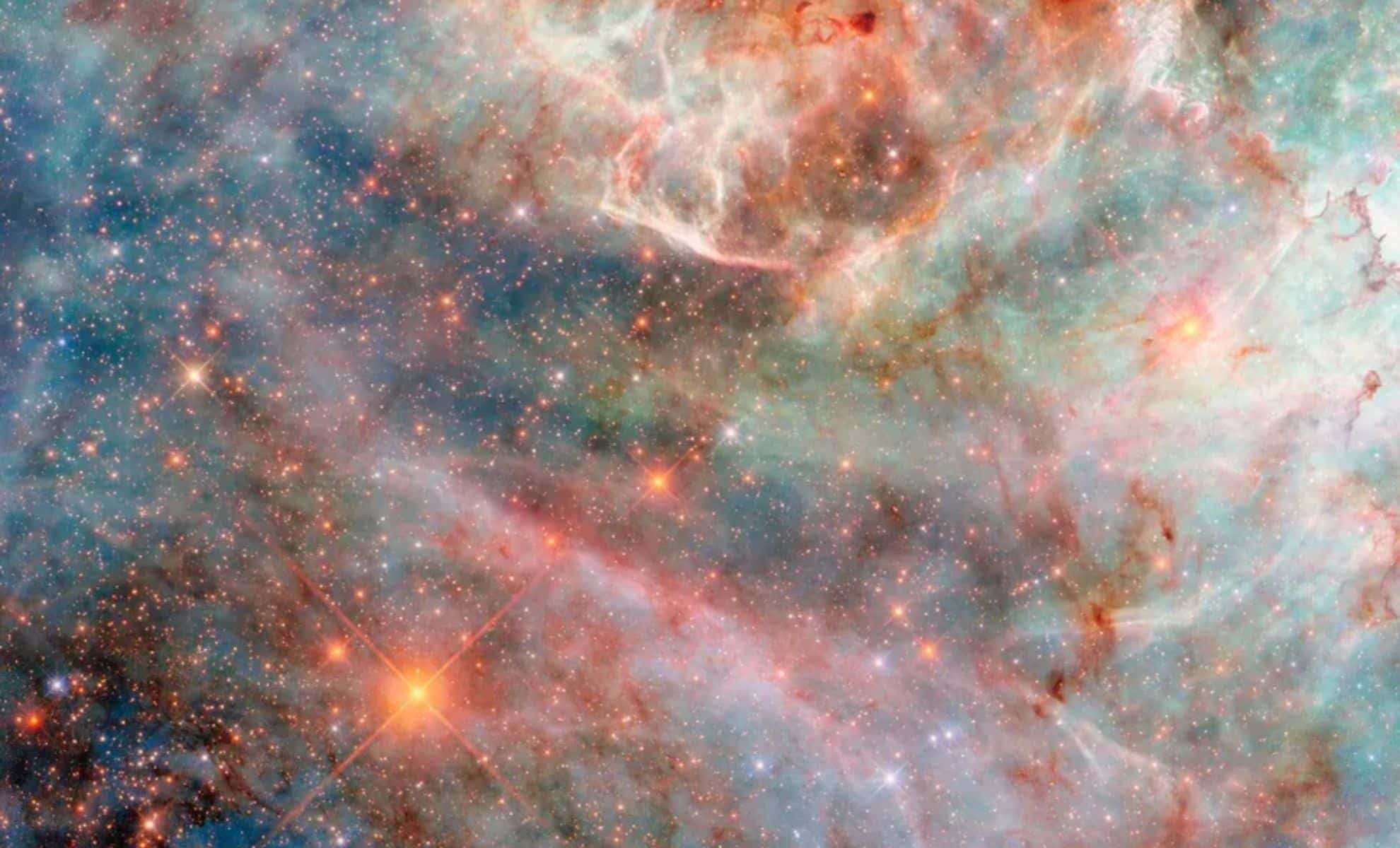
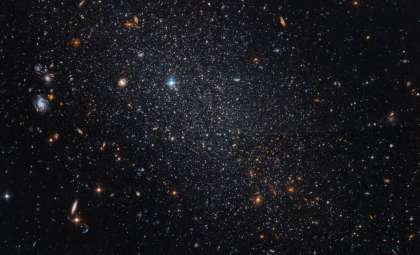
The Hubble Space Telescope recently captured a mesmerizing image from the Large Magellanic Cloud (LMC), enchanting astronomers and space enthusiasts worldwide. Released on May 12, 2025 and highlighted by LiveScience in its weekly space photo spotlight, this vivid snapshot presents ethereal, fluffy shapes reminiscent of cotton candy. The breathtaking view of this galaxy—situated roughly 160,000 light-years away—was created using Hubble’s Wide Field Camera 3, which combines ultraviolet and infrared wavelengths to reveal intricate details.
An Active Galactic Neighbor in Our Cosmic Backyard
The Large Magellanic Cloud, a notable satellite of the Milky Way, is visible exclusively from the Southern Hemisphere, mainly within the Dorado and Mensa constellations. Although classified as a dwarf galaxy, it is a hotbed of stellar formation, housing dense clusters of stars and vibrant regions brimming with newborn stars. Hubble’s multi-filter approach, employing five unique light filters, unveils elements invisible to the human eye. The resulting image is a kaleidoscope of swirling gas, glowing dust, and young stars highlighted in vivid shades of orange, blue, and pink. This visual marvel also provides detailed astrophysical data on the galaxy’s structure and the processes guiding its evolution.
Seeing Beyond Visible Light with Hubble
Hubble’s superior technology surpasses what conventional telescopes and naked-eye observations can achieve by capturing ultraviolet and infrared light. These wavelengths are essential to understanding star formation cycles. The delicate, cotton candy-like wisps in this image are vast clouds of interstellar gas and dust illuminated and shaped by stellar radiation and winds. These regions are stellar nurseries, where new stars take shape, turning this section of the LMC into a rich field for studying galactic evolution. The fine detail also sheds light on how elements disperse within galaxies, nurturing stars and the potential for planetary development.

Implications for the Milky Way’s Future
Though distant, the LMC plays a vital role in shaping the Milky Way’s trajectory. Models suggest the LMC is gradually moving closer to our galaxy, with interactions expected to initiate in roughly 2.4 billion years. While the Milky Way is already on track for a colossal collision with the Andromeda Galaxy in about 10 billion years, the LMC’s gravitational effects might accelerate or alter these cosmic events. Research indicates that the LMC could provoke disturbances in the Milky Way’s spiral arms or spark new bursts of star formation through gravitational forces.
Magellanic Companions Illuminate Galactic Evolution
The Large Magellanic Cloud travels alongside its counterpart, the Small Magellanic Cloud (SMC), another companion galaxy visible in the Southern Hemisphere during the months of October through February. These two galaxies are linked by an expansive gas bridge called the Magellanic Bridge, evidencing their prolonged interaction. Studies suggest the SMC is experiencing tidal disruption, possibly revealing it as a merger of two smaller galaxies being torn apart by tidal forces. These interactions provide astronomers with a natural laboratory for understanding how galaxy mergers and collisions sculpt the universe over billions of years.
- Categories:
- News







0 comments
Sign in to Comment