
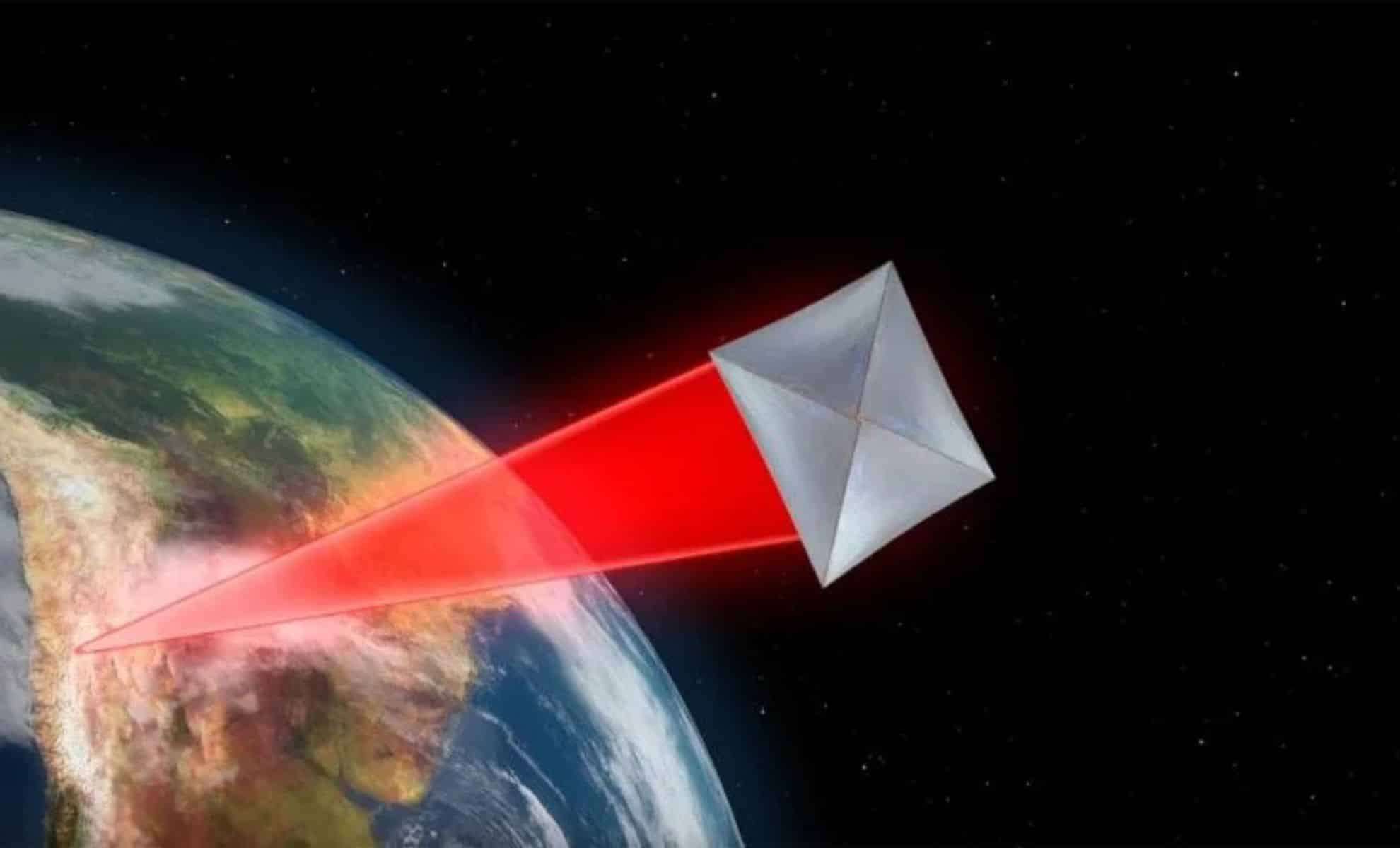
For generations, progress in space exploration has been constrained by the limitations of traditional rocket engines, which depend heavily on chemical fuels. While these engines have powered remarkable feats—such as manned lunar landings and sending probes into deep space—their fuel requirements make interstellar voyages daunting and impractical. Imagine instead propelling spacecraft across the cosmos at unprecedented velocities without carrying conventional fuel.
What once seemed purely fantastical is moving toward feasibility through pioneering investigations into laser-driven lightsails. Researchers at Caltech are developing exceedingly thin, laser-propelled membranes capable of accelerating miniature spacecraft to speeds approaching significant fractions of light speed. Achieving this could revolutionize space travel timelines, potentially enabling humanity’s first missions beyond our solar system within a few decades.
Principles Behind Laser-Driven Lightsails
Unlike chemical rockets or ion engines, lightsails harness the momentum of laser light to generate thrust. By aiming intense laser beams onto an ultra-light reflective sail, scientists aim to push small probes at extraordinary velocities. This technique removes the need for bulky fuel, opening the door to vastly faster travel across interstellar distances.

Leading these efforts is Caltech physicist Harry Atwater, who focuses on how these delicate sails respond to light forces. Atwater states, “These lightsails could outperform every spacecraft before them, potentially enabling direct exploration of interstellar space, which until now has been accessible only via telescopes and remote sensing.”
This technology holds the promise of reaching Alpha Centauri—the nearest star system—in roughly 20 years, a feat unattainable by current spacecraft which would require millennia. Such rapid missions may allow close-up studies of exoplanets, the search for alien life forms, and direct investigation of interstellar medium phenomena.
Overcoming Challenges in Lightsail Creation
Although laser-propelled lightsails represent a revolutionary breakthrough, creating durable and operational sails is extremely challenging. The sails must be incredibly lightweight and thin but also tough enough to endure powerful radiation pressures without damage or distortion. Additionally, the sail must maintain a stable trajectory when illuminated by a focused laser beam.
Atwater explains, “Developing a membrane for use as a lightsail requires it to withstand thermal load, preserve shape under intense pressure, and remain centered within a laser beam to avoid tumbling.”
A significant hurdle lies in understanding material responses under extreme conditions, necessitating precise experimental study of forces exerted during laser interaction. Atwater’s team has developed innovative approaches to investigate these dynamics.
“Before we can construct functional sails, we have to quantify how materials react to laser radiation pressure,” Atwater notes. “We discovered it’s possible to measure the minute forces on membranes by tracking their subtle movements.”
Advancements in Testing Lightsail Mechanics
To explore lightsail behavior, the researchers devised a scaled-down test apparatus in the laboratory. They fabricated a silicon nitride membrane only 50 nanometers thick, suspending it inside a vacuum chamber to mimic space conditions. This tiny lightsail, likened to a microscopic trampoline, was exposed to an intense argon laser beam to observe how radiation pressure affected its motion.
A pivotal achievement was the creation of an ultra-sensitive interferometer capable of detecting displacements as tiny as one trillionth of a meter. This allowed precise separation of radiation pressure effects from confounding variables like thermal expansion and environmental vibrations.
“This represents a crucial step toward controlling optical forces and torques needed for a lightsail to accelerate freely on a laser beam,” says Caltech physicist Ramon Gao, a key contributor to the project.
The Road Ahead for Laser-Propelled Missions
These promising experimental results mark significant progress towards practical lightsails. The continuing phases of development will include:
- Increasing sail dimensions to sizes suitable for space launches.
- Assessing performance in diverse environments, including microgravity settings.
- Optimizing the design to ensure stability during high-powered laser propulsion.
- Investigating nanotech materials to enhance heat resistance and durability.
The ultimate ambition is to engineer a 10-square-meter sail that can be propelled by a ground-based laser array, enabling spacecraft to reach distant solar system targets at unprecedented speeds—arriving at Jupiter within days and Pluto in mere weeks.
Heralding a New Chapter in Exploration
Though challenges remain, advancements in laser propulsion technology are ushering in a transformative phase of space exploration. Deploying compact, lightweight probes propelled by laser sails may redefine how humanity probes the cosmos, unlocking frontiers previously deemed unreachable.
As innovations in nanotechnology, photonics, and aerospace engineering evolve, the prospect of interstellar exploration draws ever nearer. The day may soon come when vessels journey beyond our solar system powered solely by beams of light, rather than traditional rockets.
This article has been republished from the following materials. Note: material may have been edited for length and content. For further information, please contact the cited source.
- Categories:
- News










0 comments
Sign in to Comment