
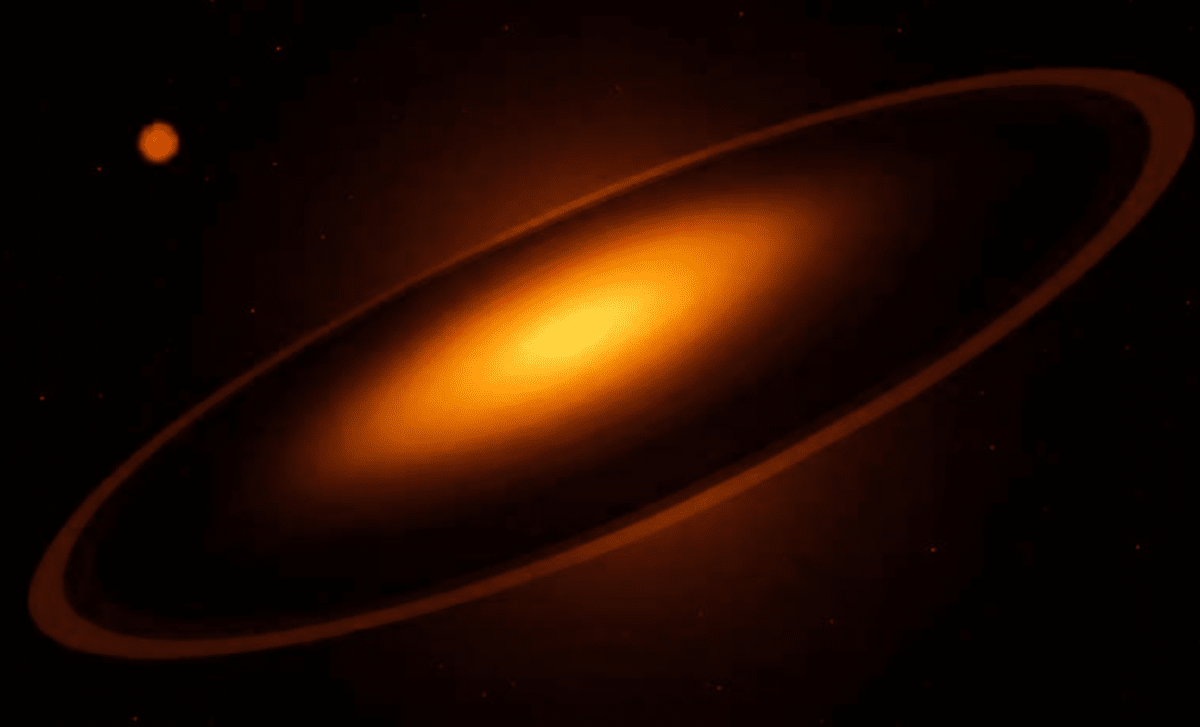
A fresh study published in Monthly Notices of the Royal Astronomical Society presents a captivating explanation for one of the most prolonged and peculiar stellar brightness drops recorded. Scientists have attributed the extended fading of the star ASASSN-24fw to the presence of an unseen brown dwarf or a super-Jupiter planet surrounded by an immense, disc-like ring system. This finding, which has intrigued astronomers globally, could significantly advance our knowledge of planetary arrangements and their intricate frameworks far beyond our solar neighborhood.
Unveiling the Phenomenon That Drew Astronomers’ Attention
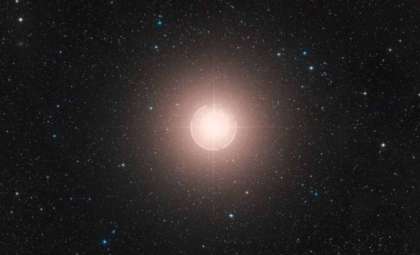
ASASSN-24fw, positioned some 3,200 light-years away in the Monoceros constellation, was known for its stable luminosity over the years. Yet, in late 2024, astronomers witnessed a remarkable event. The star’s brightness plunged by nearly 97%, an extraordinary dimming lasting over nine months—far exceeding the typical few days or weeks seen in similar stellar fade-outs.
Initially, the dimming’s gradual onset prompted hypotheses including dust obscuration or planetary eclipses. However, the extended duration suggested a more exotic cause. The turning point arrived when an international team led by Dr. Sarang Shah of the Inter-University Centre for Astronomy and Astrophysics (IUCAA) hypothesized the culprit was either a brown dwarf or super-Jupiter boasting a vast ring system, usually difficult to detect. Their results published in Monthly Notices of the Royal Astronomical Society offer a compelling model grounded in observations.

Understanding Brown Dwarfs and Super-Jupiters
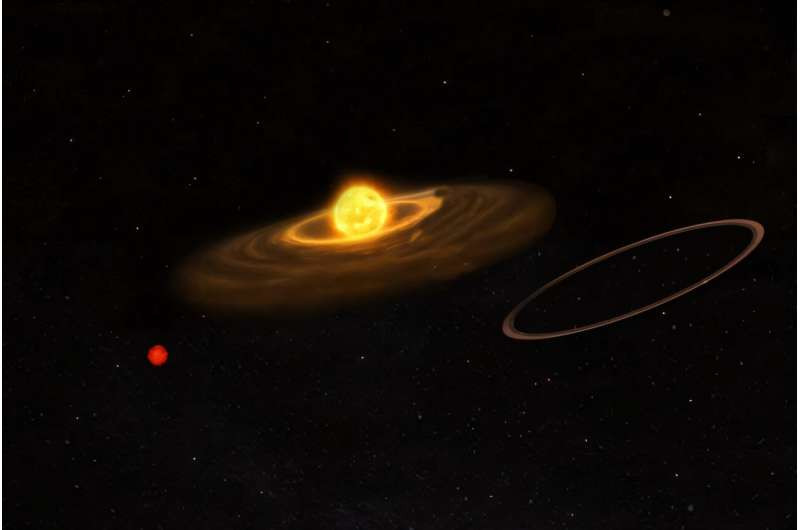
Brown dwarfs occupy a niche between stars and planets, being larger than planets but lacking sufficient mass to ignite fusion, preventing them from becoming true stars. In this context, researchers suggest that a brown dwarf with an expansive, dense ring spanning roughly 0.17 astronomical units—about half the Sun-Mercury distance—crossed ASASSN-24fw’s line of sight, causing the dramatic dimming.
Dr. Shah detailed their proposal, stating,
“Various models made by our group show that the most likely explanation for the dimming is a brown dwarf—an object heavier than a planet but lighter than a star—surrounded by a vast and dense ring system. It is orbiting the star at a farther distance with the ring.”
The gradual initial dimming is attributed to the sparse outer edges of the ring, which grew more pronounced as denser regions moved before the star.
Why Extended Dimming Events Are So Rare
Long-lasting stellar dimming phenomena like the one involving ASASSN-24fw are exceedingly rare, largely due to the precise alignment necessary between star and obscuring body. Dr. Shah noted, “Long-lasting dimming events like this are exceptionally uncommon as they require very perfect line-ups.” Because of this, capturing such an event in real-time is unusual, and the event’s length provided a unique chance to gather extensive data, enriching understanding of star-companion dynamics.
The investigation not only revealed the ring system’s role but also offered insights into how such bewildering ring structures might develop around other stars. The massive rings orbiting the brown dwarf likely interacted with ASASSN-24fw in a manner that triggered this prolonged dimming, providing vital clues to the evolutionary mechanisms shaping planetary system architectures.
Unexpected Find: A Nearby Red Dwarf Companion
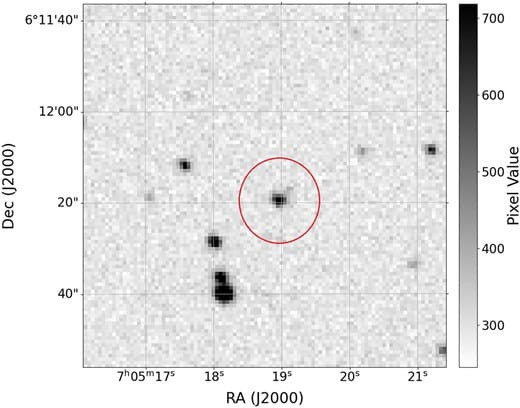
During their investigation, researchers stumbled upon an additional surprise. Dr. Jonathan Marshall, an independent postdoctoral scholar linked with Academia Sinica in Taiwan, observed that the study also uncovered a nearby red dwarf close to ASASSN-24fw. He shared,
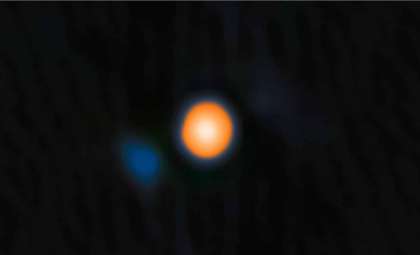
“This rare event allows us to study such a complex system in remarkable detail. In fact, while studying this dimming, we also serendipitously discovered that ASASSN-24fw also has a red dwarf star in its vicinity.”
Red dwarfs are among the most abundant stars in the cosmos but are difficult to analyze due to their dimness. The proximity of this red dwarf adds complexity to the system’s dynamics and could affect ASASSN-24fw’s observed behavior and its surrounding objects.
- Categories:
- News








0 comments
Sign in to Comment