

The distinctive landscape and three-axis shape of Mars have intrigued researchers for decades. Michael Efroimsky from the U.S. Naval Observatory proposes that these characteristics may be the legacy of a sizable moon, called Nerio, that once orbited Mars and influenced its geological development.
The Enigma of Mars’s Three-Axis Geometry
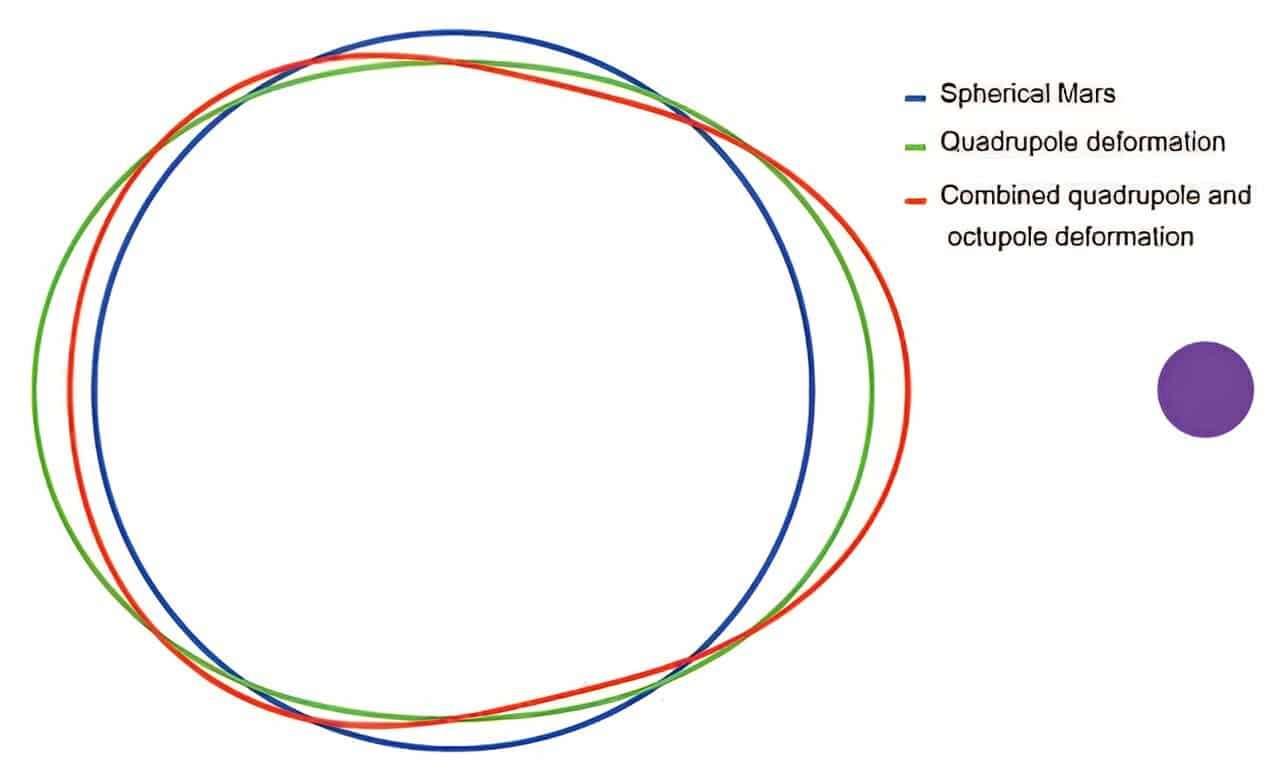
Mars stands out among planets due to its triaxial geometry, where its measurements differ along three principal axes, unlike the common oblate spheroid shape seen in planets such as Earth. The origin of this three-dimensional asymmetry has remained a scientific puzzle. According to the Nerio hypothesis, during Mars’s early molten phase, the gravitational force exerted by a large moon could have permanently reshaped the planet’s surface structure.
As the Red Planet solidified, the tidal interaction might have produced prominent surface elevations. A notable example is the Tharsis bulge, a vast elevated region extending roughly 5,000 kilometers near the equator. This area hosts colossal volcanoes, including Olympus Mons, the tallest known mountain in the solar system. Across from Tharsis, another elevated region exists, indicating that these two features may share a common genesis. Efroimsky’s model proposes that Nerio’s gravity locked these topographical features in place as Mars’s crust cooled and hardened.

How Nerio May Have Affected Volcanism and Tectonics
The Martian surface is not only marked by large bulges but also by extensive volcanic activity, sculpting much of its terrain. The towering shield volcanoes in the Tharsis region, including Olympus Mons, likely owe their origins to volcanic processes that may have been intensified by the planet’s unique shape. Efroimsky suggests that Nerio’s gravitational pull generated ongoing stress on Mars’s crust, promoting magma movement and encouraging volcanic formation.
These gravitational dynamics might also clarify the development of Mars’s highland regions, such as Terra Sabaea, located opposite the Tharsis bulge. During Mars’s formative years, Nerio’s influence could have concentrated volcanic and tectonic activity in specific zones, reinforcing these elevated landforms.
The Mysterious Demise of Nerio
Although the theory presents a convincing picture of Nerio’s impact, its ultimate fate remains uncertain. Efroimsky theorizes that Nerio either was ejected from orbit after gravitational interactions with another object or destroyed by a high-energy collision with an asteroid or proto-planetary body. Should Nerio have been shattered, the remnants may have contributed to the origin of Mars’s current small moons, Phobos and Deimos.
However, the absence of definitive physical evidence—such as a chain of impact craters aligned with Nerio’s former orbit—poses a challenge to validating this idea. Despite this, the notion aligns with the early solar system’s turbulent history, during which such events were likely common.
The Road Ahead: Testing the Lunar Hypothesis
Like all scientific ideas, Efroimsky’s hypothesis demands further investigation to be confirmed or disproven. If validated, it could significantly deepen our knowledge of Mars’s geological evolution. Current efforts involve detailed geological analyses and advanced simulations to understand how a moon of Nerio’s magnitude might have altered the Red Planet.
Though Nerio’s direct traces are elusive, this proposition invites new perspectives on planetary formation. Comparable events might have shaped other planets and their moons across the solar system, phenomena that we are just beginning to grasp. Ongoing missions to Mars and its satellites, along with further geological research, may eventually unlock the secrets behind Mars’s distinct profile.
- Categories:
- Astronomy ,
- News ,
- Space






0 comments
Sign in to Comment