

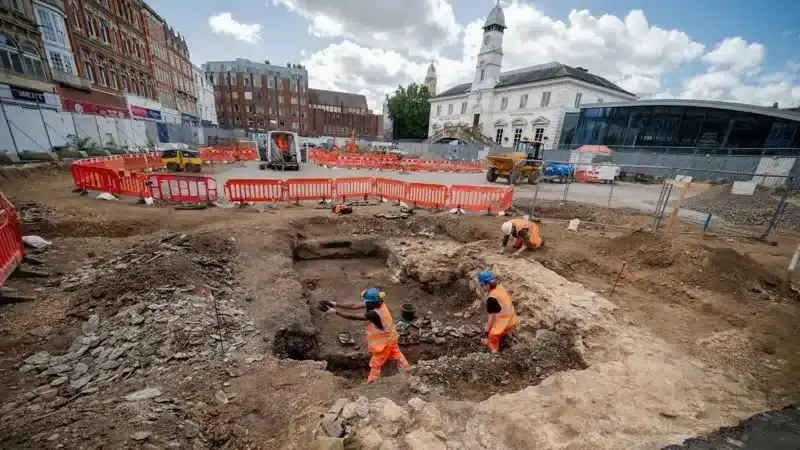
In Leicester, England, archaeologists have uncovered the remains of a medieval dungeon underneath the city's bustling Market Place during a routine dig. Led by the University of Leicester Archaeological Services, this excavation is part of a larger urban redevelopment initiative. The site has exposed traces of over 2,000 years of human settlement, transforming what began as groundwork for city improvements into one of Leicester’s most remarkable archaeological projects in years.
A Hidden Prison Beneath The Marketplace
The central feature of the find is the rediscovery of the Gainsborough Chamber, a building recorded as early as 1533. This public venue was used for official events such as mayoral meetings, banquets, and court sessions. Period documents from the 1500s refer to its jail as “a most vile prison,” implying harsh incarceration conditions. Although the structure was dismantled around 1748, archaeologists have now located its foundational walls, uncovered a stone-lined well, and identified elements of the dungeon itself.
The team was caught off guard by this discovery despite Leicester being one of the UK’s most thoroughly examined archaeological sites. According to excavation head Gavin Speed, this neighborhood had remained largely untouched until now.

Revealing Centuries of Roman and Medieval Life
This excavation uncovered a remarkable sequence of 2,000 years of continuous human presence including two Roman-era buildings: an older wooden structure and a later stone building atop it. Artifacts such as Roman tesserae, pottery shards, ancient coins, and jewelry provide vivid insights into life during Roman Leicester.
Among the notable finds was the grave of a Roman infant, laid to rest carefully beneath the timber building’s floor. While a Roman footprint was expected given the site’s location at what was the city’s southeast corner in Roman times, the exceptional preservation and depth of materials surpassed initial predictions.
Additionally, the dig revealed a dense Anglo-Saxon soil layer that sheds light on the transitional period when communities lived within the ruins of Roman Leicester, a time not well documented until now.
Documenting Nearly Eight Centuries of Market Use
Stratified layers of gravel, silt, and resurfacing materials reveal an unbroken record of market activity spanning almost 800 years. The team has also uncovered post holes from medieval market stalls, offering valuable proof of Leicester's historical role as a commercial hub.
Lead archaeologist Gavin Speed likened the excavation to "cutting through an archaeological layer cake," highlighting the evolving nature of the square through different eras. The discoveries illustrate how Leicester’s Market Place has continuously adapted to meet the changing demands of society—from medieval times up to today.
This find not only reaffirms Leicester’s legacy as a thriving trade center but also underscores how the city developed in successive layers, uniting Roman roots with medieval civic life. While modern patrons shop above, the rich history remains quietly preserved beneath their feet.
- Categories:
- News












0 comments
Sign in to Comment