
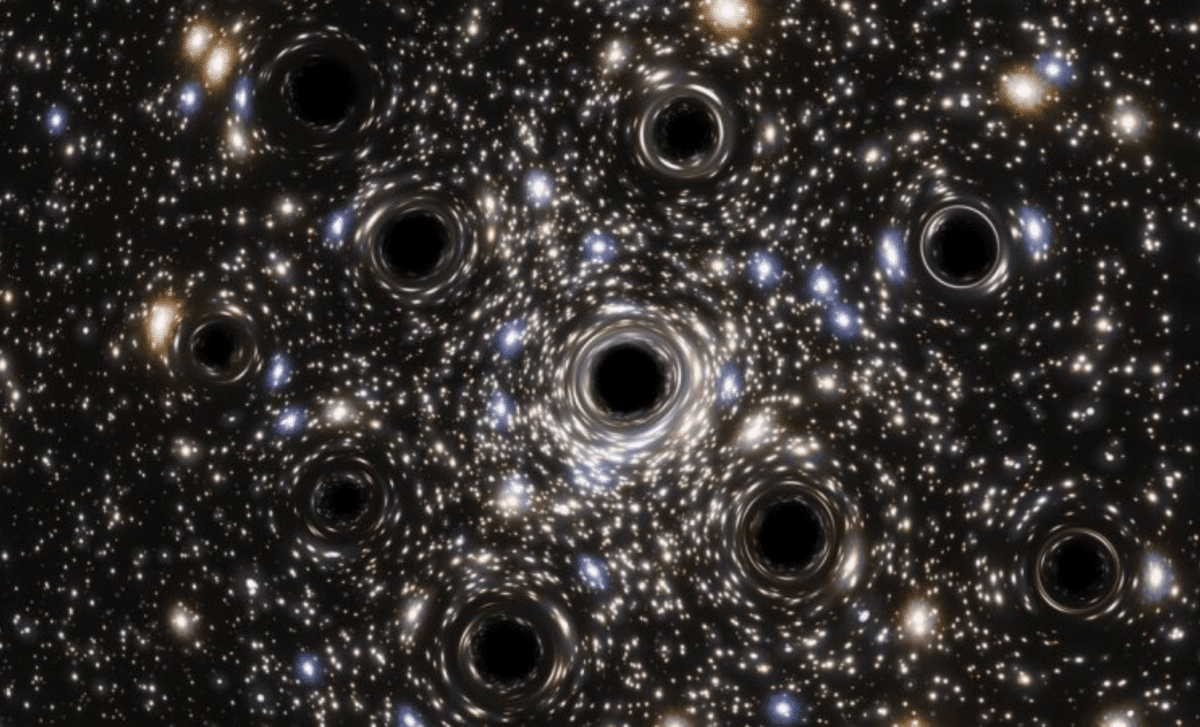
Deep within our galaxy, astronomers have uncovered an astonishing population of over 100 black holes embedded in the Palomar 5 stellar stream. Though their existence was hypothesized for years, it’s only with the precision mapping from the Gaia space observatory that the significant role these black holes play in galactic evolution has become clear. Published in Nature Astronomy, this discovery sheds light on black hole formation and their impact on star clusters.
Unraveling Stellar Stream Mysteries
Stellar streams are extended, faint trails of stars weaving through the Milky Way’s galaxy plane. These elusive features have long puzzled scientists since they appear only as subtle patterns across the sky. Gaia’s unprecedented astrometric data has accelerated the detection of these streams, including the Palomar 5 tidal stream revealed in 2021. The study, accessible in Nature Astronomy, indicated that the origins of such streams remain a subject of investigation.
“We do not know how these streams form, but one idea is that they are disrupted star clusters,” said astrophysicist Mark Gieles from the University of Barcelona in Spain. The hypothesis suggests these streams may be remnants from star clusters broken apart by gravitational influences. Gieles noted that no direct link has yet been established between newly found streams and star clusters, highlighting the need for further studies.

“So, to understand how these streams formed, we need to study one with a stellar system associated with it. Palomar 5 is the only case, making it a Rosetta Stone for understanding stream formation and that is why we studied it in detail.”
Palomar 5’s unique structure provides a rare chance to explore these cosmic phenomena comprehensively. Researchers utilized advanced N-body simulations to probe star interactions within the cluster and assess black holes’ contribution to the stream’s development.
Black Holes' Impact in Palomar 5’s Stream
The investigation reveals that black holes significantly influence the Palomar 5 tidal stream’s behavior. While initially hypothesized to exist in globular cluster cores, this research delivers compelling evidence of their prominent presence. Gieles and his team discovered the black hole count in Palomar 5 to exceed prior estimates substantially.
“The number of black holes is roughly three times larger than expected from the number of stars in the cluster, and it means that more than 20 percent of the total cluster mass is made up of black holes,” Gieles said.
These black holes, each possessing around 20 solar masses, originated from supernova remnants of massive stars during the cluster’s early years. Their gravitational influence drives stellar ejections into the tidal stream, offering an explanation for the cluster’s peculiar properties.
Understanding this mechanism is crucial to predicting the cluster’s destiny. In roughly a billion years, Palomar 5 is expected to dissipate, releasing its black holes into wider galactic orbits. This dispersal could escalate black hole mergers, presenting new opportunities to study their evolution and interactions.
Looking Ahead: Expanding the Hunt for Black Holes
The discovery’s significance stretches beyond Palomar 5. Investigations of star clusters rich in black holes may unlock answers about frequent black hole mergers. Astrophysicist Fabio Antonini from Cardiff University, UK, stated, “It is believed that a large fraction of binary black hole mergers form in star clusters.” This realization paves the way for innovative approaches to detect elusive binary black holes.
“A big unknown in this scenario is how many black holes there are in clusters, which is hard to constrain observationally because we cannot see black holes,” Antonini explained.
The study introduces a novel technique to estimate black hole populations by measuring the stars expelled from clusters through black holes’ gravitational forces. Such methods offer a revolutionary path to chart these hidden cosmic entities, enhancing our grasp of the universe’s dark constituents.
- Categories:
- Astronomy


0 comments
Sign in to Comment