
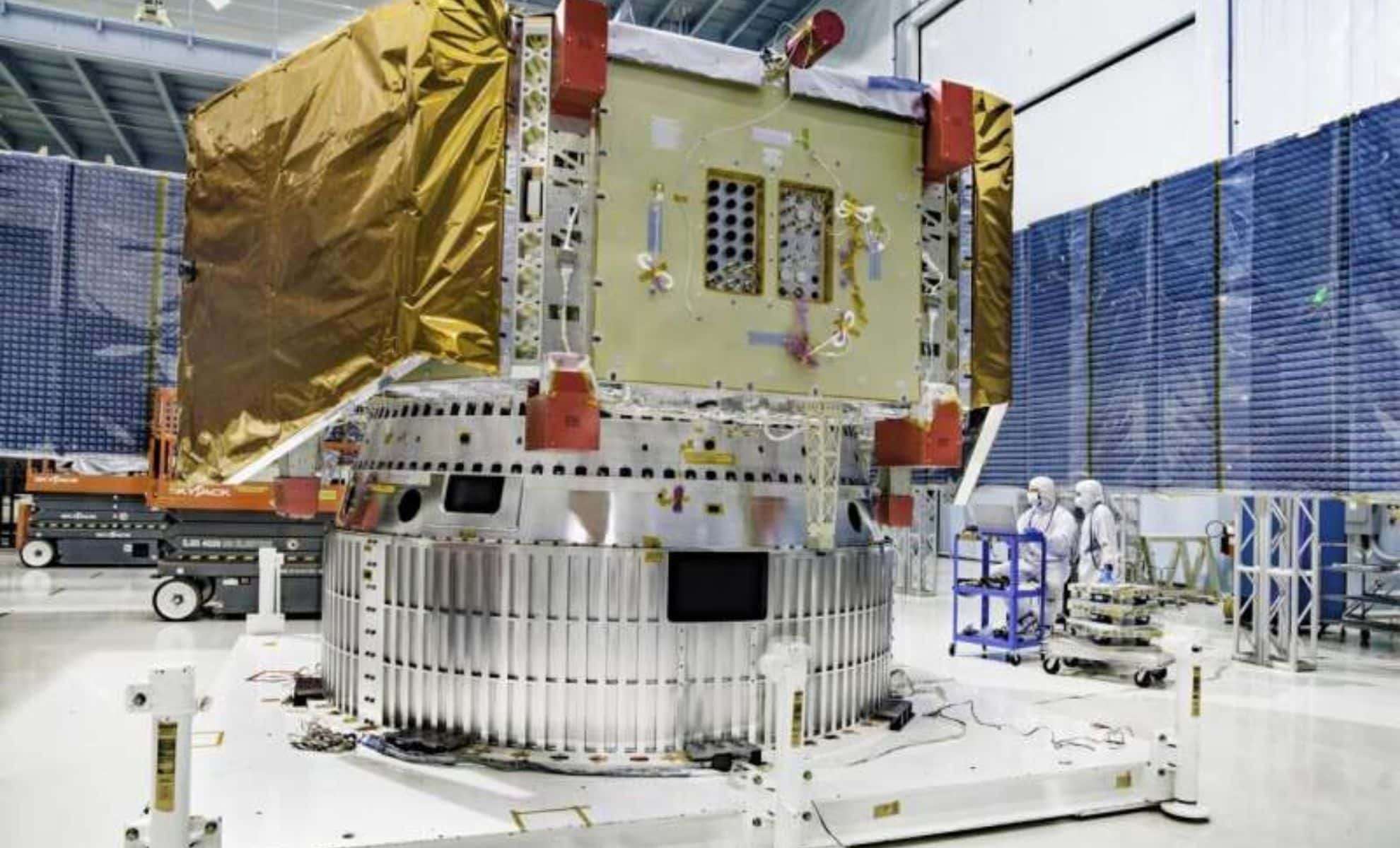
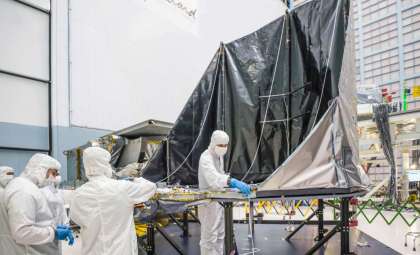
NASA has finalized the spacecraft bus assembly for the Nancy Grace Roman Space Telescope, marking a pivotal achievement in this groundbreaking mission’s progress.
Focused on unlocking the secrets of dark energy, dark matter, and exoplanets, the Roman Space Telescope represents the next era of space observatories. With the spacecraft bus construction complete, NASA is advancing toward deploying this powerful instrument, which is designed to surpass the capabilities of both the Hubble and the James Webb Space Telescopes.
Core Framework: The Spacecraft Bus
The spacecraft bus serves as the essential backbone of the Roman Space Telescope, providing the necessary support to operate and transport the telescope in orbit. More than just a carrier, it manages the critical functions such as power supply, communication links with Earth, data processing, and thermal control, enabling the observatory to perform seamlessly in the harsh environment of space.

A standout feature is the extensive network of 50 miles of wiring within the bus, facilitating smooth interaction between the telescope’s components. Once deployed, the bus will extend key devices including solar arrays, a high-gain antenna, and a deployable aperture shield. Together with the Lower Instrument Sun Shade, these elements protect the observatory from solar radiation and assist in maintaining the precise temperatures needed for infrared imaging.
Unmatched Data Transmission
The Roman Space Telescope is set to generate a staggering volume of data. Jason Hylan, the mission manager at NASA’s Goddard Space Flight Center, highlighted that Roman will downlink around 1.4 terabytes of data daily — vastly exceeding the 50 to 60 gigabytes per day from James Webb and 3 gigabytes per day from Hubble. To visualize, this is like streaming two weeks of top-quality YouTube footage every single day, whereas Webb’s output is comparable to about 13 hours of such content.
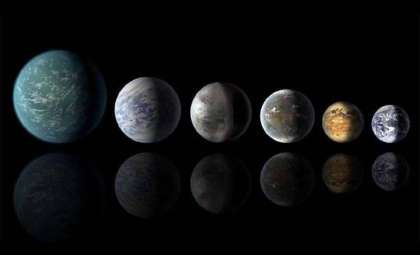
This immense data capacity powers the observatory’s ambitious missions: surveying vast areas of the sky to study the accelerating expansion of the cosmos linked to dark energy, probing the nature of dark matter, and discovering and characterizing exoplanets across other solar systems, expanding our knowledge of potentially habitable worlds.
Engineering Innovation & Modular Construction
The spacecraft bus took nearly eight years to develop, involving a vast team of engineers at NASA’s Goddard facility. Despite challenges such as supply chain interruptions and delays due to the COVID-19 pandemic, the team successfully advanced the build through inventive strategies and collaboration.
A key approach was the use of a structural verification unit—a full-size model that allowed stress testing concurrently with the actual bus assembly—saving both time and costs. The modular design permitted various teams to focus on different segments independently, accelerating completion.
The bus measures 13 feet across and 6.5 feet tall, weighing in at 8,400 pounds. Its hexagonal configuration incorporates lightweight composites and honeycomb frameworks to balance durability with minimal mass. Critical parts like the antenna dish are constructed from ultra-light composites, ensuring the structure remains robust yet light for efficient launch and in-orbit handling.
Upcoming Integration and Verification
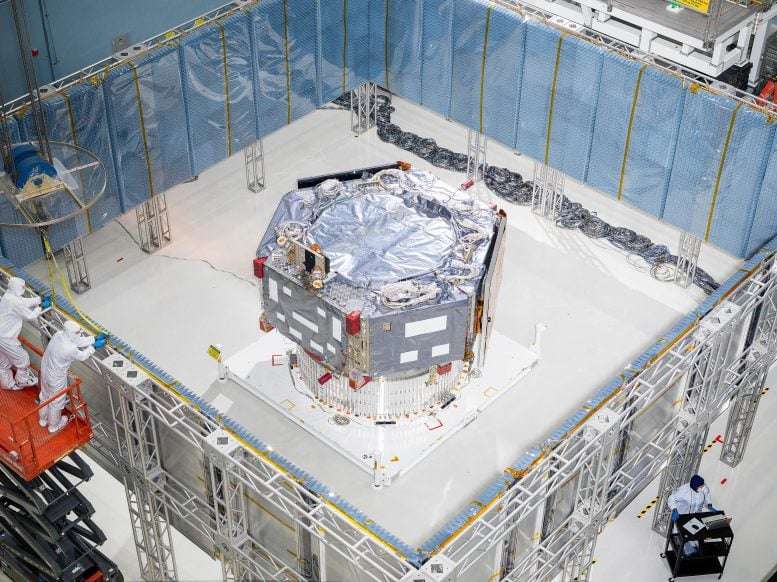
With the spacecraft bus fully built, engineers at NASA are now gearing up to add the scientific instruments and the telescope itself. This process includes mounting the deployable aperture cover, outer barrel assembly, and solar arrays. Following integration, comprehensive testing will verify the entire system’s operational readiness prior to launch.
While individual components have already passed rigorous validation, the fully assembled observatory will undergo holistic performance checks. As described by Missie Vess, a spacecraft systems expert on the mission, “The spacecraft passed the test, and now we’re getting ready to install the payload—Roman’s instruments and the telescope itself.” These final preparations aim to ensure the observatory is fully functional and ready for its targeted launch date in May 2027.
Expertise and Partnerships at Goddard
The completion of the Roman spacecraft bus reflects the dedication of experienced engineers and scientists at NASA’s Goddard Space Flight Center. This core team collaborated closely with industry leaders like BAE Systems, L3Harris Technologies, and Teledyne Scientific & Imaging to source advanced technologies and specialized materials.
Jackie Townsend, the deputy project manager, emphasized that the mission team drew upon decades of spacecraft development expertise to navigate technical complexities and schedule adjustments, particularly those sparked by supply chain issues and pandemic-related delays. “We leaned on generations of expertise in the spacecraft arena to work around cost and schedule challenges that arose from supply chain issues and the pandemic,” Townsend said.
Future Prospects for Space Discovery
The assembly milestone brings NASA closer to launching the Roman Space Telescope, a mission expected to expand our cosmic knowledge profoundly. Its powerful wide-field capabilities will deepen investigations into the universe’s accelerating growth, unravel the nature of dark matter, and fuel the quest for distant exoplanets. Upon launch and deployment, Roman will join NASA’s elite fleet of space observatories, generating data that will influence astronomical research for decades.
As the project proceeds, the focus will remain on final integration and testing ahead of the planned May 2027 launch. Once in orbit, the Roman Space Telescope promises to initiate a transformative phase in exploring the universe, with discoveries that will enhance humanity’s understanding of fundamental cosmic forces.
- Categories:
- Astronomy ,
- News ,
- Space ,
- Nasa




0 comments
Sign in to Comment