

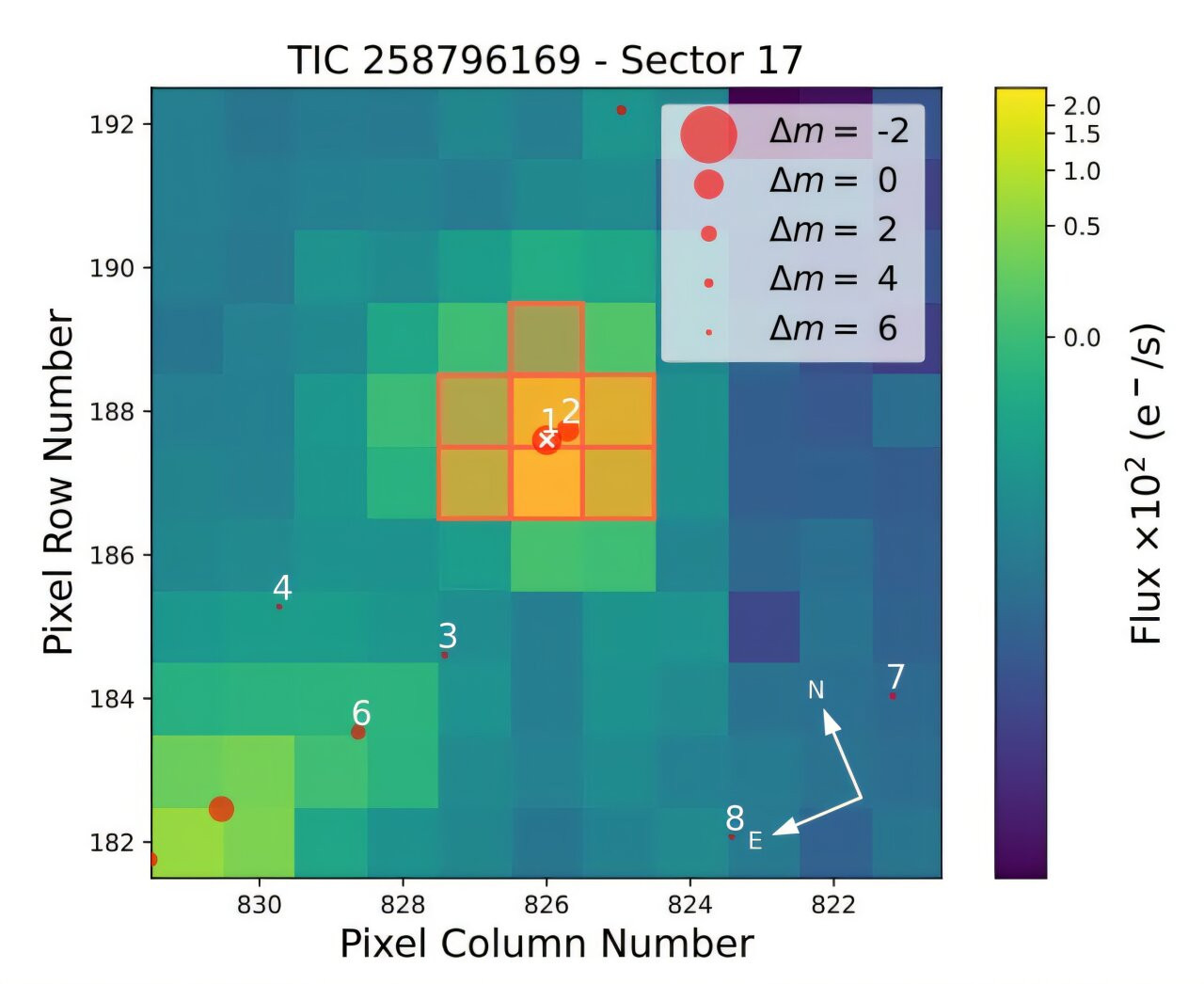
NASA’s Transiting Exoplanet Survey Satellite (TESS) has identified TOI-4616 b, a planet comparable in size to Earth orbiting a nearby M-dwarf star. Shared in a recent March preprint on arXiv, the discovery highlights a rocky planet located a mere 91.8 light years away, providing an exceptional chance to examine a terrestrial planet within close stellar neighborhood. This find represents a critical advancement in the search for Earth-like worlds orbiting prevalent stars that are prime targets for atmospheric analysis.
TOI-4616 B: Characteristics of a Close Exoplanet
The newly detected TOI-4616 b stands out as an exceptional exoplanet. It orbits the mid-M dwarf star TOI-4616 and has a radius approximately 1.22 times that of Earth, with an estimated mass ranging from 1.5 to 3 Earth masses. Its orbit is remarkably brief, completing a full revolution in only 1.5 days. With an equilibrium temperature close to 525 K (about 252°C or 485°F), TOI-4616 b exists under intense radiation, offering crucial insights into planetary conditions in proximity to their stars.
“The combination of precise stellar parameters, consistent multiband transit measurements, and the host star’s brightness makes TOI-4616 a particularly valuable system for future atmospheric and dynamical studies,” the researchers explain.
Add Cosmo Herald as a Preferred Source

This discovery positions TOI-4616 b as a vital subject for testing theories related to atmospheric loss, volatile preservation, and inner composition in planets exposed to substantial stellar radiation.

The Importance of M-Dwarf Stars in Exoplanet Research
M-dwarf stars such as TOI-4616, which are smaller and cooler than our Sun, comprise the majority of stars in the Milky Way. Their low brightness and compact size make them ideal for detecting Earth-sized exoplanets. The study published on arXiv highlights,
“Rocky exoplanets are particularly abundant around M-type stars. Their small radii and low luminosities provide favorable conditions for detecting transiting terrestrial planets and probing their atmospheric properties.”
Accounting for about 70% of stars in our galaxy, M-dwarfs offer a promising avenue for discovering new worlds. The planets orbiting these stars are often subjected to strong stellar radiation, providing valuable avenues for studying atmospheric evolution and planetary responses to extreme stellar activity.
TOI-4616 B as a Key Reference Point for Planetary Science
The close distance of TOI-4616 b to Earth and its well-defined stellar environment offer a rare opportunity for detailed comparative studies. Due to its distinctive attributes, scientists regard it as a benchmark for understanding how planets evolve when subjected to harsh stellar radiation.
“We report the discovery and statistical validation of TOI-4616 b, an Earth-sized planet transiting a nearby mid-M dwarf observed by the Transiting Exoplanet Survey Satellite (TESS),” the authors write.
This planet exists in a unique zone, intermediate between Earth-sized planets orbiting earlier M-type stars and those circling ultra-cool dwarfs, offering researchers new perspectives.
The research proposes that TOI-4616 b can serve as an essential standard for examining planetary interiors and evolution under strong radiative influence—an important factor for assessing habitability. Future observations, especially with the James Webb Space Telescope (JWST), may reveal atmospheric details, shedding light on its climate and composition.
Implications for Understanding Planetary Atmospheres
Studying TOI-4616 b advances knowledge beyond its existence, contributing to how atmospheres behave under intense environments. Because the planet probably retains a secondary atmosphere after losing its original hydrogen/helium layer, it offers opportunities to explore atmospheric escape and the retention of volatiles.
“TOI-4616 b resides in an extreme irradiation environment for an Earth-sized planet orbiting a mid-M dwarf,” the study notes. These features make the planet a valuable case for testing atmospheric modeling. With its precisely known stellar data, extensive transit observations, and bright host star, TOI-4616 b represents a prime target for upcoming atmospheric and dynamical investigations.
- Categories:
- Astronomy













0 comments
Sign in to Comment