
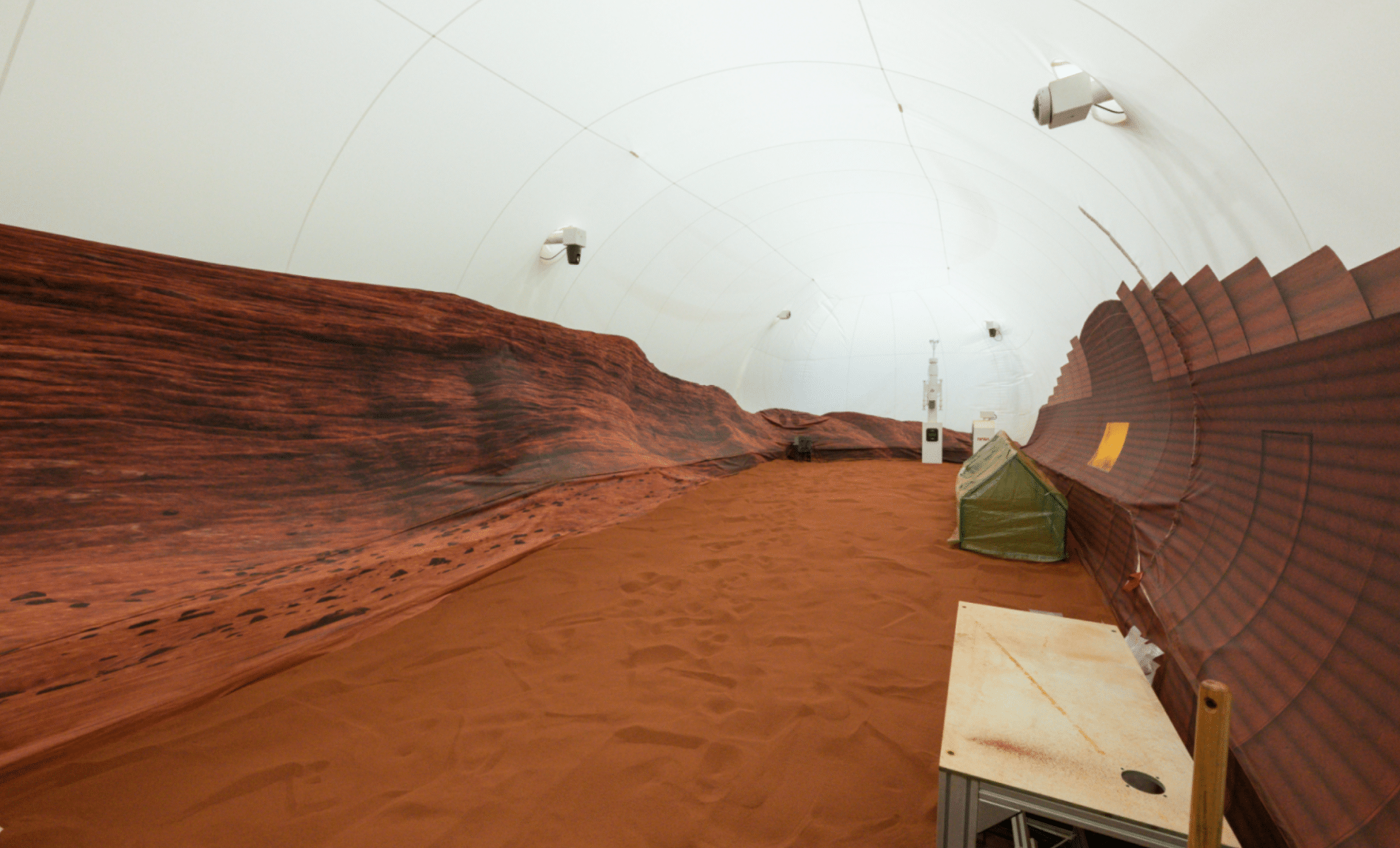
NASA recently announced the team selected for its upcoming CHAPEA mission — standing for Crew Health and Performance Exploration Analog — a groundbreaking 378-day Mars mission simulation on Earth. Beginning October 19, 2025, this intensive study will take place inside Mars Dune Alpha, a 3D-printed habitat located at the Johnson Space Center in Houston, Texas. As detailed in NASA’s official release, the initiative aims to replicate the psychological, environmental, and technical challenges astronauts will experience during Mars exploration. The primary objective is to collect invaluable health and operational data to inform future long-duration spaceflight missions.
Creating a Mars-Like Environment on Earth to Study Human Resilience
The CHAPEA experiment aims to reproduce the unique difficulties of a Mars expedition by placing participants in a confined setting for over a year. Crew members will encounter realistic obstacles such as communication delays, equipment malfunctions, and limited access to essential resources. Moreover, participants will cope with social seclusion, cramped quarters, and mentally taxing responsibilities mirroring the demands of interplanetary travel.
The team will perform simulated Mars surface explorations, operate robotic devices, and cultivate food in an on-site hydroponic garden to maintain self-sufficiency. They will also evaluate cutting-edge equipment, including a novel water dispenser and portable diagnostic medical instruments designed for deep space. Sara Whiting, scientist on NASA’s Human Research Program, remarked, “As we prepare for crewed Artemis missions, CHAPEA and related Earth analogs allow us to identify technologies and strategies that support astronaut health and performance beyond Earth’s confines, paving the way for human Mars missions.”

This upcoming second CHAPEA trial builds on insights gained from the inaugural year-long analog mission, which wrapped up on July 6, 2024. Both missions serve as essential components of NASA’s Mars exploration strategy, delivering behavioral and technical findings crucial for future space habitation challenges.
Diverse Expertise in a Four-Person Team Designed for Mars Realism
The crew selected for this mission comprises four specialists from various scientific and operational disciplines, each bringing unique skills essential for mission success. This diverse team structure reflects NASA’s vision for real interplanetary crews, emphasizing adaptability and stress resilience during extended isolation.
Commander Ross Elder, an experienced experimental test pilot with over 1,800 flight hours including combat missions, brings advanced knowledge of flight systems, AI, and human-machine collaboration essential for future spacecraft operations. Ellen Ellis, serving as the medical officer, is a U.S. Space Force colonel and senior figure at the National Reconnaissance Office, whose expertise in systems engineering and emergency response will be vital in safeguarding crew health under mission conditions.
Science officer Matthew Montgomery, an engineering consultant based in Los Angeles, specializes in robotics, lighting systems, and sustainable agriculture technologies, contributing to life-support innovation. Completing the team is flight engineer James Spicer, a technical director with extensive experience in satellite communications, navigation, and spacecraft integration—key for maintaining the simulation’s operational reliability throughout the duration.
CHAPEA’s Critical Role in NASA’s Lunar and Martian Ambitions
More than a test of endurance, CHAPEA serves as a scientific platform to establish operational models for upcoming Mars and Moon expeditions. By challenging astronauts to autonomously manage complex environments fraught with stress and delayed feedback, NASA aims to enhance understanding of decision-making, communication, and fatigue in realistic mission scenarios. The mission will closely monitor both psychological and physical effects over time to gauge human adaptability to prolonged isolation within closed environments.
Principal investigator Grace Douglas highlighted the study’s invaluable insights: “This simulation will enable collection of cognitive and physical data that illuminate the impacts of resource constraints and extended spaceflight on astronaut health, guiding NASA’s planning for future Mars missions.”
CHAPEA offers rare, continuous data on how crews address operational autonomy, unforeseen failures, and delayed responses while sustaining morale and productivity, helping NASA refine protocols and human factors for deep space missions far beyond Earth’s immediate support network.
Evaluating Essential Technologies for Mars Survival and Success
The mission also acts as a testing ground for innovative technologies astronauts will depend on during interplanetary travel and settlement. These include advanced agricultural systems, autonomous health diagnostic devices, and water purification innovations designed to operate reliably without Earth resupplies. Each system must be user-friendly and effective under the cognitive strain of isolation.
The habitat, Mars Dune Alpha, produced by ICON through 3D-printing, represents a prototype for off-world living. This experiment will assess the viability of constructing sustainable habitats using local resources, evaluating material durability, temperature regulation, and psychological impacts of confined spaces—vital factors for future Martian bases.
Robotic tools and remotely operated systems will also be trialed, allowing the crew to perform extravehicular activities safely from within the habitat. Such technologies could minimize risks during Mars surface operations, including exploration and sample collection, by reducing direct exposure to hazardous environments.
- Categories:
- News





0 comments
Sign in to Comment