
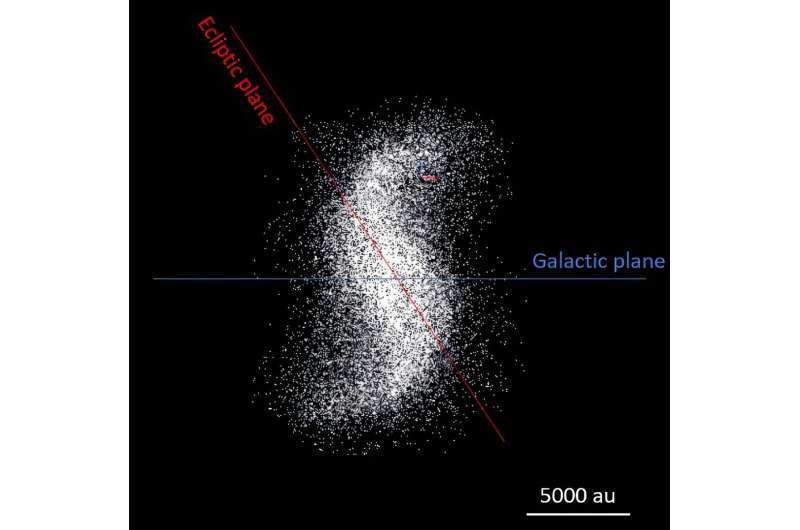
At the fringes of our solar system lies a newly identified structure that could transform our understanding of its formation. Utilizing cutting-edge simulations, a NASA supercomputer has unveiled that the Oort Cloud—a distant reservoir of icy objects surrounding the Sun—is not a simple spherical shell but may take the form of a spiral arrangement reminiscent of a small galaxy. This insight has the potential to reshape our perception of the solar system's boundary and highlight the Milky Way’s role in influencing objects beyond Pluto.
NASA Supercomputer Sheds Light on a Spiral Shape in the Oort Cloud
This revelation originates from a recent study released on February 16, 2025, on arXiv. Though awaiting peer evaluation, the research indicates the Oort Cloud’s internal form manifests as a spiraling disk stretching about 15,000 astronomical units (AU). Powered by NASA’s Pleiades supercomputer, the simulation examined comet trajectories and the various gravitational forces at play.
While it has long been theorized that external forces shape the Oort Cloud, this model is the first to suggest those influences form its spiral configuration. The findings imply that the Sun’s gravity alone does not govern the solar system’s distant outskirts.

What Creates the Oort Cloud’s Spiral Structure?
The spiral pattern most likely arises due to galactic tides—a gravitational effect stemming from the collective pull of the Milky Way, neighboring stars, and even remote black holes. Unlike objects closer to the Sun firmly held in orbit, the icy bodies in the Oort Cloud exist at the Sun’s gravitational limits, making them more vulnerable to these external forces.
These far-reaching gravitational influences may twist and extend the Oort Cloud into a spiral rather than a simple spherical shape. This mechanism also offers a potential explanation for the atypical paths long-period comets take as they enter the inner solar system, hinting at complex internal structures within the cloud.
Implications for Solar System Boundaries and Beyond
If the Milky Way’s gravity indeed shapes the Oort Cloud, it could redefine where astronomers consider the solar system's boundary. Previously defined by the heliosphere—the solar wind dominated zone—the solar system’s reach might be more extensive if the Oort Cloud’s shape is molded significantly by galactic forces.
Moreover, the discovery of an ordered structure in our Oort Cloud suggests that other planetary systems in the galaxy might possess similarly organized outer regions influenced by their galactic environment.
Challenges in Verifying the Spiral Form of the Oort Cloud
Confirming this spiral structure remains difficult due to the enormous distance and faintness of the Oort Cloud’s constituents. Current telescopes cannot resolve the tiny, icy bodies that make up the cloud directly.
NASA’s Voyager 1 spacecraft, moving at over a million miles daily, would require around 300 years to reach the inner edge of the Oort Cloud and about 300,000 years to cross it, making direct observation impossible for now.
Scientists are exploring alternatives such as:
- Monitoring the paths of comets to detect alignment with predicted spiral regions.
- Examining reflected light from Oort Cloud objects to identify spatial concentrations or patterns.
- Employing future advanced space telescopes to gather new data on distant icy bodies.
- Categories:
- News













0 comments
Sign in to Comment