

Researchers have, for the first time, directly identified fully developed turbulence within the Sun’s corona, offering vital new perspectives on solar wind dynamics.
This pivotal revelation, achieved by ESA’s Solar Orbiter, advances our comprehension of how the Sun’s complex magnetic environment induces turbulent flows in its outer atmosphere. The remarkable footage showcases turbulence playing a central role in shaping the solar wind that influences planetary magnetic environments and satellite systems throughout the Solar System, including effects on Earth.
Revolutionary Video Highlights Turbulence Near the Sun’s Surface
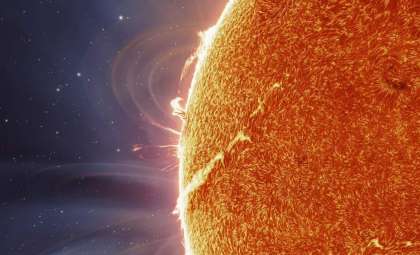
A remarkable video shared by ESA presents for the first time the swirling turbulent patterns within the solar corona. Captured by the Metis coronagraph aboard Solar Orbiter on October 12, 2022, the spacecraft was positioned just 43.4 million kilometers from the Sun—about one-third the Earth-Sun distance. By employing the coronagraph’s light-blocking capabilities, Metis filtered out intense solar disk brightness and revealed faint visible and ultraviolet emissions from the corona, providing an unprecedentedly detailed view of how the solar wind begins.

The video exposes the disorderly motion of charged particles in the Sun’s atmosphere, delivering the first definitive proof that turbulence in the solar wind originates very near the Sun’s surface. Daniel Müller, ESA’s Solar Orbiter Project Scientist, emphasized the breakthrough: “This new analysis provides the first-ever evidence for the onset of fully developed turbulence in the Sun’s corona. Solar Orbiter’s Metis coronagraph was able to detect it very close to the Sun, closer than any spacecraft could approach the Sun and make local measurements.”
Why Turbulence in the Solar Wind Matters
Turbulence is not an oddity in the solar wind; it is fundamental to this flow of charged particles emitted from the Sun. The footage illustrates how turbulent motion emerges at the solar wind’s origin in the corona and intensifies as it travels through space. This chaotic activity is crucial for explaining particle heating and acceleration within the solar wind.
The solar wind’s interaction with planetary magnetic fields—particularly Earth’s—can trigger space weather effects that disrupt satellites, GPS systems, and power infrastructure. Enhanced insight into solar wind turbulence will improve space weather forecasting, a critical goal given our reliance on space-based technology. Highlighting this, Dr. Alfredo Carpineti from IFLScience said, “space weather affects satellites in a variety of ways. Communication, predictions, and remote sensing all depend on the instruments above our heads, and space weather can cause trouble up above and down on Earth.”
Solar Orbiter’s Vital Role in Solar Exploration
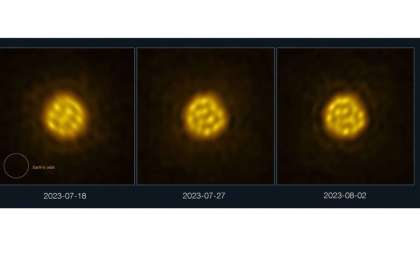
The Solar Orbiter mission is at the forefront of unveiling solar mysteries. Alongside Metis, instruments like the Extreme Ultraviolet Imager (EUI) have captured complementary images of the Sun’s surface from the same timeframe. These combined datasets elucidate the solar wind’s structure and behavior in real-time. By merging high-resolution corona observations with ultraviolet surface imagery, researchers gain fresh understanding of turbulence driving forces in the solar atmosphere.
As Solar Orbiter progresses, it will collect even more comprehensive data, especially as it adjusts its orbit to observe the Sun’s poles. These regions remain largely unexplored but are essential to grasping how the solar magnetic field forms and regulates charged particle streams across the Solar System.
Published recently in the Astrophysical Journal Letters, these findings promise wide-ranging impacts on space weather prediction and solar physics research.
The Effects of Solar Turbulence on Our Planet
Observing turbulence within the Sun’s corona is more than a scientific milestone; it has direct implications for Earth and other planets. As solar wind turbulence interacts with planetary magnetic shields, it can spark geomagnetic storms that disrupt technology and communications. The fluctuating nature of these turbulent streams poses challenges, underscoring the urgency of advancing space weather prediction techniques.
By revealing the chaotic roots of solar wind formation, Solar Orbiter equips scientists with the tools to better anticipate solar particle behavior and their interaction with Earth’s magnetic field. As Daniel Müller highlighted, “Understanding solar wind turbulence is crucial for predicting space weather and its effects on Earth.”
- Categories:
- Astronomy ,
- News ,
- Space






0 comments
Sign in to Comment