

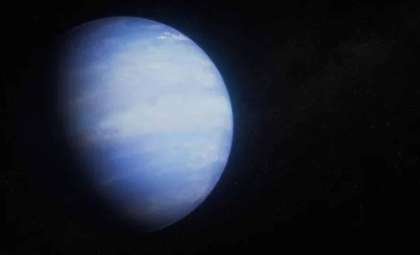
Utilizing NASA’s James Webb Space Telescope (JWST), researchers have uncovered remarkable atmospheric features on WASP-107b, a highly inflated exoplanet with a strikingly uneven atmospheric structure.
This super-Neptune-sized world, whose radius is comparable to Jupiter but with a mere tenth of its mass, displays notable disparities between the eastern and western halves of its atmosphere. The results, published on September 24, 2024, in the journal Nature Astronomy, shed new light on the atmospheric circulation and weather phenomena of this remote exoplanet.
WASP-107b: A Low-Density Giant with Puffy Atmosphere
Discovered in 2017, WASP-107b ranks among the most diffuse exoplanets known, earning monikers like “super-puff” or “cotton-candy” planet due to its extremely low density. It orbits the K-type star WASP-107, situated roughly 212 light-years away in the Virgo constellation. Despite a size akin to Jupiter, the planet’s mass is substantially lower, leading to a highly expanded atmosphere resulting from its weak gravitational pull.

WASP-107b circles its star much closer than Earth orbits the Sun, completing a revolution in just 5.7 days. This close orbit heats the atmosphere to temperatures near 500 degrees Celsius (932 degrees Fahrenheit). The heating effect is amplified by tidal forces generated by the planet’s slightly elliptical orbit, which maintains the atmosphere’s swollen state. “The inflated nature of WASP-107b, despite moderate temperatures, distinguishes it from other gas giants,” explained Matthew Murphy, the study’s principal investigator at the University of Arizona.
Detecting Atmospheric Differences Between East and West
For the first time, scientists have measured an east-west atmospheric asymmetry on an exoplanet during its transit, using transmission spectroscopy from space. This method examines starlight that filters through the planet’s atmosphere, revealing notable variances in temperature and cloud composition on the planet’s two hemispheres.
“This represents the initial observation of east-west atmospheric asymmetry on any exoplanet during a transit from space,” Murphy said. Such disparities are especially compelling because WASP-107b is tidally locked, with the same side persistently facing its host star. Unraveling this asymmetry is essential for understanding the planet’s climate systems, weather variations, and atmospheric behavior.
JWST’s Precision Opens New Frontiers
The James Webb Space Telescope’s exceptional sensitivity enabled researchers to isolate signals originating separately from the planet’s eastern and western atmospheres, a feat unprecedented in exoplanet studies. “These measurements offer detailed insights into the planet’s atmospheric gases, cloud dynamics, chemical makeup, and the effects of varying sunlight exposure,” Murphy elaborated.
This achievement highlights the benefits of observations made beyond Earth’s atmosphere. While terrestrial telescopes have contributed valuable data on exoplanets, space observatories like JWST provide unparalleled clarity for probing atmospheric conditions. “Space-based observations have numerous advantages over ground-based efforts,” Murphy stressed.
Implications and Next Steps in Research
The detection of atmospheric asymmetry on WASP-107b challenges prior theoretical frameworks that did not anticipate such features for similar planets. “Some models suggested that WASP-107b shouldn’t display this kind of asymmetry, so this discovery is already reshaping our understanding,” Murphy noted. This prompts further investigation into what processes produce these differences and how frequently they might appear on other exoplanets.
Murphy’s team plans additional observations aimed at comprehensively uncovering the mechanisms behind the asymmetry, including examining other inflated exoplanets. “For most exoplanets, direct observations are difficult, let alone distinguishing conditions on different hemispheres,” Murphy remarked. Continued study of these unusual traits is expected to refine our grasp of atmospheric mechanisms on worlds beyond our solar system.
Besides expanding knowledge about WASP-107b, this research also showcases the power of JWST for dissecting complex atmospheric features of distant planets. As more data arrives, astronomers anticipate uncovering novel phenomena that will deepen insights into planetary evolution and atmospheric science across the cosmos.
- Categories:
- Astronomy ,
- News ,
- Space ,
- Nasa









0 comments
Sign in to Comment