
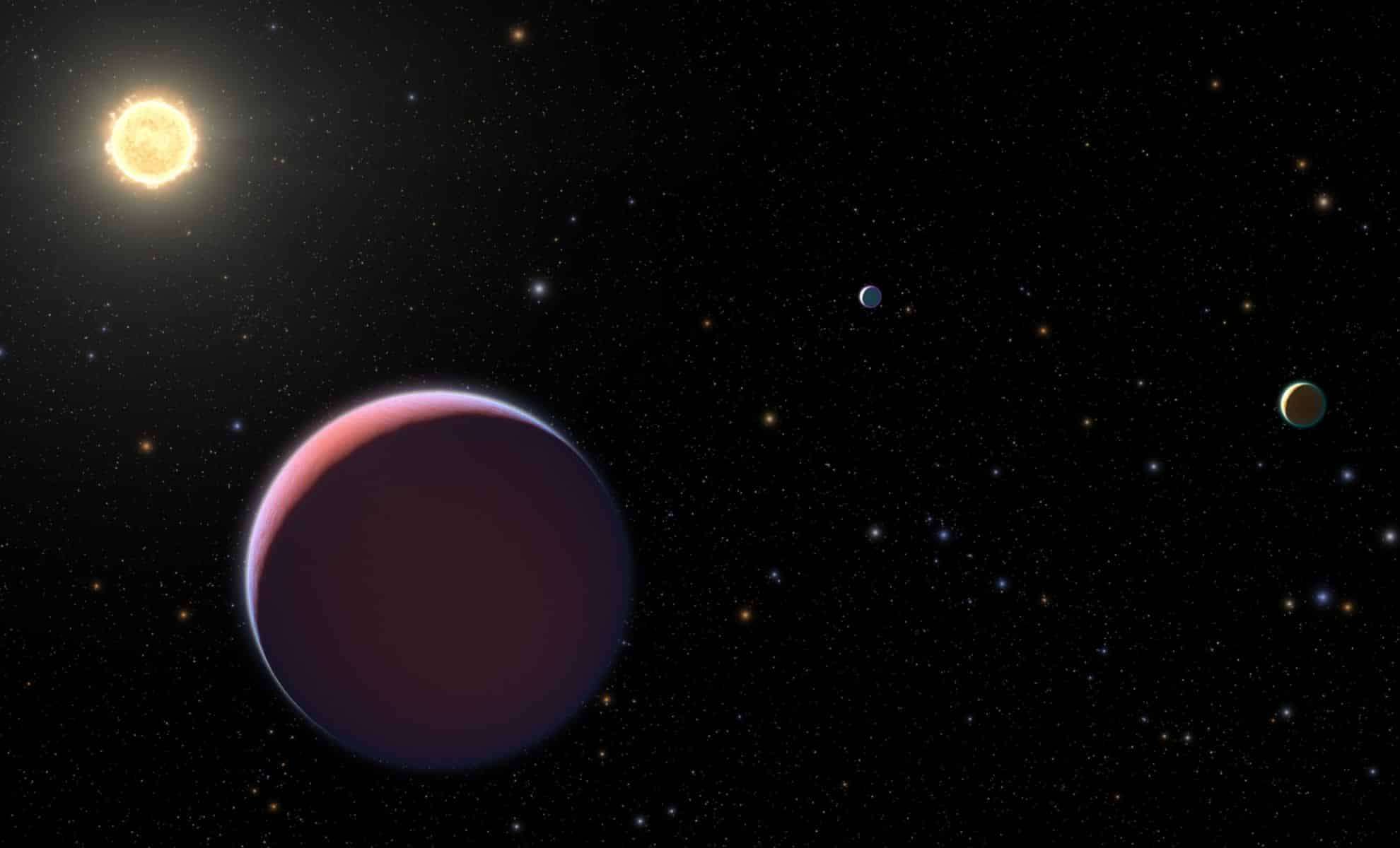
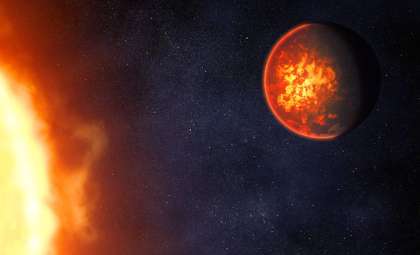
Using the powerful capabilities of the James Webb Space Telescope (JWST), astronomers have identified a previously unknown planet within the intriguing Kepler-51 system, a star system already renowned for its strange, fluffy “super-puff” planets. This finding has sparked renewed interest in understanding how such delicate planets—often likened to cotton candy due to their incredibly low densities—can form and persist so close to their luminous host star.
The newfound world, designated Kepler-51e, was detected through subtle irregularities in the transit timing of one of the system’s known planets. This discovery adds another intriguing piece to the puzzle of this already extraordinary planetary family and marks an important breakthrough for exoplanet exploration with JWST.
The Remarkable Kepler-51 System
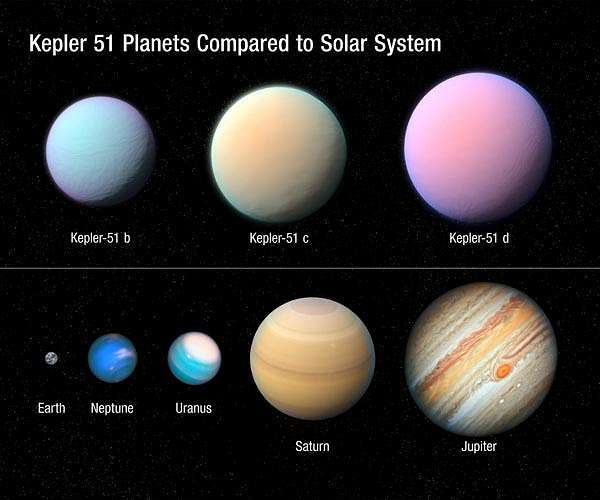
Situated roughly 2,600 light-years away in the Cygnus constellation, the Kepler-51 system has long challenged astronomers’ expectations. Home to several rare super-puff exoplanets, this system features planets that are comparable in size to Saturn but with masses just a few times that of Earth. These bizarre features suggest that these planets have small rocky cores shrouded by expansive envelopes dominated by hydrogen and helium gases.

“Super-puffs are incredibly rare because of their low mass and density,” explained Jessica Libby-Roberts, postdoctoral researcher at Penn State’s Center for Exoplanets and Habitable Worlds. “The three known planets orbiting Kepler-51 resemble Saturn in size but have masses only a few times that of Earth, making their densities remarkably low, like cotton candy.”
One of the biggest mysteries regarding the Kepler-51 planets is how their thick atmospheres survive the harsh radiation from their young, active star, which theoretically should strip these gaseous layers away. This enduring atmospheric presence has made Kepler-51 a prime target for studying planetary atmospheric evolution under extreme conditions.
Transit Timing Variations Reveal New Planet
The detection of Kepler-51e came unexpectedly during JWST observations of the known super-puff Kepler-51d. Astronomers monitored a planetary transit, when the planet passes in front of its star, intending to gather detailed measurements of Kepler-51d. However, the transit occurred approximately two hours earlier than predicted by existing models.
“We fortunately began observations earlier than scheduled,” said Libby-Roberts. “Upon reanalyzing our data, we spotted a slight dip in starlight signifying the transit’s start, two hours ahead of expectations.” The unusual timing suggested the gravitational effect of an unseen planet influencing the orbit.
Further study confirmed these timing shifts—known as Transit Timing Variations (TTVs)—arose from an additional planetary body’s pull. This detection represents the first-ever identification of a planet through TTVs using JWST.
“Only by adding a new planet could we explain the timing discrepancy,” noted Kento Masuda, co-first author and associate professor at Osaka University. “This marks JWST’s inaugural planet discovery by transit timing variations.”
Insights into Kepler-51e
Preliminary analyses indicate Kepler-51e orbits the star roughly every 264 days, placing it just within the system’s habitable zone, where conditions might allow liquid water to exist. However, no direct transit of this planet has yet been observed, so its precise size and density remain unknown. Whether Kepler-51e is also a super-puff remains an open question, but its detection reshapes astronomers’ understanding of the system’s architecture.
Accounting for Kepler-51e’s gravitational role, researchers refined mass estimates for the other planets, which turned out slightly higher but still within the super-puff classification.
“Our JWST observations aimed to study one of these planets to solve existing puzzles, but instead we found a new low-mass neighbor,” Libby-Roberts commented. This surprise highlights JWST’s ability to reveal hidden worlds along with characterizing known ones.
Continuing to Decode the Kepler-51 System
Kepler-51 remains one of the most fascinating planetary systems discovered, largely due to its collection of super-puff planets that defy standard models of formation and atmospheric retention. The addition of Kepler-51e only deepens the enigma and implies more undiscovered planets might be lurking in this system.
Ongoing JWST data analysis aims to unravel the atmospheric compositions of these super-puffs, potentially revealing whether they formed close to their star or migrated inward from colder zones.
“With an orbit somewhat larger than Venus and inside the habitable zone, Kepler-51e suggests there’s much more to explore in this system,” said Libby-Roberts. Detecting additional distant planets could transform our theories of planetary birth and development.
- Categories:
- Astronomy ,
- News ,
- Nasa








0 comments
Sign in to Comment