
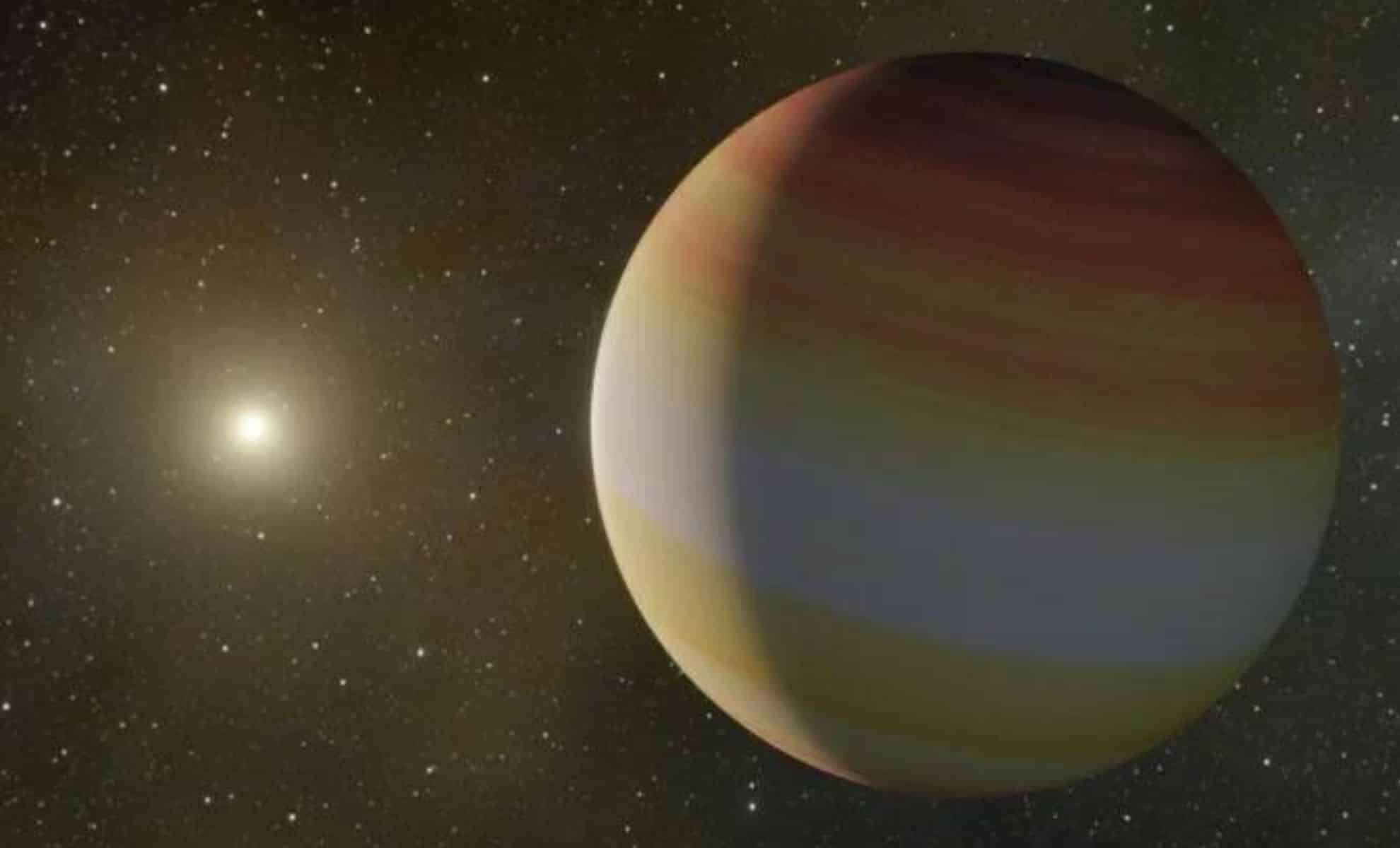
A team of astronomers has identified an enormous exoplanet within the Ursa Major constellation, broadening our understanding of the variety of planets beyond our solar system.
This recently identified world, classified as a super-Jupiter, boasts a mass exceeding 11 times that of Jupiter, the biggest planet orbiting our Sun. This discovery was achieved by researchers at the NCU Institute of Astronomy alongside experts from Spain and the USA, offering a rare perspective on planetary arrangements in far-off systems.
An Immense World in a Remote Star System
The massive planet orbits the star HD 118203, situated approximately 300 light-years away from Earth. This star surpasses the Sun in size by about 20% and is roughly twice as large. While a smaller gas giant already orbits this star rapidly in a six-day period, the recent identification of the super-Jupiter introduces a much larger companion that circles the star every 14 years at a farther distance, enduring temperatures near -100 degrees Celsius.

Though the super-Jupiter has not been seen directly, its existence was inferred from radial velocity data that detect minute shifts in the star’s movement caused by the gravitational influence of the planet. As lead researcher Gracjan Maciejewski explained, “While the planet itself eludes direct observation, the presence of its host star allows us to track the wobble indicating the planet’s pull.” This indirect detection confirmed the planet’s presence.
A Distinct Planetary System
This newly discovered hierarchical planetary system adds valuable insights into planet formation. The first known planet, discovered in 2005, is a hot Jupiter orbiting closely in just six days. In contrast, the super-Jupiter moves along a much broader orbit, taking 14 years to complete a cycle at an orbit roughly six astronomical units (AU) away—about six times the Earth-Sun distance.
The system’s complex gravitational interactions are especially interesting, as the two massive planets maintain a stable balance over long timescales. As study co-author Krzysztof Goździewski noted, “The stability arises partly because of influences predicted by the general theory of relativity. Without these relativistic effects, the planets’ orbits would fluctuate dramatically, causing instability.” This stability provides an intriguing example for understanding the evolutionary processes of large planetary systems.
Long-Term Observation Brings Breakthrough
Uncovering this super-Jupiter is the fruit of almost two decades of focused monitoring. Initial hints suggested the possibility of an additional planet, prompting the team to study HD 118203 extensively. Observations gathered from instruments like the Hobby-Eberly Telescope in Texas and the Telescopio Nazionale Galileo in the Canary Islands were pivotal in confirming the find.
A comprehensive data set, enhanced by precise Doppler measurements, was essential for defining the planet’s orbital properties. As Maciejewski remarked, “The observations recorded as recently as March 2023 were crucial for clarifying the planet’s orbit.” The persistence and thorough analysis by the research group enabled a detailed characterization of the planetary architecture.
Advancing Our Understanding of Planet Formation
The addition of this super-Jupiter expands the exoplanet inventory and sheds light on the processes shaping planetary systems, especially those containing massive gas giants. The configuration, featuring one planet in a tight orbit and the other far out, allows researchers to probe mechanisms ensuring long-term orbital stability.
Co-author Andrzej Niedzielski observed, “Initial Doppler data hinted at more to be discovered, and indeed, we have confirmed another planet in the system.” Their findings provide a fresh lens through which to examine planetary systems beyond our own.
This exciting discovery, detailed in the journal Astronomy and Astrophysics, is expected to stimulate further investigation and may reveal more planets within this intriguing star system. It enhances our grasp of planetary mechanics and informs models of how large planetary systems develop and sustain over extensive periods.
- Categories:
- Astronomy ,
- News ,
- Science ,
- Space








0 comments
Sign in to Comment