
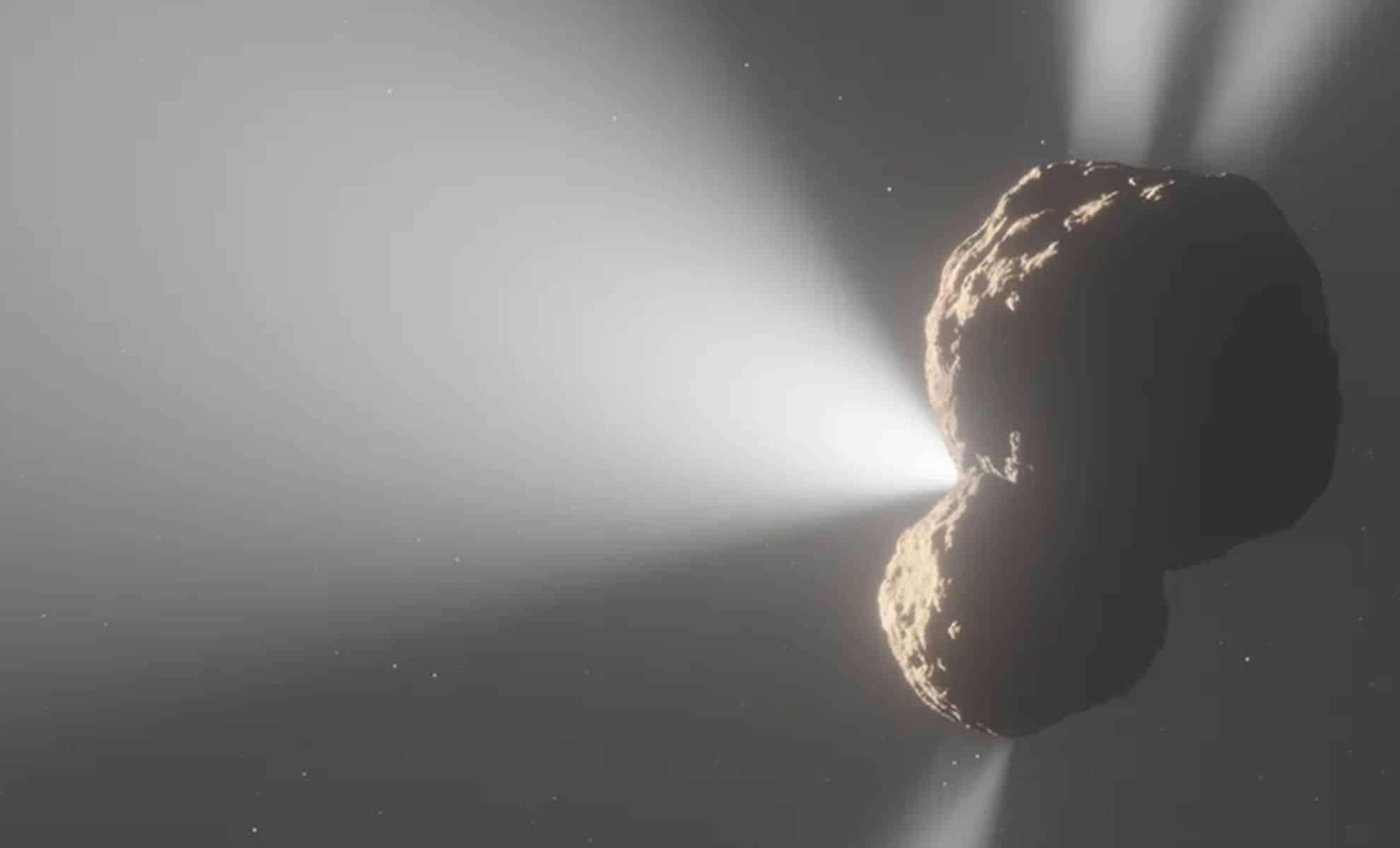
The James Webb Space Telescope (JWST) has uncovered extraordinary jets of gas streaming from Centaur 29P/Schwassmann-Wachmann 1 (29P), a dynamic icy object orbiting between Jupiter and Neptune. Known for its recurring eruptions, this centaur has now been observed releasing jets of both carbon monoxide (CO) and carbon dioxide (CO₂), providing fresh clues about the makeup and history of such bodies and their significance in the development of the solar system.
The Intriguing Nature of Centaur 29P
Centaurs—named after mythical creatures with a human upper body and the legs of a horse—are transitional objects moving from the Kuiper Belt region toward comet-like orbits. Positioned between the orbits of Jupiter and Neptune, these bodies are believed to have been displaced closer to the Sun by the gravitational pull of giant planets. Among them, 29P stands out due to its frequent bursts of gas and dust activity, typically erupting every six to eight weeks.
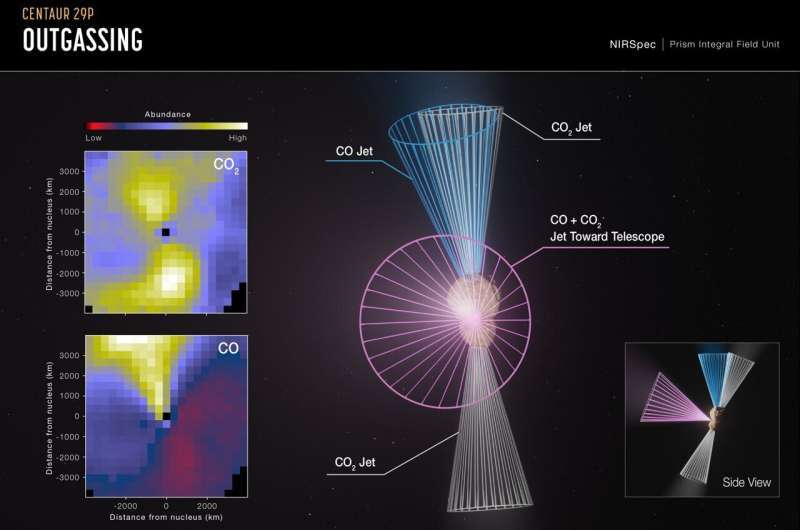
Employing JWST’s Near-Infrared Spectrograph (NIRSpec), astronomers have captured the most detailed views of these jets to date. While earlier studies hinted at CO jets directed sunward, the enhanced sensitivity of JWST has allowed detection of CO₂ jets that were previously unobserved.

According to Sara Faggi, the study’s lead researcher at NASA’s Goddard Space Flight Center, “Centaurs act as some of the frozen remnants from when our planetary system was forming. Their preservation at extremely low temperatures keeps details about early volatile compounds intact.” She continued, “Webb’s advanced resolution and sensitivity amazed us—I don’t think we’ve ever seen anything quite like these data before.”
Detailing the Jets and 29P’s Unique Makeup
The investigation uncovered two distinct CO₂ jets emerging from the centaur’s northern and southern hemispheres, alongside a CO jet pointing north. The presence of CO₂ is particularly noteworthy since it represents a key reservoir of carbon in the solar system. This implies the surface chemistry of 29P is more diverse than past data indicated.
Researchers further developed a three-dimensional model to analyze the jets’ directions and origins, deducing they originate from separate areas of the nucleus. This suggests the centaur might be a conglomerate of distinct fragments with varying compositions. Geronimo Villanueva, a study co-author, commented, “The striking differences in CO and CO₂ levels across 29P’s surface hint at it being a composite object. Possibly, it formed from the merger of two or more bodies that experienced different evolutionary paths.”
Continuing Enigma of Centaur Outbursts
Despite JWST’s groundbreaking findings, many questions about 29P remain unresolved. The cause behind its cyclical outbursts is still uncertain. Unlike typical comets, where water ice sublimation fuels jets, 29P’s great distance from the Sun makes water vaporization unlikely. Instead, volatile gases like CO and CO₂ are probable drivers of its activity.
Adam McKay, also involved in the research, remarked, “Our observations offer just a single snapshot in time. Future studies tracking 29P over extended periods are essential. We need to see if these jets keep the same orientations or if additional CO jets appear at different rotation phases.” While further monitoring will be necessary, JWST’s exceptional capabilities have opened an exciting avenue for exploring these mysterious solar system residents.
- Categories:
- Astronomy ,
- News ,
- Space ,
- Nasa





0 comments
Sign in to Comment