
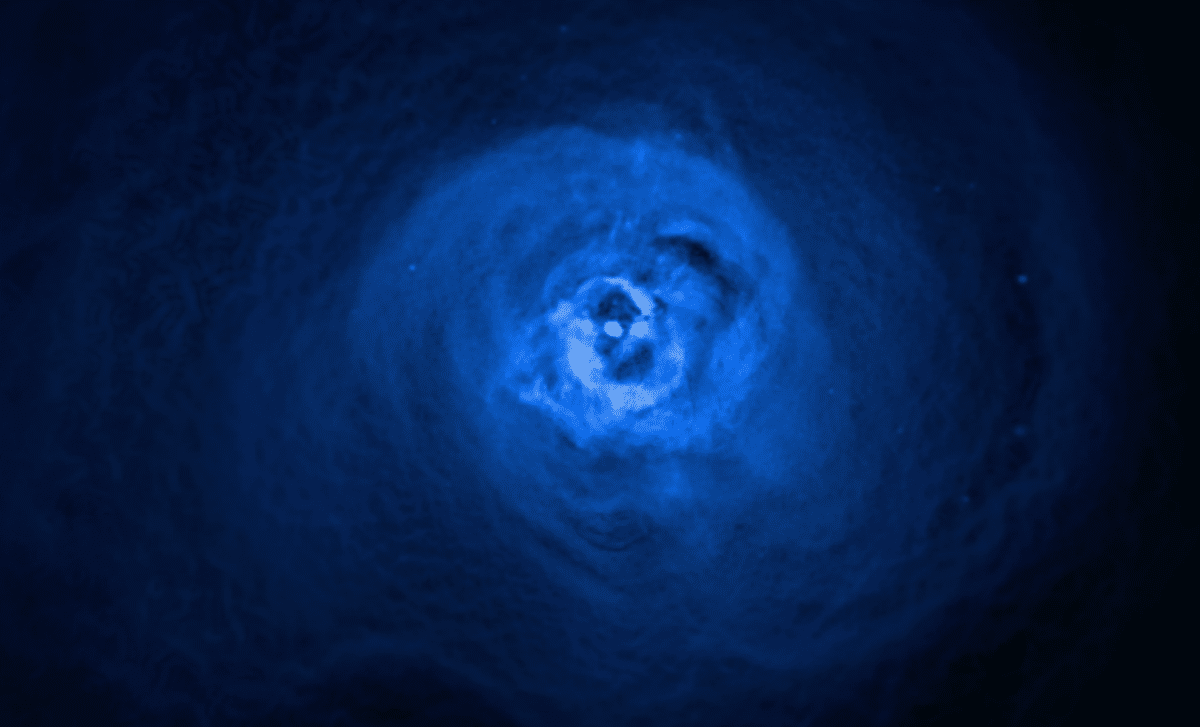
In a significant advancement detailed in The Astrophysical Journal Letters, an international team of astronomers utilizing NASA’s Imaging X-ray Polarimetry Explorer (IXPE) has resolved a longstanding puzzle concerning the source of X-rays in jets emitted by supermassive black holes. This groundbreaking study, which involved the most extended observation of a single object ever conducted by IXPE, has delivered vital clues about the emission mechanisms behind these powerful cosmic jets, ending decades of scientific uncertainty.
Transformative Insights into X-ray Emissions
NASA’s IXPE mission has achieved a remarkable feat by mapping the polarization of X-rays from 3C 84, an enormous active galaxy at the core of the Perseus Cluster. This historic observation lasted over 600 hours, making it IXPE’s longest single-target study and its inaugural investigation of a galaxy cluster. The primary objective was to identify how X-rays are generated within the jets of enormous supermassive black holes such as 3C 84. Previously, scientists hypothesized that inverse Compton scattering — a process where low-energy photons gain energy through interactions with fast-moving particles — might be responsible, but the latest data provides the conclusive proof long sought by researchers.
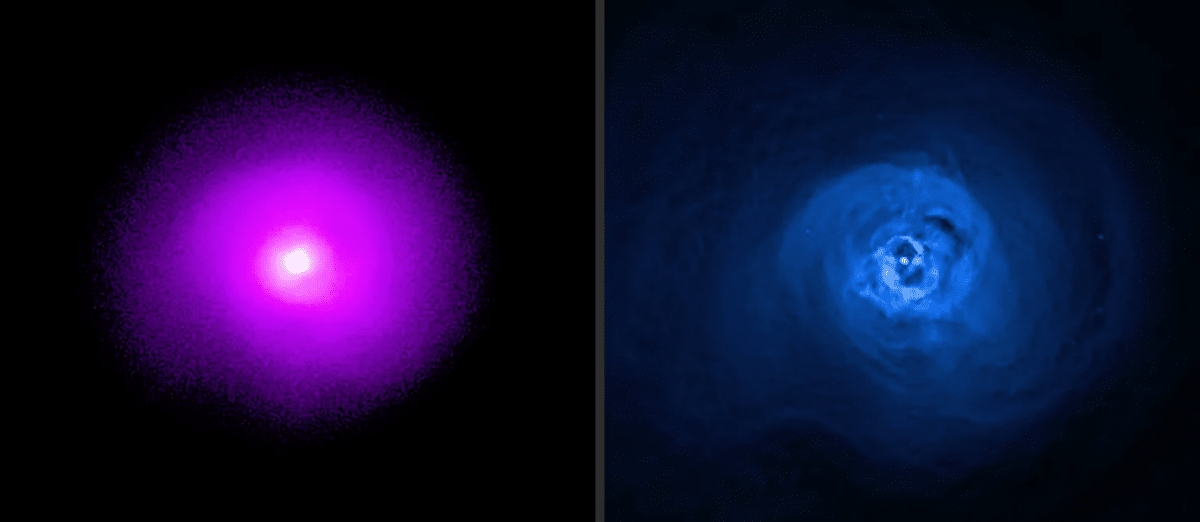
Leading the IXPE team from NASA’s Marshall Space Flight Center, scientists integrated observations from multiple space-based X-ray telescopes, including the sharp imaging abilities of NASA’s Chandra X-ray Observatory, accompanied by datasets from the Nuclear Spectroscopic Telescope Array (NuSTAR) and the Neil Gehrels Swift Observatory. This multi-instrument approach enabled a refined analysis of the X-ray emissions from 3C 84, confirming inverse Compton scattering as the source of these energetic rays.

Polarization: Key to Unlocking Black Hole Jet Mysteries
Essential to this discovery was IXPE’s capacity to measure the polarization of X-rays, revealing the internal structure of the jets and the directional properties of the emitted light waves. Steven Ehlert, IXPE’s project scientist, remarked,
“While measuring the polarization of 3C 84 was one of the key science goals, we are still searching for additional polarization signals in this galaxy cluster that could be signatures of more exotic physics.”
This suggests that this breakthrough opens the door to further investigations that could unveil new physics beyond current understandings of black hole jet phenomena.
The polarization findings enabled researchers to differentiate between two primary hypotheses about the origin of seed photons — the low-energy light that is boosted to X-ray energies. The synchrotron self-Compton model proposes that seed photons originate within the jet itself, while the external Compton model claims they come from outside the jet, from surrounding radiation fields. The data gathered offered robust support for the synchrotron self-Compton explanation. As Ioannis Liodakis, a principal author of the study, stated:
“We’ve already determined that for sources like 3C 84, the X-rays originated from inverse Compton scattering. With IXPE observations of 3C 84, we had a unique chance to determine the properties of the seed photons.”
Separating Signals to Pinpoint X-ray Origins
The researchers faced the intricate challenge of isolating the polarization signature from the active galactic nucleus (AGN) of 3C 84 amid intense X-ray emissions from the surrounding hot gas in the Perseus Cluster. This sophisticated disentanglement was performed by combining data from several telescopes, a feat impossible with any single observatory alone.
“The synchrotron self-Compton and external Compton scenarios have very different predictions for their X-ray polarization,” explained Frederic Marin, co-author of the study. “Any detection of X-ray polarization from 3C 84 almost decisively rules out the possibility of external Compton as the emission mechanism.”
This essential conclusion narrows down the processes responsible for X-ray production in the black hole's jet, heavily favoring the synchrotron self-Compton mechanism.
Integrating IXPE’s polarization results with observations from Chandra, NuSTAR, and Swift was crucial for accurately attributing the X-ray polarization to 3C 84’s jets. As Sudip Chakraborty, another co-author, expressed, “Separating these two components was essential to this measurement and could not be done by any single X-ray telescope, but by combining the IXPE polarization data with Chandra, NuSTAR, and Swift, we were able to confirm this polarization measurement was associated specifically with 3C 84.”
- Categories:
- Astronomy







0 comments
Sign in to Comment