

Following over three years of examining the ancient lakebed of Jezero Crater, NASA’s Perseverance rover is gearing up for its next ambitious journey: scaling the western edge of the crater.
This endeavor, named the Crater Rim Campaign, will lead Perseverance through some of Mars’ most captivating and seldom-explored geological features, where scientists anticipate gaining fresh insights into the planet’s past environment and its capacity to host ancient life.
Ascending the Crater Rim: A Path to New Insights
The trek to Jezero Crater’s western rim is challenging, involving an elevation gain of about 820 feet across varied and scientifically rich terrain. The climb begins at Pico Turquino, an area marked by fractured ground potentially linked to ancient hydrothermal activity. These fissures, resulting from volcanic or tectonic movements, could hold key information about Mars’ geological evolution billions of years ago.

After overcoming Pico Turquino, Perseverance will advance towards Witch Hazel Hill, a visually distinct feature contrasting with the typical red Martian landscape. From orbital images, Witch Hazel Hill’s pale coloration hints that it might consist of some of the planet’s primordial crustal rocks, possibly formed under conditions favorable to life.
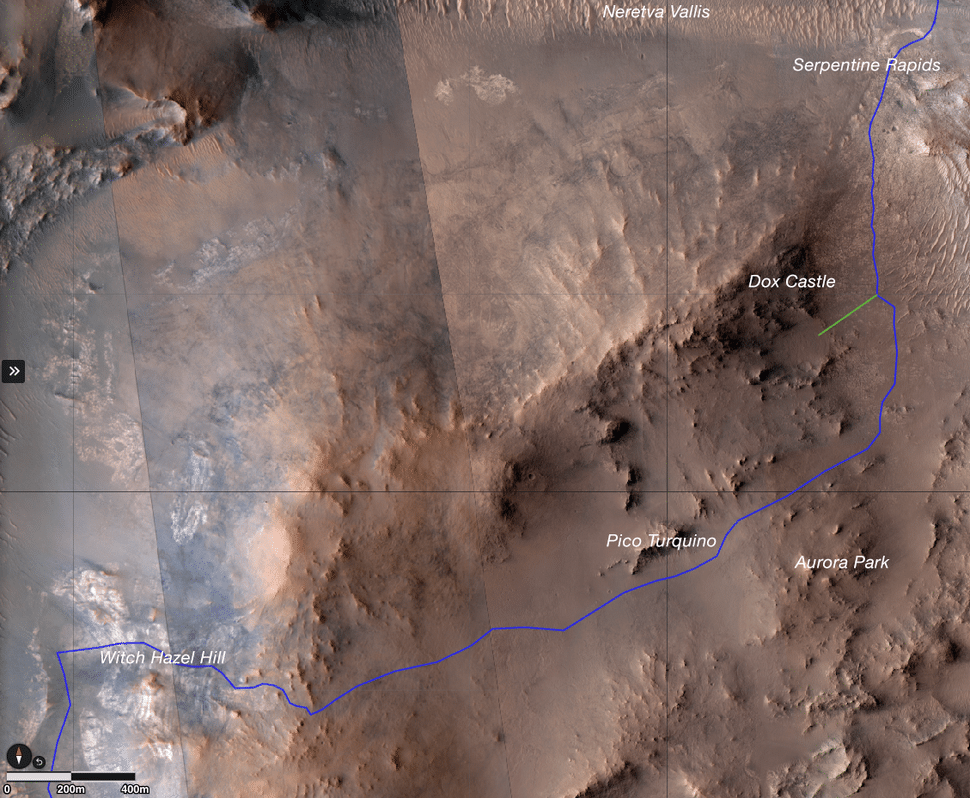
Eleni Ravanis, a doctoral researcher at the University of Hawaii at Mānoa and member of the Perseverance Mastcam-Z science team, highlights the significance of these rocks. “They represent diverse geological origins, including environments potentially suitable for life, which have never been studied on the surface before,” she noted. This phase of the mission aims to deepen understanding of Mars’ geologic background and its habitability potential.
Following Ancient Waterways: Exploring Neretva Vallis
Perseverance’s route to Jezero’s rim has itself been a journey through Mars’ watery history. The rover has spent months traversing Neretva Vallis, a now-dry river valley believed to have once supplied water to the crater’s basin. This ancient channel suggests Mars once had flowing rivers and lakes, indicating a climate more similar to early Earth.
During its trek through Neretva Vallis, the rover encountered the Bright Angel formation, noted for its bright white appearance. Considered part of Mars’ primordial crust, Bright Angel has been exposed by erosion from the ancient river flow. Nearby lies Cheyava Falls, a spotted rock formation containing iron, phosphate, and organic molecules that fascinates scientists.
Unraveling Mars’ Past: The Role of Organic Molecules
The presence of organic molecules at Cheyava Falls has excited astrobiologists. On Earth, such compounds coupled with iron and phosphate often indicate microbial life. While not definitive evidence of past life on Mars, this discovery strengthens the case for ancient habitable conditions on the planet.
Researchers aim to determine whether these organics have biological origins or stem from non-biological chemistry. One mission scientist remarked, “On Earth, this combination of organics and mineral deposits typically points to microbial processes,” but emphasized the need for further study and sample collection to draw firm conclusions about Mars’ biological history.
Cheyava Falls offers a rare glimpse into Mars’ ancient environmental conditions. The imminent examination of Witch Hazel Hill, which shares characteristics with Bright Angel, may reveal even more about the Red Planet’s early environment and its potential to have supported life.
What Awaits Beyond the Crater Rim
As Perseverance climbs toward the summit, the scientific community eagerly anticipates what will be uncovered. Navigating rugged terrain and steep gradients will likely take several months. Once at the crest, the rover will gain panoramic views of Jezero Crater and surrounding areas, providing critical context for future exploration targets.
The Jezero Crater Rim exploration promises to deliver pivotal discoveries regarding Mars’ geological history, water’s influence on the landscape, and the possibility of ancient life. Art Thompson, the project manager at NASA’s Jet Propulsion Laboratory, stated, “The rover is in excellent shape as we begin the Crater Rim Campaign, and the team is eager to see what discoveries await on top of Jezero.”
- Categories:
- Astronomy ,
- News ,
- Space ,
- Nasa












0 comments
Sign in to Comment