
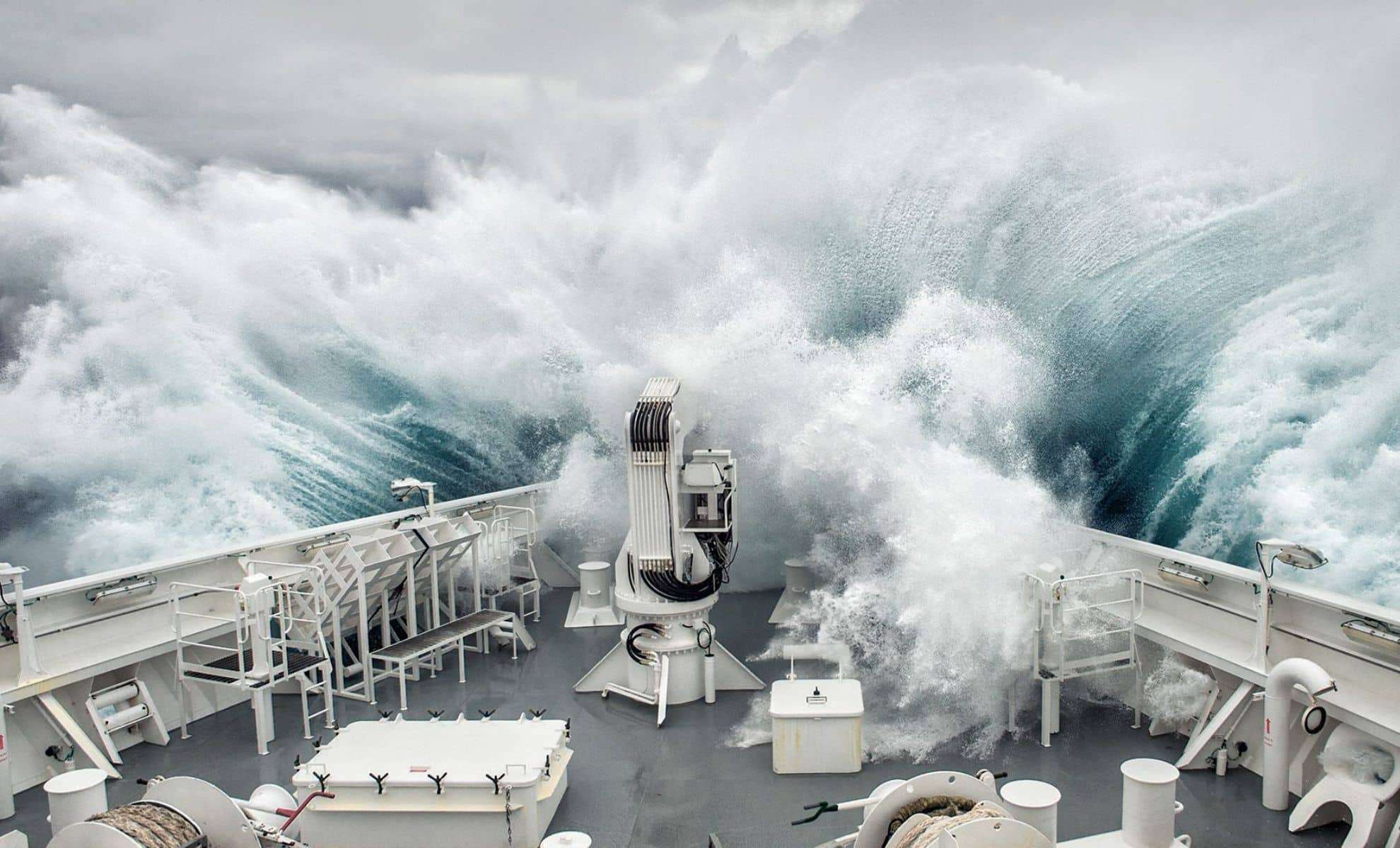
The Drake Passage, situated between the southernmost point of South America and the Antarctic Peninsula, is infamous for being one of the world’s most perilous maritime routes. Enormous waves reaching heights of up to 80 feet (25 meters) and relentless storms make this passage a severe test for any crew.
This channel, named after the 16th-century navigator Sir Francis Drake, forms a vital link between the Atlantic, Pacific, and Southern Oceans. Stretching roughly 600 miles (965 kilometers) across, its narrow width relative to the surrounding seas accelerates ocean currents, producing relentless rough waters, as detailed by Live Science.
A Harrowing Journey
Widely recognized for the fierce climatic conditions it spawns, the Drake Passage’s open southern airflow generates powerful winds that whip through the channel without obstruction. These winds can provoke waves soaring to 80 feet, with sudden weather shifts intensifying the challenges faced by seafarers.

Crossing the Drake Passage is often viewed as a necessary expedition for Antarctic travelers, albeit a hazardous one. Researcher Karen Heywood recalls her 2024 voyage:
“It’s always interesting when you go to dinner and they put sticky mats on all the tables to make sure your plates and things don’t slide around.”
The nonstop rocking and pitching make the typical 48-hour crossing feel considerably longer as sailors grapple with relentless motion and unpredictable waves.
Seafarers refer to this notorious ocean turbulence as the “Drake Shake,” describing the rough and often nerve-wracking passage through these tumultuous waters.
What Makes the Drake Passage So Perilous?
The danger in the Drake Passage arises primarily from its unique geography. The passage acts as a narrow corridor where powerful wind streams and marine currents converge and amplify, triggering enormous swells and volatile weather that define the region.
Functioning as the junction of the Atlantic, Pacific, and Southern Oceans, it blends contrasting temperatures of warm and cold waters, generating persistent turbulence that elevates the severity of its stormy profile.
Besides its navigational hazards, the Drake Passage plays a significant role in Earth’s climate system by promoting the transfer of carbon deep into the ocean, helping regulate global temperature patterns.
Scientists also believe the opening of the Drake Passage between 49 million and 17 million years ago was instrumental in initiating Antarctica’s cooling and the development of its extensive ice sheets.
Ecological Importance Despite Its Risks
Beyond its reputation for danger, the Drake Passage is essential for maintaining vibrant marine ecosystems. The persistent mixing of surface and deep ocean waters supports nutrient cycling that sustains abundant life forms.
This fertile environment fuels vast populations of krill, which in turn serve as a cornerstone food source for species like whales, seals, and penguins.
Without the dynamic forces at work within the Drake Passage, the ice coverage and distinct ecosystem of Antarctica as known today might not exist.
However, climate change is beginning to disrupt these processes, potentially weakening the natural systems that preserve the continent’s frozen state.
- Categories:
- News













0 comments
Sign in to Comment