
Astronomers are making significant progress in deciphering the nature of odd radio circles (ORCs), an intriguing class of circular radio emissions. A recent in-depth analysis by Ruhr University Bochum scientists focuses on a newly detected ORC—ORC J0356–4216—utilizing cutting-edge radio spectropolarimetry. The findings, detailed in a pre-print posted on arXiv, provide vital clues about the potential causes behind these vast and mysterious radio rings.
Defining Odd Radio Circles
Odd radio circles are enormous, ring-shaped radio wave formations observed in the sky. Discovered only recently, they remain quite rare. These structures differ from many known cosmic objects because they are invisible in visible light, infrared, and X-ray emissions, being detectable solely through radio frequencies. Their unique characteristics challenge existing astronomical classifications. The most remarkable attribute of ORCs is their nearly perfect circular symmetry, distinguishing them from other known celestial entities.
ORC J0356–4216 was identified in October 2023 with the MeerKAT telescope and represents one of the few ORCs subjected to detailed exploration. This breakthrough supplied the scientific community with new observational data that may unravel the enigma surrounding their formation. By studying this ORC, experts hope to clarify why these enormous rings of radio waves form and what drives their creation.

The Unique Double-Ring Feature of ORC J0356–4216
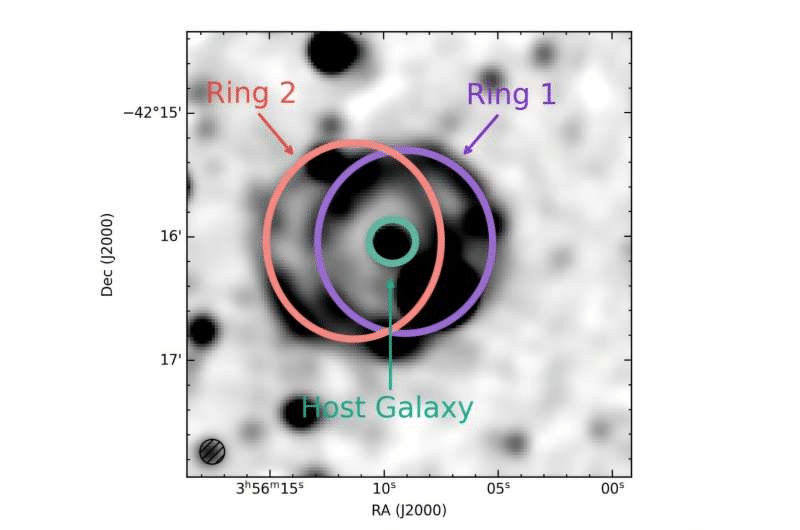
A remarkable aspect of ORC J0356–4216 is its double-ring structure. Spanning roughly two arcminutes across—a size translating to approximately 2.18 million light-years—this ORC consists of two nested rings of radio emission. Its vast scale ranks it among the largest radio formations ever recorded in the universe. The rings exhibit symmetrical patterns and distinct polarization traits that are key to understanding the nature of their signals.
This double-ring form is not coincidental. Researchers identified that the polarization data indicates a probable source. “In the case of ORC J0356–4216, the double-ring morphology and polarization patterns best correspond to relic radio emission from past AGN activity or outflows driven by jets. The WISE infrared colors align with the host galaxy being an AGN within an elliptical galaxy. Based on current evidence, an AGN-related origin is the most consistent explanation,” the study authors state.
These results suggest a link between the ring structures and an active galactic nucleus (AGN), which is a supermassive black hole capable of launching energetic jets. This relationship may clarify why the radio rings exhibit their specific shapes and polarized signatures, providing a fresh perspective on how AGN activity influences large-scale cosmic features.
Exploring Origins of ORC J0356–4216
Determining the genesis of ORC J0356–4216 involves weighing scenarios that could give rise to such extraordinary shapes. Two main theories stand out: radio emissions may be remnants from former AGN activity, or they might stem from extensive shock waves triggered by galaxy encounters or mergers. The observations lean towards the AGN-related explanation, as the object's characteristics resemble known features from jet-driven outflows and aged emissions linked to earlier galactic processes.
Particularly telling are the polarization measurements taken throughout the rings, showing values between 20% and 30%. This degree of polarization, together with magnetic field orientations, strongly supports the jet-outflow origin hypothesis. Researchers speculate the elliptical galaxy hosting this ORC was far more active in the past, possibly undergoing intense AGN phases.
These findings imply that ORC J0356–4216 likely represents a fossil remnant from an earlier active phase of its central black hole. Although the AGN is presently less energetic, its historical activity left lasting imprints detectable in the radio sky.
Galaxy Mergers and Shock Waves as Alternatives
Despite the preference for the AGN explanation, the idea that expansive shock waves caused by galaxy collisions might produce these rings remains viable. Galaxy mergers can unleash powerful shock fronts, compress interstellar gas, and merge central black holes, leading to dramatic environmental transformations. Such phenomena might create ripple-like radio features analogous to shock waves from massive impacts.
Understanding ORC J0356–4216 could shed light on how mergers shape cosmic architectures. If ORCs are linked to such events, they may serve as markers for specific stages in the evolutionary cycles of colliding galaxies. This raises intriguing questions: Do ORCs frequently appear in galaxy clusters undergoing fusion? Could they represent a transient stage in galactic life following collision?
- Categories:
- News











0 comments
Sign in to Comment