

A group of astronomers based in Taiwan has presented intriguing new evidence hinting at the existence of Planet 9, a speculative planet situated in the outermost parts of our Solar System, beyond Pluto. Their findings rely on data collected by the Infrared Astronomical Satellite (IRAS) and Japan's AKARI infrared observatory, representing a significant advance in the ongoing search for this elusive celestial body.
Understanding Planet 9
The idea of Planet 9 arose years ago to explain unusual gravitational effects observed among objects within the Kuiper Belt, a distant area beyond Neptune. These effects include clusters of trans-Neptunian objects (TNOs) with unusual orbital inclinations, suggesting the presence of an unseen massive planet affecting their paths. Hypothetically, Planet 9 resembles a Neptune-like planet, primarily icy and gaseous, with a mass between seven and 17 Earth masses.
Despite these proposals, Planet 9 has never been directly detected due to its considerable distance from the Sun—estimated at about 300 Astronomical Units (AU), more than ten times Neptune's distance. Such remoteness means the planet reflects minimal sunlight, rendering it virtually invisible to conventional telescopes.

Leveraging Infrared Observations
To overcome the difficulty of spotting a faint, distant object, astronomers utilize infrared radiation, which the planet emits rather than reflects. This method increases the chances of detection significantly, motivating the focus on infrared datasets from IRAS and AKARI.
- IRAS (Infrared Astronomical Satellite), launched in 1983, was the pioneering space telescope to survey the entire sky in infrared light.
- AKARI, Japan's infrared satellite launched in 2006, continued this mission with observations in the far-infrared spectrum.
These missions collected extensive data—IRAS from 1983 to 1986 and AKARI from 2006 to 2009—forming the basis for recent investigations led by Taiwanese astronomer Terry Long Phan and his team.
Identifying Planet 9 Candidates
In their recent work, covered by the BBC Skyatnightmagazine, Terry Long Phan and collaborators from National Tsing Hua University and partners in Japan and Australia analyzed infrared data from both satellite missions. Their objective was to detect slight shifts in faint celestial sources over time that might indicate a slow-moving planet at extreme distances.
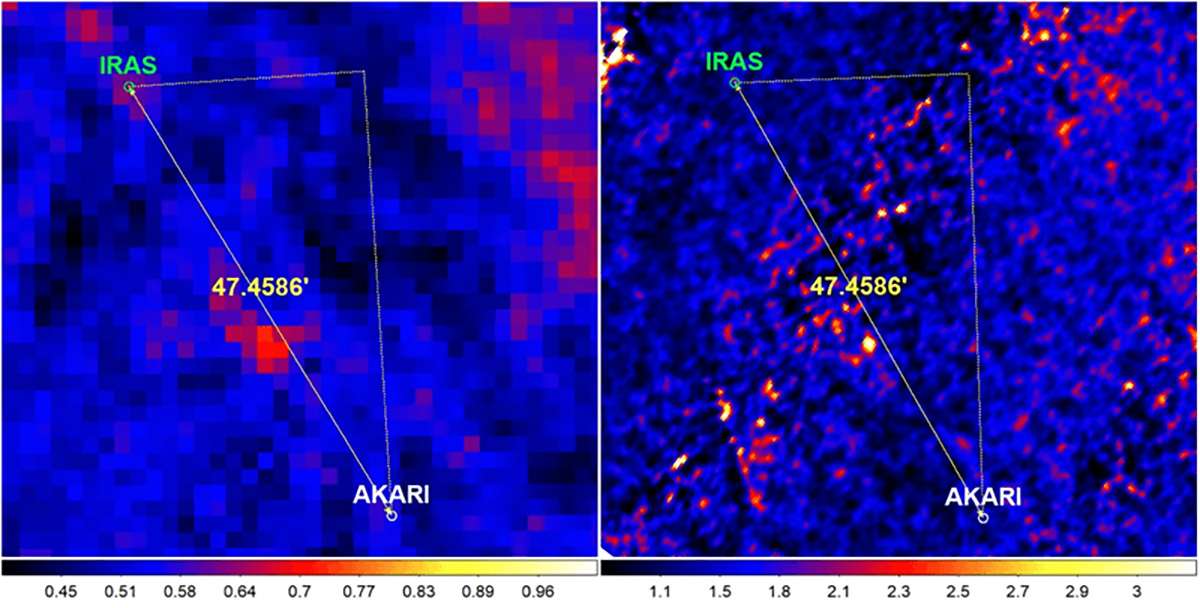
By applying advanced software techniques, the team shortlisted 13 potential candidates that exhibited positional changes between the IRAS and AKARI datasets. Following a rigorous manual review process, only one pair of observations matched the expected slow movement profile of a distant planetary body. The identified object shifted by approximately 47.5 arcminutes during the 23-year interval, roughly equivalent to one and a half times the full Moon's apparent size.

This degree of motion aligns well with expectations for an object orbiting beyond 300 AU, hinting it could indeed be Planet 9, a faint and slow-moving world at the edge of the Solar System.
Characteristics and Next Steps
The discovered body corresponds with predictions for Planet 9—a cold ice giant with a mass ranging between seven and 17 times Earth’s mass, resembling Neptune or Uranus in composition. The estimated temperature in this remote zone is near -200 degrees Celsius.
While this discovery is compelling, it remains tentative. The object has only been noted at two distant times, and further observational confirmation is crucial. Follow-up studies using the DECam (Dark Energy Camera) at the Victor M Blanco Telescope in Chile are planned. This powerful instrument may help verify the object's trajectory and refine understanding of its orbit.












0 comments
Sign in to Comment