

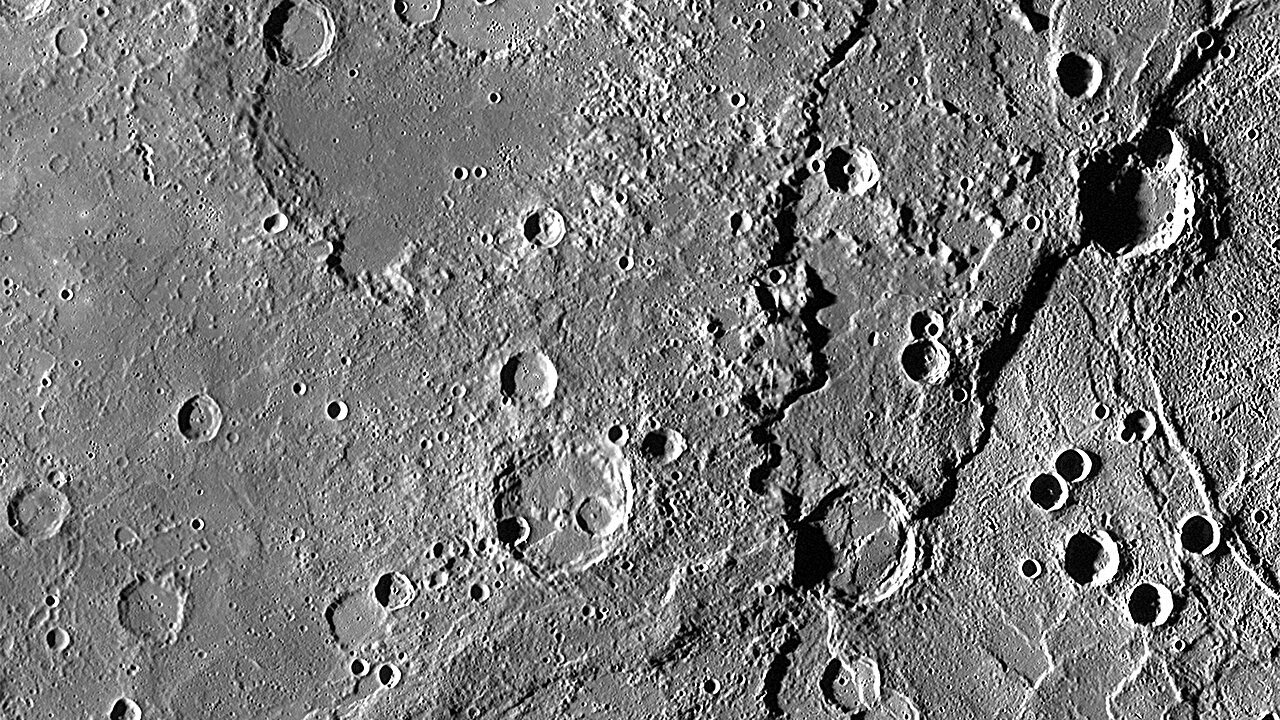
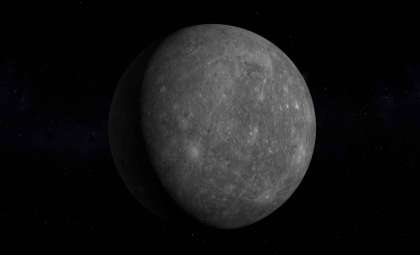
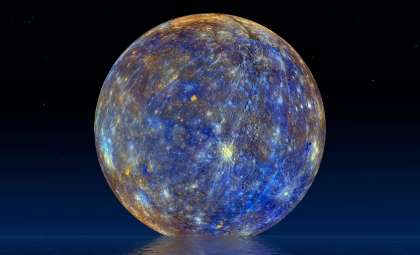
A pioneering analysis featured in AGU Advances offers fresh perspectives on the extent of Mercury’s contraction since its formation more than 4.5 billion years ago. Utilizing an innovative technique to assess planetary shrinkage, this study delivers a refined estimate of how Mercury’s cooling internal core has influenced its surface evolution. Much like how baked items reduce in size as they cool, Mercury’s radius has diminished, evidenced by pronounced thrust faults—large surface cracks created by the planet’s contracting interior. Whereas earlier studies suggested Mercury’s contraction ranged from 1 to 7 kilometers, this new analysis narrows that to approximately 2.7 to 5.6 kilometers.
Tracking Mercury’s Progressive Shrinkage Through Geological Clues
Mercury’s reduction in size is driven by the gradual cooling of its core, causing the planet to contract. This process generates thrust faults, which are formed when portions of the crust warp and buckle due to interior cooling. Such surface features serve as vital markers that reveal Mercury’s dynamic thermal past.
Before Loveless and Klimczak’s research, the typical method to estimate Mercury’s shrinkage involved measuring the lengths and elevation differences of these uplifted faults. However, this strategy risked inconsistent results, as estimates varied based on the quantity and selection of faults analyzed.

The new approach by Loveless and Klimczak mitigates this inconsistency by concentrating on the largest fault observed in the dataset. Using this as a baseline, they extrapolate total planetary contraction, yielding a more dependable and uniform measurement regardless of how many faults are included.
The Breakthrough Approach to Measuring Mercury’s Contraction
The innovation in the work of Loveless and Klimczak lies in their focus on the fault exhibiting the maximum vertical displacement, which most clearly represents Mercury’s surface contraction. Instead of averaging numerous faults with varying characteristics, their method scales the contraction from this key fault to the whole planet. This technique leads to a more accurate overall shrinkage estimate.
Across different datasets, they consistently found the planet’s radius had shrunk between 2 and 3.5 kilometers. When accounting for contraction caused by additional cooling phenomena beyond fault formation, the total shrinkage likely falls between 2.7 and 5.6 kilometers. This method advances our understanding of Mercury’s thermal evolution by providing more precise contraction figures.
Understanding Mercury’s Cooling and Fault Formation
The gradual cooling of Mercury’s deep interior plays a central role in its geological development. Over billions of years, cooling and contraction of its metal-rich core caused surface thrust faults—large cracks formed as the shrinking interior exerts stress on the crust, causing it to fold and uplift.
Mercury’s thrust faults resemble the cracks that appear when baked items like cookies or cheesecakes cool and contract. These features form systematically rather than randomly, accommodating ongoing planetary shrinkage.
By examining such faults, researchers can reconstruct Mercury’s thermal history, shedding light on the rate of core cooling and the degree of planetary contraction. These geological signatures preserve invaluable clues about its internal processes through time.
Why Precise Estimates of Mercury’s Shrinkage Matter
Estimating Mercury’s contraction with accuracy is pivotal for decoding its thermal evolution. Knowing the magnitude of radius change enables improved modeling of internal heat flow and core cooling dynamics. With no atmosphere and extreme temperature swings, understanding Mercury’s contraction aids in unraveling how these conditions shaped its geological path.
The research by Loveless and Klimczak refines prior shrinkage values, deepening insight into Mercury’s past thermal state and facilitating comparisons with other planetary bodies. Their precise contraction measurements open avenues for more comprehensive and realistic simulations of Mercury’s geological history.
- Categories:
- News




0 comments
Sign in to Comment