
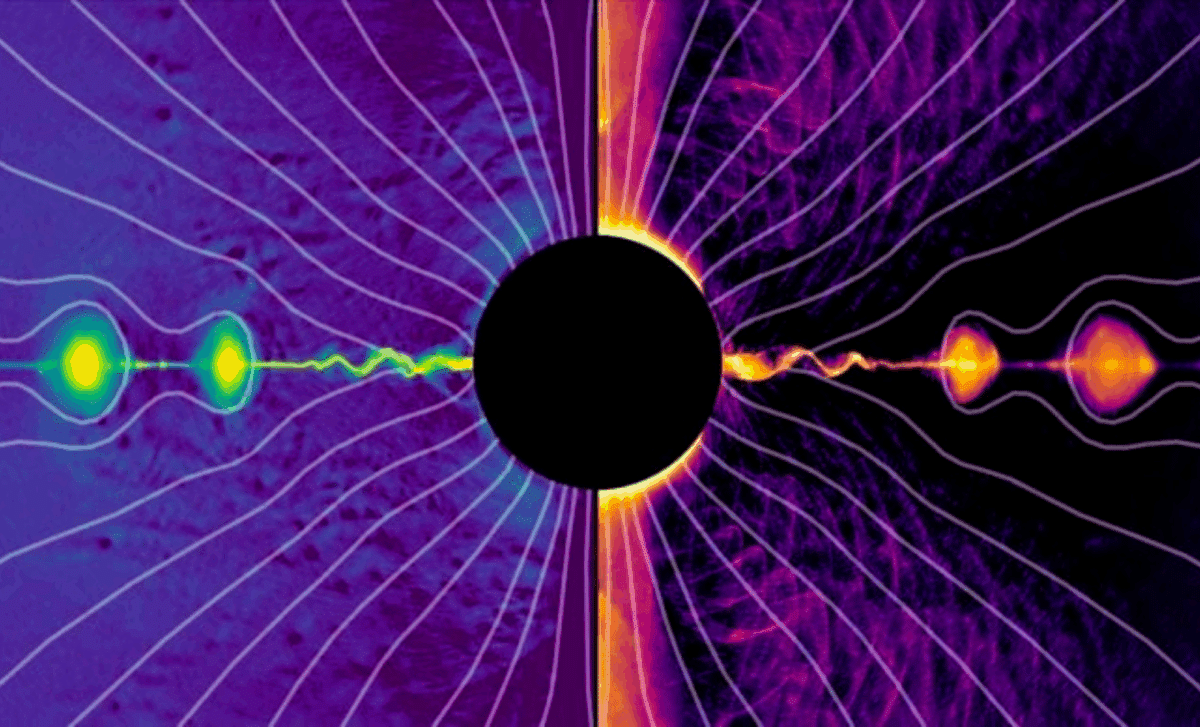
Researchers at Goethe University Frankfurt have uncovered new evidence about the supermassive black hole M87*, reshaping our understanding of how such cosmic giants produce their extraordinary energy. Published in The Astrophysical Journal Letters, their study demonstrates that magnetic reconnection is a crucial factor near the event horizon of M87*, influencing the release of the black hole’s vast energy.
Deciphering the Power Behind Black Hole Jets
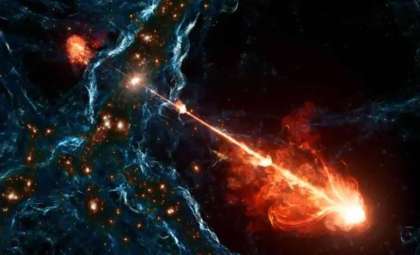
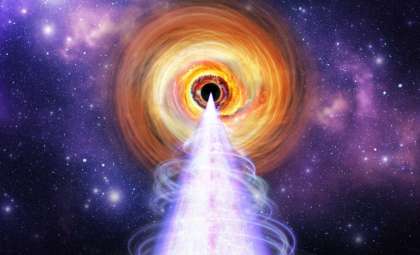
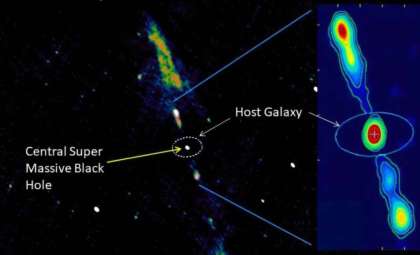
For almost 200 years, scientists have been intrigued by the powerful energy emissions and relativistic jets emitted by supermassive black holes, particularly M87*, located in the Virgo galaxy cluster. This gargantuan black hole weighs in at approximately six and a half billion times the mass of our Sun. It is known for propelling jets of matter at velocities nearing the speed of light, stretching across thousands of light-years. Yet, until now, the exact processes fueling these magnificent jets remained elusive.
Earlier models concentrated on the Blandford-Znajek mechanism, which explains how magnetic fields around spinning black holes tap into their rotational energy. The new findings highlight the additional importance of magnetic reconnection, a phenomenon where magnetic field lines break and reconnect, transforming magnetic energy into heat, radiation, and accelerated particles. This discovery sheds light on the dynamics of powerful relativistic plasmas close to black holes and clarifies the drivers behind their energetic jets.

Magnetic Reconnection: A Game Changer
A standout feature of this research is the identification of magnetic reconnection as a significant mechanism. Dr. Filippo Camilloni, a primary contributor to the project, stated,
“Our results open up the fascinating possibility that the Blandford–Znajek mechanism is not the only astrophysical process capable of extracting rotational energy from a black hole, but that magnetic reconnection also contributes.”
This breakthrough suggests that multiple processes likely operate together to fuel the jets around black holes. While the Blandford-Znajek effect has long been viewed as the dominant mechanism, magnetic reconnection adds complexity to how energy is extracted and channeled into space.
Computational simulations played a vital role in reaching these conclusions. The lead developer of the simulation software, Meringolo, highlighted its significance:
“Simulating such processes is crucial for understanding the complex dynamics of relativistic plasmas in curved spacetimes near compact objects, which are governed by the interplay of extreme gravitational and magnetic fields.”
By modeling particle behaviors and electromagnetic interactions near M87*, the team could track magnetic reconnection events in real-time and observe how these contribute to jet production.
Advanced Simulations Illuminate Black Hole Physics
The study employed a cutting-edge computational platform known as the Frankfurt particle-in-cell code for black hole spacetimes (FPIC). This tool enabled precise modeling of charged particles and the intense electromagnetic environment surrounding the spinning black hole. Simulations revealed that energetic plasmoids—compact plasma structures moving at nearly light speed—form due to intense magnetic reconnection near the black hole’s equatorial plane.
Project leader Dr. Luciano Rezzolla emphasized the significance of these findings:
“With our work, we can demonstrate how energy is efficiently extracted from rotating black holes and channeled into jets,” he said. “This allows us to help explain the extreme luminosities of active galactic nuclei as well as the acceleration of particles to nearly the speed of light.”
This research provides valuable insights into not only M87*, but also other active galactic nuclei (AGN) exhibiting similar high-energy behaviors across the cosmos.
Far-reaching Impact on Astrophysics
The implications of this discovery extend well beyond black holes themselves. Understanding the production of jets and energy release helps clarify the influence black holes exert on galaxy formation and development. By dispersing energy and matter across space, these jets shape the cosmic landscape over billions of years. Additionally, this study enhances comprehension of extreme phenomena in environments like neutron stars and magnetars.
The researchers’ detailed simulations offer a more accurate depiction of the intense interplay between electromagnetic forces and gravity near black holes, deepening our grasp of relativistic plasma behavior. As computational capabilities advance, such simulations will be pivotal in refining astrophysical theories and unraveling the mysteries surrounding these extraordinary entities.
- Categories:
- News




0 comments
Sign in to Comment