
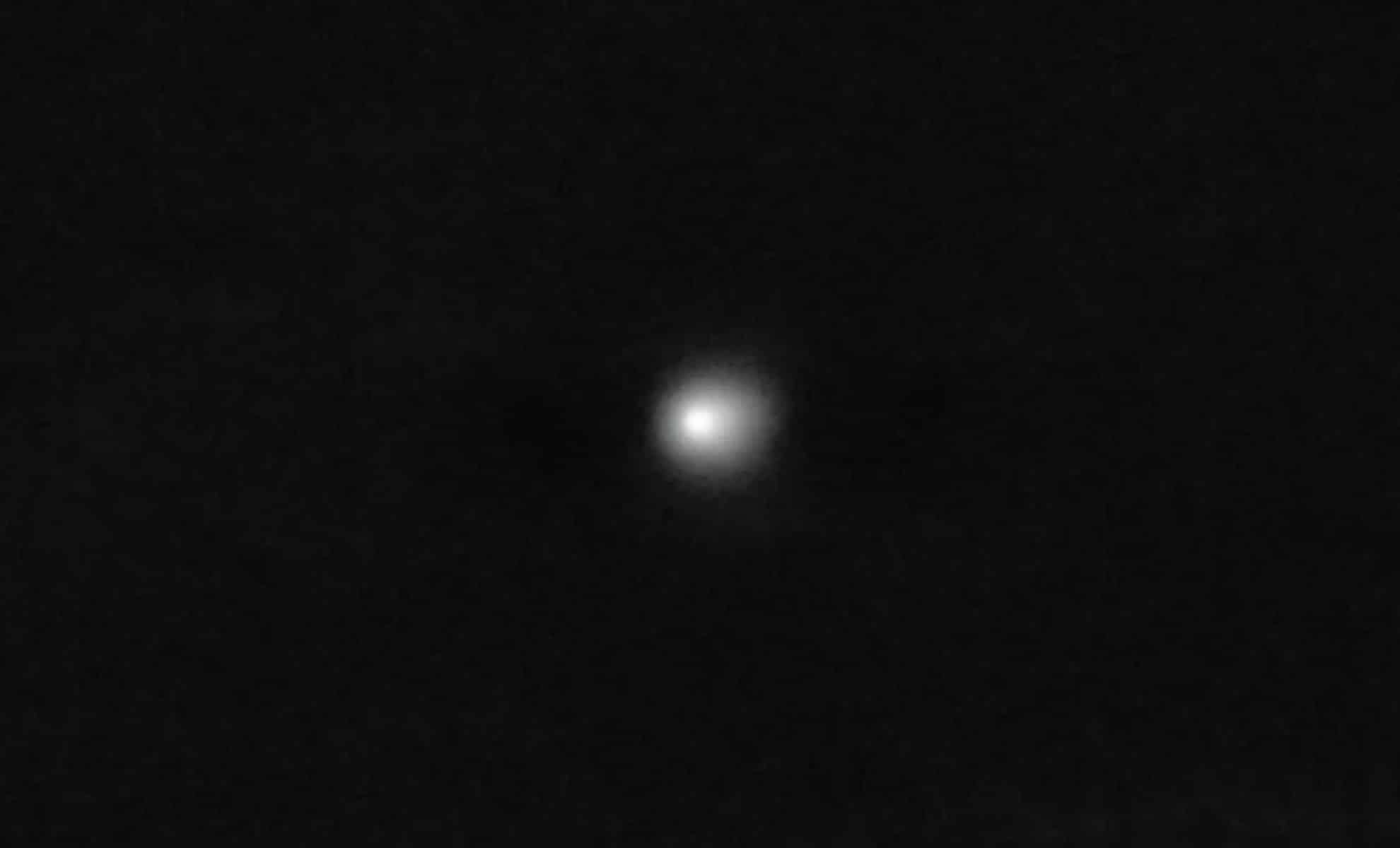
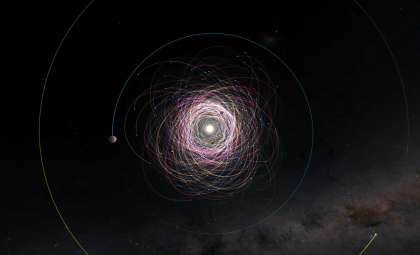
Astronomers have confirmed the arrival of a third interstellar traveler entering our solar system, igniting enthusiasm among researchers worldwide. On June 30, 2025, Matthew Hopkins, a doctoral candidate at the University of Oxford, finalized his PhD dissertation on the dynamics of interstellar objects. The following day, the Atlas Terrestrial-impact Last Alert System (ATLAS) telescope in Chile spotted an unusual object rapidly approaching the Sun.
A Comet Traveling Through Space
By July 3, 2025, the International Astronomical Union’s Minor Planet Center officially identified this object, designated 3I/ATLAS, as a visitor from beyond our solar system. The discovery has generated great anticipation, with astronomers keen to explore the visitor’s properties and origins.
3I/ATLAS stands out as the largest and brightest interstellar object documented to date. Measuring between 6 and 19 miles (10 to 30 kilometers) in diameter, it surpasses earlier visitors such as ‘Oumuamua and Comet 2I/Borisov. At the time of detection, it was traveling at an astounding pace of 137,000 miles per hour (221,000 kilometers per hour), with expectations of further acceleration as it approaches the Sun.

Initial data suggests 3I/ATLAS is most likely cometary in nature. Its distinctive reddish tint sets it apart from typical solar system comets. Some preliminary analyses show its color resembles trans-Neptunian objects — icy bodies beyond Neptune’s orbit. Further photometric studies indicate 3I/ATLAS is bluer than ‘Oumuamua and 2I/Borisov, offering new insights into its composition.
Connection to Ancient Galactic Regions
Hopkins and fellow researchers propose that 3I/ATLAS originates from the thick disk of the Milky Way, an area populated by older stars. This thick disk contains nearly 10% of the galaxy’s stellar mass and features stars considerably older than those in the thin disk. The team estimates there is about a two-thirds chance that 3I/ATLAS is over 7 billion years old, predating our solar system.
Oxford astrophysics professor Chris Lintott, a study co-author, commented, “There’s a two-thirds probability that it dates back more than 7 billion years, which may account for its coloration.”
If 3I/ATLAS indeed stems from the thick disk, it is anticipated to display pronounced cometary activity as the Sun’s heat causes surface ice to sublime. Older stars tend to generate water-rich interstellar objects, which trigger this gas transformation near the Sun.
Clues About Formation of Planetary Systems
Darryl Seligman, associate professor of physics and astronomy at Michigan State University, points out that objects like 3I/ATLAS are “pristine, primordial remnants from planet formation processes occurring in distant planetary systems.”
Currently, astronomers are continuing to monitor 3I/ATLAS closely, aiming to learn more about its distant origin and its significance in the broader galactic landscape. The detection of this third confirmed interstellar visitor enriches our understanding of the cosmos and inspires further exploration into our solar system’s galactic environment.
- Categories:
- News








0 comments
Sign in to Comment